The Announcement – What SoftBank Is Actually Doing
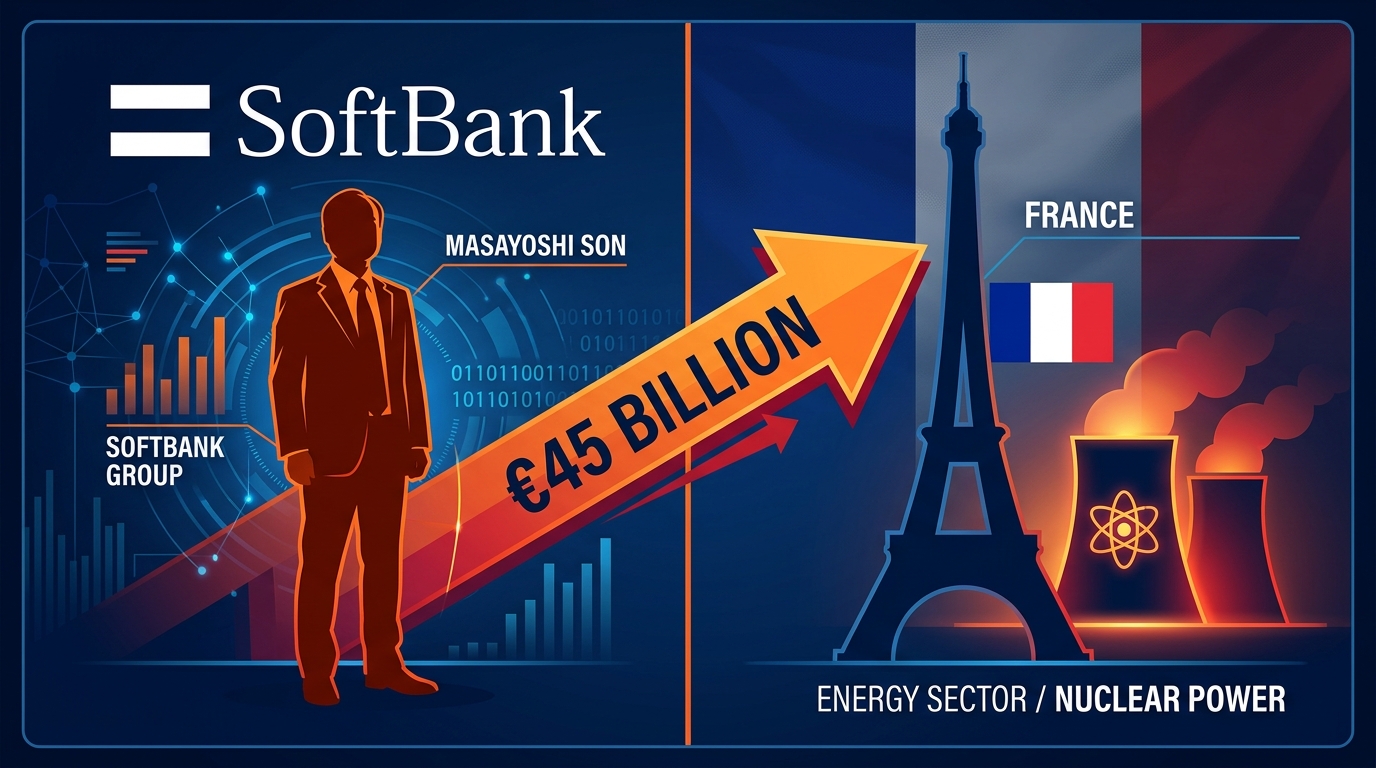
On the last day of May 2026, SoftBank Group made a declaration that will reshape the European AI landscape. At the annual Choose France business conference, the Japanese technology conglomerate committed to investing €45 billion ($48.8 billion) over the next five years to build artificial intelligence infrastructure in the country.
This is not a small or symbolic gesture. SoftBank described it as the largest investment of its kind in Europe to date.
The investment will be concentrated in the northern Hauts‑de‑France region, near the Belgian border. It will deliver 3.1 gigawatts (GW) of new AI computing capacity – roughly equivalent to three large nuclear reactors or enough to power over 2 million homes.
Three sites, including one in the port city of Dunkirk, are expected to become operational by 2031. Additional sites spread across France are planned further down the road, which would push the overall investment sum to €75 billion ($81.3 billion).
The project has two key French partners:
- Schneider Electric, the global energy management and automation giant, will equip the sites with its electrical modules and data center infrastructure.
- EDF, the state‑owned nuclear energy company, is handing over one of its former power plants to be transformed into a data center. This repurposing of existing energy infrastructure is both cost‑efficient and symbolic.
The announcement comes as SoftBank accelerates its global AI infrastructure spending. The company has already invested over $30 billion in OpenAI (acquiring roughly an 11% stake) and is a major backer of the Stargate AI infrastructure project in the United States.
But France, it turns out, offers something that neither Texas nor Virginia can match: stable, low‑carbon, grid‑scale nuclear power.
Why France? The Nuclear Advantage (The Core “Why” Section)
If you ask most technology executives what matters most when siting a billion‑dollar data center, they will list the usual suspects: land, connectivity, tax incentives, and political stability. But for AI infrastructure at the scale SoftBank is planning – 3.1 gigawatts, expanding to perhaps 5+ GW – there is a more fundamental requirement: electricity.
Lots of it. Reliably. For decades.
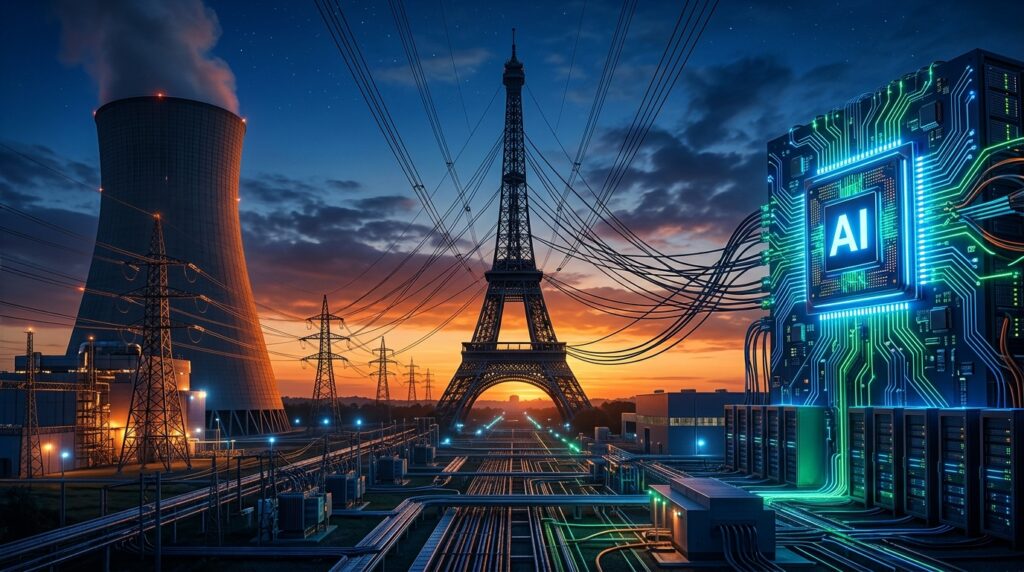
France has something that few other Western nations can offer: a deep, stable, low‑carbon energy grid anchored by nuclear power. The country produces roughly 70% of its electricity from nuclear reactors—a higher percentage than any other nation on Earth.
This is not an accident. After the oil shocks of the 1970s, France made a national commitment to energy independence through nuclear power. Today, that decision is paying dividends in the AI era.
The Energy Decisive Factor
SoftBank founder Masayoshi Son made the logic explicit. In an interview with the French newspaper La Tribune du Dimanche, he said:
“The fact that the country is a producer and exporter of energy is absolutely decisive for investments in AI infrastructure.”
He did not say “producer of renewable energy.” He said “producer and exporter of energy.” France generates more electricity than it consumes—it exports the surplus to neighboring countries. This gives it a structural advantage over nations that rely on intermittent sources (solar and wind) or imported fossil fuels.
Contrast with the US – Texas vs. France
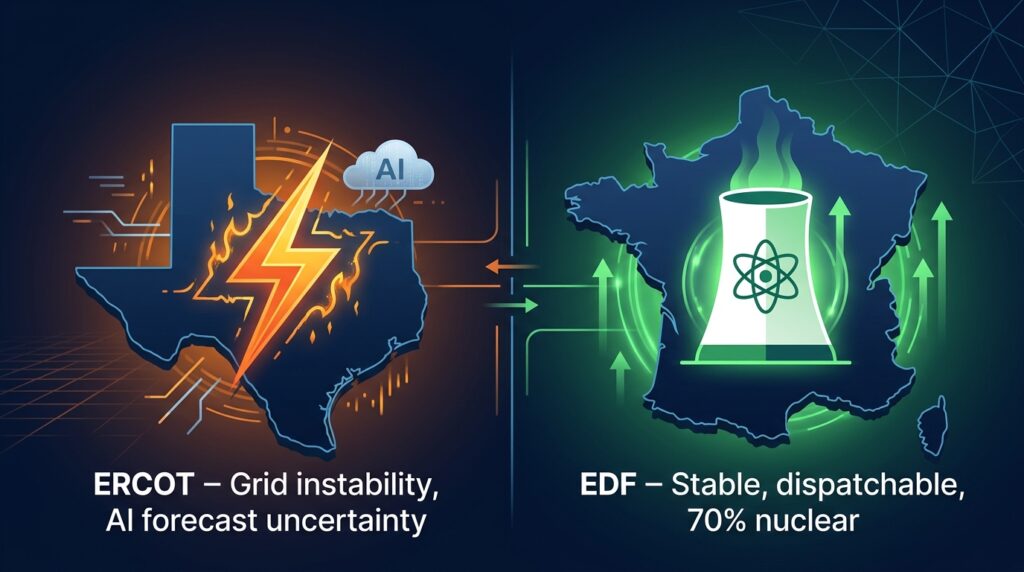
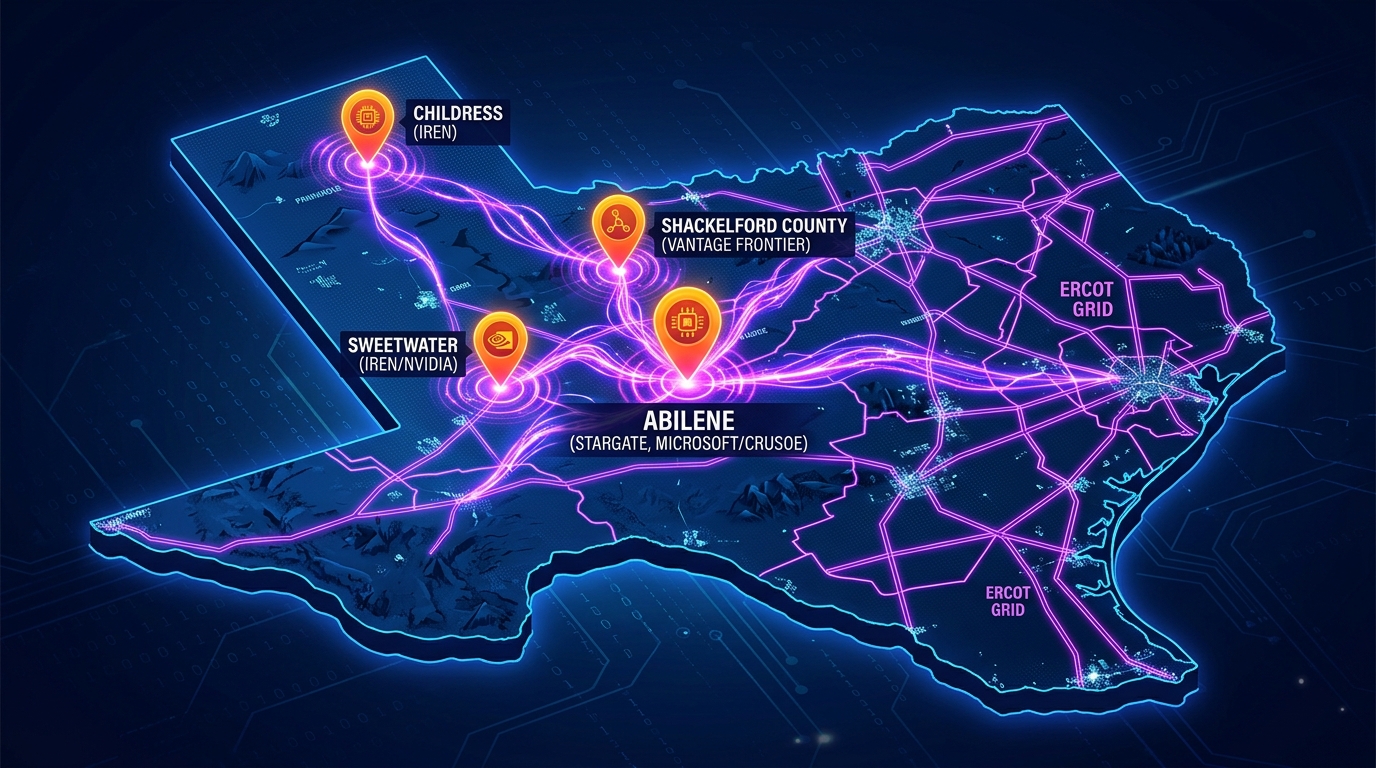
Earlier this year, you wrote about Texas becoming the AI data center capital of the United States. But Texas has a problem: its grid, managed by ERCOT, is notoriously unstable. In 2024, experts warned that AI could “accelerate the shift away from reliable power” in the state. In 2026, ERCOT itself has warned that AI‑driven load forecasts “may overstate proposed data center demand,” and the grid operator is considering adjusting its forecasts downward based on “actual historical realization rates.”
France does not have this problem. Its grid is centrally managed, heavily invested, and designed for large, predictable industrial loads. The transfer of a former EDF nuclear plant to SoftBank for conversion into a data center is a testament to that alignment.
The Nuclear Data Center Model
France is not the only country exploring nuclear‑powered AI infrastructure. In the United States, Microsoft has signed a deal to restart the Three Mile Island nuclear plant to power its data centers. But France has a head start: its entire grid is already nuclear‑heavy, and its state‑owned utility (EDF) is a direct partner in SoftBank’s project.
For SoftBank, the calculus is simple: in France, the energy is already there, already clean, and already reliable. The only remaining task is to build the data centers to consume it.
The Former Nuclear Plant – A Case Study in Adaptation
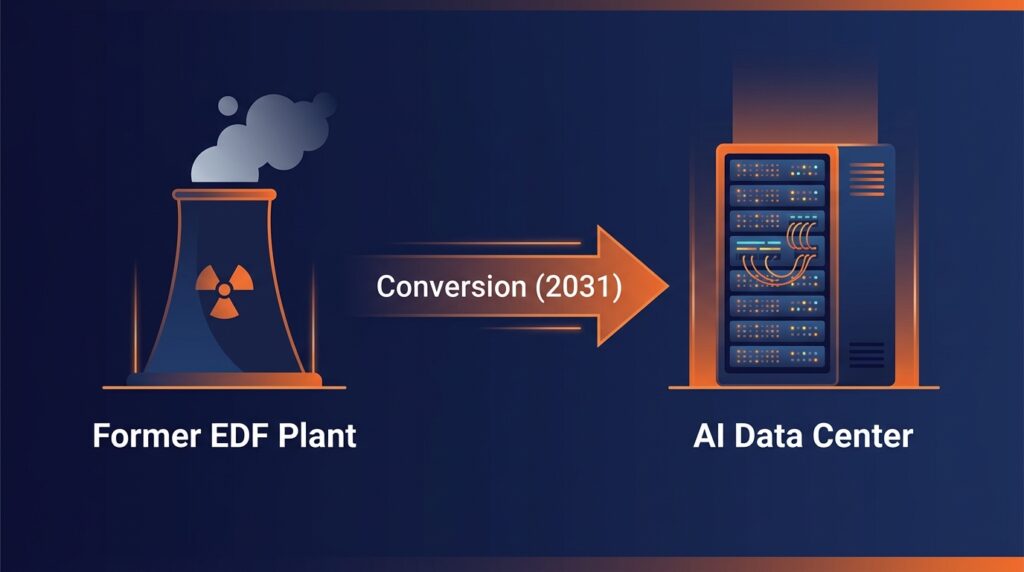
Among the three initial sites SoftBank plans to develop, one stands out as particularly symbolic: a former power plant owned by EDF, France’s state‑owned nuclear utility, which will be handed over to SoftBank and transformed into an AI data center.
This is not a greenfield development. It is a repurposing of existing energy infrastructure—an approach that could become a template for AI expansion across Europe and beyond.
From Reactors to Racks
Nuclear plants are designed to generate massive amounts of electricity. That electricity must go somewhere. When a plant is decommissioned or scaled back, the grid connection and substation infrastructure remain.
For an AI data center developer, this is gold. The two hardest parts of building new capacity – securing grid interconnection approval and constructing high‑voltage substations – are already solved. The former nuclear site comes with:
- Existing high‑capacity grid connections – No waiting 3–8 years for interconnection studies.
- Pre‑built substations and switchgear – Avoids the 24‑month lead times currently plaguing the industry.
- Cooling water infrastructure – Nuclear plants require massive cooling systems, which are also useful for liquid‑cooled AI racks.
The EDF partnership suggests that SoftBank is not just leasing land. It is inheriting an energy ecosystem designed for industrial‑scale consumption.
A Model for Other Countries
The repurposing of former nuclear sites for AI data centers is not unique to France. In the United States, Microsoft has signed a deal to restart the Three Mile Island nuclear plant to power its data centers. But that project involves bringing a reactor back online—a far more complex undertaking than converting an already‑decommissioned facility.
France’s approach is less ambitious but more immediately practical. EDF has a portfolio of aging nuclear assets. Some are still operating; others are being phased out. Converting the latter into AI infrastructure turns a liability (a plant needing decommissioning) into an asset (a data center generating tax revenue and jobs).
The 2031 Timeline
The first three French sites, including the former nuclear facility, are expected to become operational by 2031. That is a five‑year horizon—long by technology standards, but fast for heavy infrastructure. In contrast, new nuclear reactors take 10–15 years to plan and build. Data centers can be constructed in 18–24 months once the power is secured.
The critical path is not the data center construction. It is the energy readiness. By starting with an existing nuclear site, SoftBank has effectively bypassed the hardest part of the AI infrastructure problem.
SoftBank’s Global AI Infrastructure Spree – Connecting the Dots
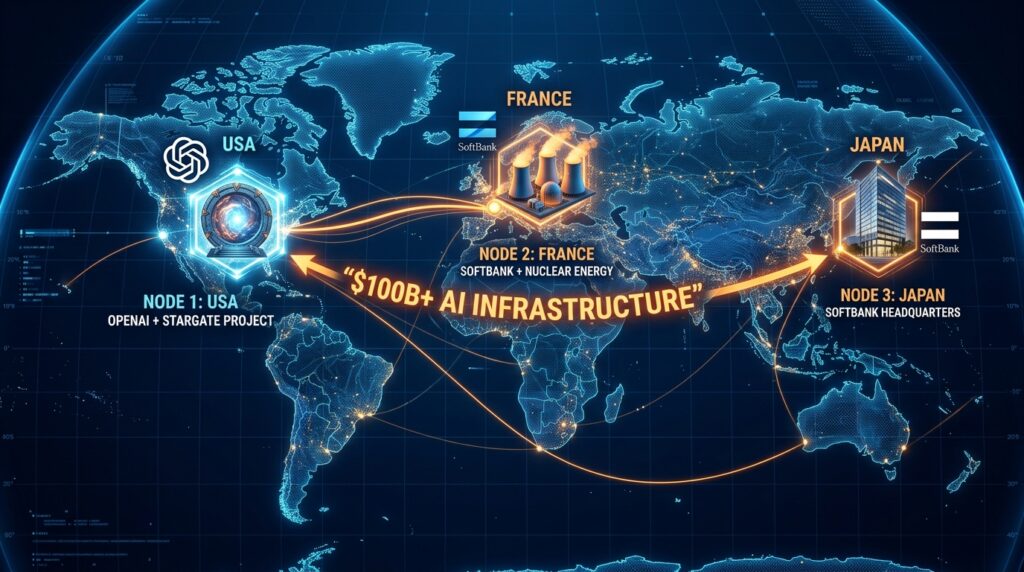
The €45 billion French investment is not an isolated event. It is the latest – and largest – move in a global AI infrastructure spending spree by SoftBank that now totals well over $100 billion.
Masayoshi Son is not a passive investor. He has long argued that AI will be the most transformative technology of the century, and he is positioning SoftBank as the primary financier of the physical infrastructure required to run it.
The OpenAI Stake
SoftBank has invested more than $30 billion in OpenAI to date, acquiring approximately an 11% stake in the company behind ChatGPT. This is not a passive financial investment. It is a strategic bet that OpenAI’s models will be the primary drivers of AI compute demand—and that SoftBank will own a piece of the demand.
The Stargate Project
In the United States, SoftBank is a major backer of Stargate, an AI infrastructure project that aims to build massive data center campuses across the country. While details remain private, Stargate is widely understood to be a multi‑billion dollar effort to rival the hyperscale builds of Amazon, Google, and Microsoft.
The France Investment: A Different Model
The France investment differs from SoftBank’s US efforts in two critical ways:
- Direct ownership. In France, SoftBank is building and owning the infrastructure itself, rather than merely investing in another company’s project.
- Nuclear partnership. The direct involvement of EDF, France’s state‑owned nuclear utility, gives SoftBank access to a stable, low‑carbon energy source that is difficult to replicate in the United States.
The Global Pattern
Taken together, SoftBank’s investments reveal a pattern:
- In the US: SoftBank invests in AI model developers (OpenAI) and infrastructure projects (Stargate) led by others.
- In Europe: SoftBank builds and owns its own infrastructure, leveraging state‑owned energy assets.
Why the difference? The answer is politics and energy. Europe has a more centralized, state‑guided approach to energy and industrial policy. France, in particular, is willing to partner directly with foreign investors to advance its AI ambitions. The United States relies more on private markets.
For SoftBank, the strategy is opportunistic: adapt to the local political economy and build wherever the energy is available.
Frequently Asked Questions (FAQ)
Q1: Why didn’t SoftBank build this in Germany or the UK?
A: Germany is phasing out nuclear power and has struggled with energy price volatility. The UK has nuclear capacity, but its grid is less dominated by a single state-owned utility. France offered a combination of stable, low-carbon, state-backed energy that was uniquely attractive.
Q2: Will this create AI jobs in France?
A: Yes, but mostly in construction, operations, and data center management – not in AI model training or research. SoftBank is building infrastructure, not a research lab. The jobs will be valuable, but they are not the high‑profile AI roles that make headlines.
Q3: How does this compare to Microsoft’s and Google’s European data center investments?
A: Microsoft and Google have each invested billions in European data centers, but their investments are spread across multiple countries (Ireland, the Netherlands, Denmark, Sweden, Finland, Spain, and Germany). SoftBank’s €45 billion is larger in scale but concentrated in a single country—a bet on France as the hub of European AI infrastructure.
Q4: Is France’s grid really ready for 3.1 GW of new load?
A: EDF’s direct involvement suggests yes. The 2031 timeline is deliberately conservative—it allows for grid upgrades, regulatory approvals, and data center construction. France’s grid is also interconnected with its neighbors, providing additional flexibility.
Q5: What happens to SoftBank’s other AI investments?
A: This is additive, not substitutive. SoftBank continues to hold its OpenAI stake and support Stargate in the US. Masayoshi Son has signaled that he views AI infrastructure as a utility-like investment—one that will generate steady returns regardless of which AI model company ultimately wins.
Q6: Could this model be replicated in other countries?
A: Yes, but only in countries with (a) state-owned or heavily regulated energy utilities, (b) a large nuclear or hydroelectric baseload, and (c) a government willing to partner directly with foreign investors. Candidates include Sweden (hydro/nuclear), Finland (nuclear), and possibly the UK (if it recommits to nuclear expansion).
Q7: How does this connect to your earlier article on Texas AI data centers?
A: Directly. The Texas article explained why US data centers are clustering in deregulated energy markets with abundant wind and solar. The France article explains the opposite model: state-guided, nuclear-powered, centrally planned infrastructure. Together, they show that there is no single “right” way to power AI, but energy availability is the binding constraint everywhere.
Q8: Is SoftBank’s €45 billion investment at risk from political change?
A: The investment spans five years and involves state-owned partners (EDF). A future French government could theoretically slow or block it, but the current administration under President Emmanuel Macron has made attracting AI investment a national priority. The Choose France conference is a direct manifestation of that policy.
Conclusion – Energy Is Now the #1 Factor in AI Infrastructure
The AI industry has spent years obsessing over chips. Which GPU is fastest? Which architecture is most efficient? Which fab has the best yields?
All of that matters. But SoftBank’s €45 billion bet on France reveals a deeper truth: energy is now the binding constraint.
You can have all the chips you want. If you cannot power them, they are expensive paperweights. And in a world where grid interconnection takes 3–8 years, transformer lead times exceed 24 months, and hyperscalers are spending $700 billion annually on AI infrastructure, the companies and countries with reliable, scalable, low‑carbon energy will win.
France has nuclear power. EDF has underutilized grid connections. The government is willing to partner. SoftBank brought the capital.
The result is the largest AI infrastructure investment in European history—and a model that other nations will study closely.
The age of AI is not just about who builds the best model. It is about who builds the physical infrastructure to run it. And in that race, France just placed a very large bet.
Sources & Further Reading
1. Primary Source – Reuters
- Reuters – “SoftBank to build up AI data centres in France with major investment” (May 30, 2026)
2. Supporting Sources & Context
- SoftBank Group – Public announcements and investor materials (May 2026)
- EDF (Électricité de France) – Press releases on partnership with SoftBank
- Schneider Electric – Statements on role as key project partner
- Choose France conference – Annual business summit background
- La Tribune du Dimanche – Interview with Masayoshi Son (May 30, 2026)
3. Background on AI Infrastructure & Energy
- Earlier ExplainThisTech articles:
- “Why Texas Is Becoming the AI Data Center Capital (6 Key Drivers)”
- “Why AI & Cloud Infrastructure Demand Is Outpacing Supply (5 Critical Bottlenecks)”
- “ERCOT Just Warned Texas’ AI Power Boom May Not Happen – Here’s Why”
- Industry analysis on nuclear-powered AI data centers (Microsoft / Three Mile Island)
- Grid interconnection and transformer shortage reporting (2025‑2026)
4. SoftBank’s Global AI Investments
- SoftBank’s $30B+ investment in OpenAI (~11% stake)
- Stargate AI infrastructure project (US)
- Masayoshi Son’s public statements on AI as a transformative technology
Leave a Reply