

Last updated: May 6, 2026
Reading time: 12 minutes
Introduction
In 2026, Microsoft sits on $80 billion in unfulfilled Azure orders—not because customers lack interest, but because the company cannot find enough electricity to power its GPUs. Across the industry, Nvidia’s newest AI chips are backordered through 2027, and nearly half of planned US data center builds have been delayed or cancelled.
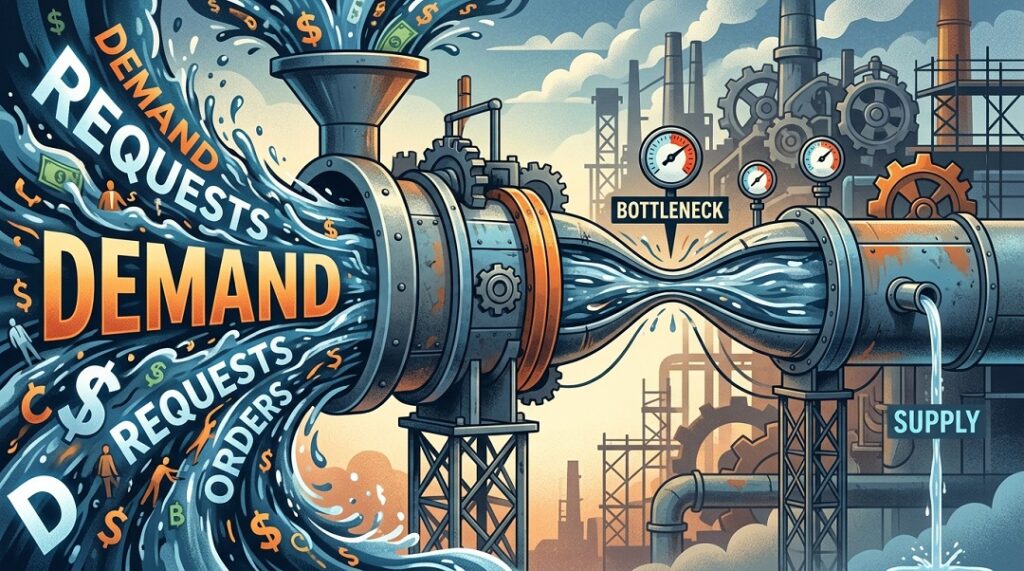
We are living through the AI infrastructure paradox: record investment meets record delays. Hyperscalers (Google, Microsoft, Amazon, Meta, and Oracle) are on track to spend $660–690 billion this year alone, yet new capacity is coming online at a crawl.
This article explains why. We break down the five critical constraints that together are throttling the global AI and cloud build‑out. You will learn:
- Why power grids are the hidden “kilowatt wall”
- How advanced chip packaging – not just silicon – became the bottleneck
- Why record spending does not guarantee fast delivery
- The skilled labor shortage you have never heard about
- How water and cooling have become strategic concerns
By the end, you will understand why analysts at J.P. Morgan expect the AI compute supply‑demand gap to persist through 2027—and what that means for developers, startups, and anyone who uses ChatGPT, Claude, or Gemini.
1. The Power Grid – The Hidden Kilowatt Wall
Why AI data center power demand is exceeding grid capacity
How Much Power Does One AI Rack Need?
Traditional enterprise servers consume 10–20 kilowatts (kW) per rack. An AI training rack, by contrast, draws 100 kW to more than 1 megawatt (MW)—the same as 10 to 100 homes.
When a single data center campus requires 200–500 MW, it becomes larger than many small cities. The US electrical grid, built for a pre‑AI era, is simply not ready.
The 300 GW Shortfall
According to Beroe Inc. analysis, the United States faces an approximate 300 GW power shortfall by the end of the decade. That gap is driven by 200 GW of new AI load plus the retirement of more than 100 GW of legacy generation. Grid interconnection wait times now stretch 3–8 years in major markets such as Northern Virginia and the Southwest.
Key stat: Interconnection wait times have tripled since 2020. Even if you have the capital and the land, you cannot plug in quickly.
Transformers and Switchgear – The Forgotten Bottleneck
Power is not only about generation and transmission. Even when a data center secures a connection, it must wait for electrical transformers and switchgear—critical components that step down voltage and protect equipment.
Lead times for these components have exploded:
- 2020: 12 months
- 2024: 18–24 months
- 2026: over 24 months for custom high‑voltage gear
Sightline Climate (Bloomberg data) reports that of the roughly 12 GW of US data center capacity expected to come online in 2026, only about a third is actively under construction. The rest face multi‑quarter postponements because transformers and other electrical gear simply are not available.
Real‑world example: A 1.4 GW campus in Texas intended to supply OpenAI is far behind schedule, pushing delivery from 2026 to late 2027. The cause? Power infrastructure delays.
Nearly Half of Planned Builds Cancelled or Delayed
The European Business Magazine reported in April 2026 that nearly half of planned US data center builds this year are now projected to be either significantly delayed or outright cancelled. The reason is not falling demand—it is that the existing electrical grid cannot support their projected loads.
Takeaway for readers: When a region’s grid is effectively “pre‑leased” for years, no amount of capital can bypass physics. This constraint is becoming the principal cap on new compute capacity for 2026–2027.
2. Chip Manufacturing Bottlenecks – More Than Just Silicon
Why the AI chip shortage persists – advanced packaging and memory constraints
CoWoS: The True Bottleneck
Most people think the chip shortage is about silicon wafers. In reality, the binding constraint is advanced packaging – specifically TSMC’s CoWoS (Chip‑on‑Wafer‑on‑Substrate) technology. CoWoS is the method used to stack high‑bandwidth memory (HBM) directly on top of AI accelerators.
Without CoWoS, premium AI chips cannot be assembled. And TSMC is the only company producing it at scale.
Who Gets the CoWoS Capacity?
According to TrendForce and KeyBanc, TSMC’s CoWoS capacity allocation for 2026–2027 looks like this:
| Company | Estimated CoWoS Share |
|---|---|
| Nvidia (Rubin, H200, B200) | ~53% |
| Google (TPU v7/v8) & Broadcom designs | ~22% |
| AWS (Trainium3) & other custom silicon | ~15% |
| AMD (MI350X), startups, others | ~10% |
Nvidia has booked more than half of all CoWoS capacity through 2027. As a result, Google reduced its 2026 TPU production target from 4 million to approximately 3 million units. Even with record spending, hyperscalers cannot get enough packaged chips.
HBM4 Memory – The Bottleneck Inside the Bottleneck
Advanced packaging is useless without high‑bandwidth memory (HBM). The next‑generation HBM4, required for Nvidia’s Rubin platform and other 2026 accelerators, has slipped schedule. SK Hynix, Samsung, and Micron are all struggling to ramp production.
- Nvidia’s Rubin GPU production target for 2026 was cut from ~2 million units to roughly 1.5 million units due to HBM4 delays.
- Lead times for HBM from order to delivery: 9–12 months.
The Time Problem
Chip supply cannot respond quickly:
- Time to deploy a new AI chip from blueprint to first customer shipment: 24–36 months.
- Time to materially expand TSMC’s CoWoS capacity (from final investment decision): 18–24 months.
Key stat: Industry estimates (KeyBanc, TrendForce) project a global AI compute supply‑demand gap of 15–30% for 2026, lasting into 2027.
Takeaway for readers: The chip shortage is not a temporary spike. It is a structural inability of global advanced packaging and memory supply to keep pace. Expect tight conditions through at least 2027.
3. The Hyperscaler Capex Mirage – Record Spending, Slow Delivery
Why $660 billion in AI spending isn’t translating into ready capacity
The Numbers Look Massive
Hyperscaler capital expenditure in 2026 is unprecedented:
- Total Capex (Google, Microsoft, Amazon, Meta, Oracle): $660–690 billion, a ~30% increase from 2025 (Introl Research, Feb 2026).
- Global AI infrastructure spending in 2025: $318 billion – more than double the previous year (IDC).
One might assume this flood of money is rapidly building out cloud capacity. But on the ground, the story is different.
Projects Delayed or Canceled – Not Due to Demand
Despite the spending, multiple large projects have been pushed back or scrapped. The culprits are the constraints we have already discussed: power, transformers, construction, and labor.
Satellite evidence: Construction Connect and Bloomberg tracked planned US data center capacity for 2026. Of the 16 GW scheduled, only about 5 GW is actively under construction. The remaining 11 GW faces delays of 3–12+ months or outright cancellation.
Equipment Lead Times Are Crippling
Critical equipment (generators, switchgear, cooling systems) now averages 33 weeks lead time – 50% longer than before 2020. Even when developers order materials up to 24 months in advance, more than half of data center projects in 2025 faced delays of three months or longer.
Construction Costs Are Skyrocketing
Tighter supply and labor shortages have driven up construction costs:
| Year | Data Center Construction Cost per Sq Ft |
|---|---|
| 2020 | $183 |
| 2026 | $488 |
That is a 167% increase in six years – a direct reflection of design bottlenecks, material scarcity, and intense competition for skilled trades.
Case in point: The 1.4 GW Texas campus for OpenAI is far behind schedule. Originally planned for 2026, delivery has slipped to late 2027 – not because of chip shortages, but because power and construction delays moved the entire timeline.
The Gap Between Announced and Deliverable Capacity
This gap is now the defining fault line of the current build cycle. Record investment is not translating into record capacity. Instead, it is driving inflation in construction costs, extending lead times, and rewarding incumbents who already have power contracts and land.
Takeaway for readers: When you hear “$X billion invested in AI infrastructure,” remember that a large portion will be absorbed by higher prices and delays – not by immediate new compute.
4. Skilled Labor – The Human Bottleneck You Haven’t Heard About
Why a shortage of electricians & HVAC engineers is slowing AI data centers
The Scale of the Problem
You can have all the money, chips, and power lines in the world – but without skilled workers to install, maintain, and operate the infrastructure, nothing gets built.
- 95% of data center builders surveyed by Computer Weekly (Feb 2026) reported skills shortages affecting delivery, and 86% said supply chain volatility remains high. Most expect the situation to worsen.
- The US Bureau of Labor Statistics projects the need for roughly 81,000 additional electricians each year over the next decade – that is 810,000 total. This is one of the fastest‑growing labor shortages in the economy.
Which Trades Are Most in Demand?
Analysis of 50 million global job postings by Randstad (2022–2026) shows explosive growth in specific roles:
| Occupation | Demand Increase (2022–2026) |
|---|---|
| HVAC systems engineers | +67% |
| Industrial automation technicians | +51% |
| Robotics technicians | +107% |
Data center construction projects require all three. The shortage of HVAC engineers directly impacts the installation of liquid cooling systems. The shortage of electricians delays substation connections. The shortage of controls engineers slows system bring‑up.
How Construction Delays Cascade
Currie Brown’s Construction Certainty Index for 2026 reports:
- 33% of data center construction projects have been delayed due to skilled labor shortages.
- 53% of data center construction leaders expect this to get worse in the next two years.
Europe is not immune. Data center vacancy rates there are predicted to hit an all‑time low of 6.5% by the end of 2026, driven by intense demand for engineering, construction, and project management professionals.
Projected shortfall: By Self’s estimate, the skilled worker gap could range from 75,000 to 140,000 workers over the next few years, depending on how aggressively capacity is added. There is no shortcut – construction timelines are fundamentally limited by craft labor availability.
Takeaway for readers: Even if every transformer and GPU arrived tomorrow, you could not staff enough qualified electricians and HVAC engineers to plug them in. This human bottleneck will persist for years because training a skilled tradesperson takes 2–5 years.
5. Water and Cooling – The Thirst of AI
Why liquid cooling and water scarcity are now critical constraints for AI
The Densification Challenge
AI workloads generate immense heat. Traditional air cooling works for racks at 10–20 kW. But modern AI racks draw 100 kW to over 1 MW – air is no longer sufficient. Liquid cooling (direct‑to‑chip or immersion) has shifted from optional to mandatory.
This shift introduces a new constraint: water availability.
AI’s Growing Thirst
According to the International Energy Agency (IEA 2025), total water consumption across the AI supply chain is projected to climb from approximately 560 billion liters in 2023 to roughly 1,200 billion liters by 2030.
A more recent analysis from the University of California Riverside (April 2026) puts the number even higher: without new water efficiencies, data center cooling systems four years from now could require an additional 697 million to 1.45 billion gallons of peak water capacity per day – roughly comparable to the daily water supply of New York City.
Key stat: Projections suggest AI’s global water footprint could reach 4.2–6.6 billion cubic meters annually by 2027, with many data centers located in water‑stressed regions (e.g., the US Southwest, Spain, India).
Water as a Siting Constraint
Water has become a key design constraint alongside power, land, and connectivity. Operators are increasingly turning to:
- Reclaimed water (treated wastewater) – available but requires additional infrastructure and permits.
- Closed‑loop water reuse systems – reduce consumption but increase capital cost and complexity.
In practice, where water is abundant, permits are contested (environmental groups, local communities). Where water is scarce, projects cannot locate at all. In both cases, direct liquid cooling introduces significant expansion delay and cost.
Takeaway for readers: Every time you ask ChatGPT a question, you are indirectly consuming a small amount of fresh water. Multiply that by billions of queries, and you begin to see why water is becoming a strategic resource for the AI industry.
6. The Cascade Effect – How One Bottleneck Worsens Another
Why AI infrastructure constraints don’t act alone – the domino effect
A Single Failure Multiplies
The five constraints we have described do not operate in isolation. They cascade.
Consider this realistic chain:
- Power delay: Transformer shortage pushes substation completion from Q3 to Q2 next year.
- Chip order curtailment: Microsoft or Google, unable to secure power, reduces its chip order from TSMC.
- Construction schedule slip: General contractor lays off or reallocates electricians and HVAC crews.
- Labor shortage worsens: Skilled workers who were idle move to other projects (a hospital, a solar farm). When the transformers finally arrive, there is no labor to install them.
- Further delay + higher costs: The project slips another 6–9 months and costs 20–30% more.
This is not hypothetical. Industry planning memos (synthesized from multiple sources) confirm that all five constraints are now binding simultaneously. Late 2024–mid‑2025 planning assumed only one or two bottlenecks at a time. In 2026, all five are biting. That is why lead times have doubled and project cancellations have accelerated.
Why This Matters for Your Article’s Uniqueness
Most coverage treats each constraint separately – a story about chips, a story about power, a story about labor. This article is different. We show that the AI infrastructure shortage is a system of overlapping, mutually reinforcing constraints. Solving any single one will not fix the problem; relief will come only when the weakest links (packaging, transformer production, skilled labor) are addressed together.
Takeaway for readers: The next time you read about a data center delay, look beyond the headline. It is rarely one issue. It is almost always a cascade.
7. What This Means for You – Developers, Startups & Investors
How the AI compute gap affects cloud costs, GPU access, and startup viability
For Developers and AI Practitioners
- Expect compute costs to remain elevated through 2027. GPU rental prices have already surged 32% in six months, with some startups reporting $3.70 per chip hour.
- Model optimization is a competitive advantage. Techniques like pruning, quantization, and distillation reduce dependency on raw compute. Companies that master these will out‑spend less efficient rivals.
- Be prepared for rationing. Cloud providers are quietly allocating GPU capacity to internal teams and strategic partners (OpenAI, Anthropic) before external customers. Wait times for non‑priority accounts now exceed three months in many regions.
For Startups
- The “compute gap” is reshaping the startup landscape. Early‑stage companies that need to train foundation models face severe headwinds. Some are moving to self‑hosted GPU clusters or using less popular cloud regions.
- Supply‑demand ratio for cloud‑based AI compute is estimated at roughly 1:10 (10 units of demand for every 1 unit of supply). That means most requests are being turned away or heavily delayed.
- Alternative paths: Consider building on top of existing foundation models (fine‑tuning, RAG) rather than training from scratch. Use inference‑optimized instances where possible.
For Investors
- Look beyond chip designers. Power infrastructure (utilities, transformer manufacturers), advanced packaging (TSMC, Amkor), and liquid cooling companies may offer more resilient growth than pure‑play AI chip stocks, which are already priced for near‑perfect execution.
- Watch GPU utilization rates. Any sustained decline would signal overcapacity forming – the classic sign of a market turning. Historically, infrastructure cycles (railroads, telecom, cloud) have seen capital flood in, supply race ahead, and then a painful correction.
For General Readers (and Everyone Who Uses AI)
- The hidden cost of every ChatGPT query is embedded in these constraints. When a query costs the provider a fraction of a cent in electricity and water, those fractions add up to billions. Expect those costs – and therefore prices – to rise before they fall.
- Why your cloud storage or AI service might get more expensive: Providers cannot absorb higher construction, power, and labor costs forever. Price increases are likely in 2027–2028.
Conclusion – Structural, Not Temporary
The AI infrastructure shortage is not a fleeting supply chain glitch. It is a multi‑year structural gap driven by:
- Power grids that take 3–8 years to upgrade
- Advanced packaging (CoWoS) that takes 18–24 months to expand
- Skilled labor training that takes 2–5 years
- Transformer and switchgear production that remains stubbornly slow
- Water and cooling constraints that are only now being fully appreciated
Even if chip supply catches up in 2028, power, water, construction, and labor will remain binding through 2029 and beyond. The companies and countries that solve these physical bottlenecks – not just design better AI models – will shape the next decade of technology.
What surprises you most about these constraints? Have you experienced GPU rationing or cloud delays firsthand? Share your thoughts in the comments below. And if you want more deep dives into the why behind tech, subscribe to ExplainThisTech.
References & Further Reading
- J.P. Morgan (April 2026) – AI Infrastructure Supply‑Demand Outlook
- Introl Research (Feb 2026) – Hyperscaler Capex Report
- IDC (2025) – Worldwide AI Infrastructure Spending Guide
- TrendForce & KeyBanc – CoWoS and HBM Market Analysis
- US Bureau of Labor Statistics – Electrician and Skilled Trades Projections
- Randstad (2026) – Global Skilled Trades Demand Analysis (50M job postings)
- University of California Riverside (April 2026) – AI Water Footprint Study
- IEA (2025) – Energy and Water Use in AI Data Centers
- Sightline Climate / Bloomberg – Power Transformer and Construction Data
- European Business Magazine (April 2026) – US Data Center Delays
- Computer Weekly (Feb 2026) – Data Center Skills Shortage Survey
- Currie Brown – Construction Certainty Index 2026
💬 Call to Action (CTA)
Did this article change how you think about AI infrastructure?
- Leave a comment below with your biggest takeaway.
- Share this post on LinkedIn or Twitter to help others understand the real bottleneck behind AI.
- Subscribe to ExplainThisTech for more “why” explainers on cloud, AI, and the future of technology.
1 thought on “Why AI & Cloud Infrastructure Demand Is Outpacing the World’s Ability to Support It (5 Critical Constraints)”