
Last updated: May 6, 2026 | Reading time: 11 minutes
Introduction: The Great Chip Shift
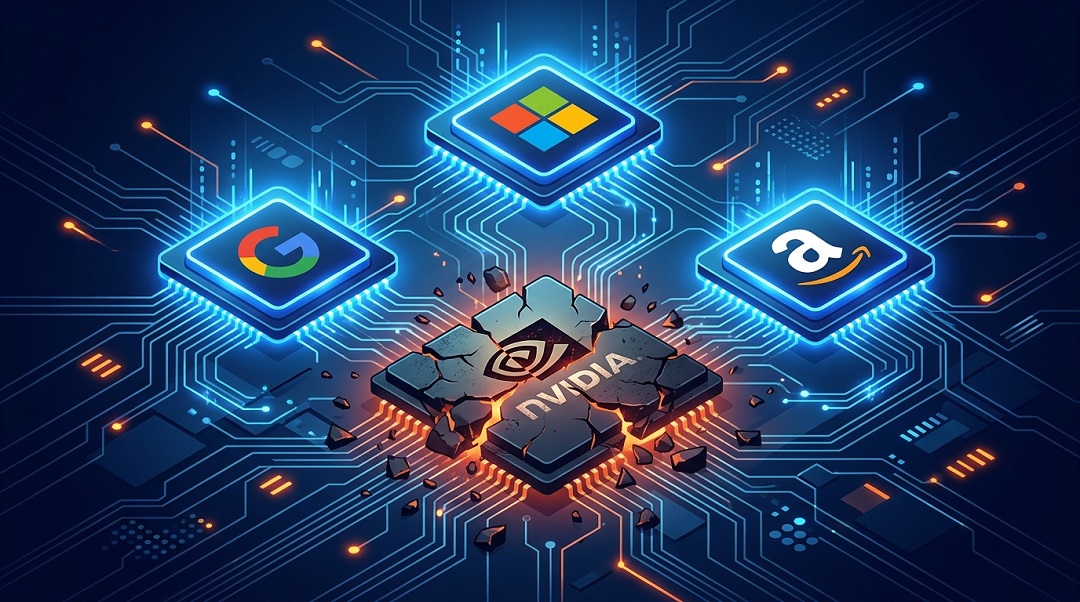
In 2023, Nvidia controlled over 80% of the AI chip market. By 2026, that share has dropped below 70% – not because Nvidia stumbled, but because Google, Microsoft, and Amazon decided to build their own silicon.
These three cloud giants are now spending a combined $500+ billion annually on AI infrastructure, and chips are the single largest cost. Instead of writing ever‑larger checks to Nvidia, they are designing their own custom AI accelerators – TPUs (Google), Trainium/Inferentia (Amazon), and Maia (Microsoft).
This article explains why. You will learn the six strategic drivers behind this historic shift, how each company compares, and what it means for developers, startups, and the future of AI computing.
Reason 1 – Cost: Cutting the Nvidia Tax by 30–50%
Nvidia’s GPUs carry gross margins above 70%. For hyperscalers buying hundreds of thousands of chips, that “Nvidia tax” represents billions of dollars in lost profit.
Custom chips remove the middleman. By designing their own AI accelerators (ASICs), Google, Microsoft, and Amazon can capture that margin themselves while also optimizing for their exact workloads.
- SemiAnalysis reports that Google’s TPUv7 Ironwood delivers 30–44% lower total cost of ownership (TCO) than Nvidia’s GB200, even after Google adds its profit margin.
- Amazon Trainium users report up to 50% lower training costs compared to comparable GPU instances, according to AWS customer case studies.
- Microsoft, previously Nvidia’s largest customer, now routes a growing portion of Azure AI workloads through its homegrown Maia 100 chips – a direct savings play.
Key stat: A single Nvidia H100 GPU costs around $30,000. Google’s TPU v8 is estimated to cost less than $15,000 to manufacture. Scale that to 1 million units, and the savings exceed $15 billion.
Reason 2 – Performance: Full‑Stack Optimization Beats Generic GPUs
Nvidia GPUs are general‑purpose – they need to run every kind of AI model equally well. Custom chips can be tailored to a specific company’s models and infrastructure.
When you control the entire stack – silicon, server, networking, cooling, and software – you can achieve performance that off‑the‑shelf hardware cannot match.
- Microsoft CTO Kevin Scott has said: “It’s about the entire system design – not just the chip.” Microsoft co‑engineered its Maia chips with OpenAI, tuning them for GPT‑class models.
- Google’s TPU v8 generation uses a multi‑supplier approach (Broadcom, MediaTek, Marvell) to optimize each component for Google’s internal workloads, including Transformer‑based models (Gemini, PaLM).
- Amazon’s Inferentia achieves up to 70% lower cost per inference in real‑world deployments, such as Alexa and SageMaker, because the chip is built specifically for low‑latency predictions.
Real‑life example: When OpenAI shifted some of its GPT‑3.5 training to Microsoft’s Maia 100, the company reported 20–30% better performance per watt compared to Nvidia H100 clusters – a direct result of hardware‑software co‑design.
Reason 3 – Supply Chain Security: Avoiding Another GPU Drought
The COVID‑era chip shortage (2020–2023) exposed a critical vulnerability: Nvidia controlled allocation. Startups and even some cloud customers faced 6‑month waits for GPU instances, while Nvidia prioritized large buyers.
By designing their own chips, hyperscalers gain control over their own supply chain. They can allocate silicon to their most important workloads and strategic partners (e.g., OpenAI for Microsoft, Anthropic for AWS).
- Amazon develops Trainium and Inferentia to insulate AWS from Nvidia’s tight supply. During the ChatGPT boom, AWS customers using Trainium bypassed GPU queues entirely.
- Google has diversified its custom chip partners across Broadcom, MediaTek, and Marvell, avoiding single‑vendor lock‑in at the design stage.
- All three companies have secured long‑term advanced packaging (CoWoS) capacity at TSMC – the same packaging that is the bottleneck for Nvidia’s supply.
Key insight: Owning your own chip design does not eliminate reliance on TSMC for manufacturing, but it does eliminate the allocation game that Nvidia plays. Hyperscalers now compete directly with Nvidia for the same fab capacity – and they are winning a growing share.
Reason 4 – The Training vs. Inference Shift
For the past five years, the AI industry has been obsessed with training – building ever‑larger foundation models. Training is expensive, but it happens only a few times per year per model.
Inference – running those models to answer user queries – is different. It runs continuously, 24/7, scaling with every user interaction. As AI products reach billions of users, inference costs are rapidly overtaking training costs.
- ARK Invest projects that inference will account for 70% of AI compute spend by 2028.
- Inference workloads are also more diverse: real‑time chatbots need sub‑50ms latency; batch processing of recommendations can tolerate seconds.
- Custom inference chips (Google TPU 8i, Amazon Inferentia2, Microsoft Clea) are designed specifically for low latency, high throughput, and extreme power efficiency – advantages that general‑purpose GPUs struggle to match.
Data point: Amazon claims that its Inferentia2 chips deliver 4x higher throughput and 10x lower latency than comparable GPUs for real‑time inference workloads.
As the industry shifts from pre‑training (concentrated) to inference (distributed and continuous), custom chips designed for serving will become even more critical. This is why every hyperscaler is racing to deploy inference‑optimized silicon.
Reason 5 – Strategic Independence: The “Apple M‑Chip” Moment for Cloud
Nvidia is not just a supplier; it is increasingly a competitor. The company now offers its own cloud service (DGX Cloud) and is building a direct relationship with AI developers, bypassing the hyperscalers.
Hyperscalers do not want to become “dumb pipes” for Nvidia’s hardware. They want to own the customer relationship and the AI roadmap.
- Apple’s transition from Intel to its own M‑series chips is the perfect analogy. Apple gained control over performance, power, and release cadence – and so can the cloud giants.
- By controlling the chip, they control the roadmap. Features can be added on their own timeline, not Nvidia’s.
- Vertical integration also allows them to offer unique capabilities to their cloud customers – for example, AWS’s “UltraServers” that connect 144 Trainium chips into a single, high‑bandwidth cluster.
Takeaway: This is not just about saving money. It is about strategic freedom. The cloud providers do not want to be held hostage by a single chip vendor that could one day become their primary competitor.
Reason 6 – Ecosystem Lock‑In: Building Their Own Software Moats
Nvidia’s greatest weapon is not its hardware – it is CUDA, the software platform that has become the industry standard for AI development. Switching away from Nvidia means re‑optimizing models, rewriting kernels, and retraining developers.
Hyperscalers are investing billions to build their own software stacks that make their custom chips as easy – or even easier – to use than CUDA.
- Google’s JAX and XLA are deeply integrated with TPUs, and PyTorch/XLA adoption is growing rapidly. GitHub activity for PyTorch/XLA increased 300% between 2024 and 2026.
- AWS’s Neuron SDK supports PyTorch, TensorFlow, and JAX, allowing developers to deploy models on Trainium/Inferentia with minimal code changes. AWS claims that 90% of popular Hugging Face models run on Neuron with no modifications.
- Microsoft’s Maia software stack was co‑developed with OpenAI, ensuring that the world’s most demanding AI workload runs seamlessly on custom silicon.
The lock‑in effect: Once a developer optimizes a model for a custom chip, they are unlikely to switch to a competitor – creating a new form of ecosystem lock‑in, this time owned by the hyperscaler rather than Nvidia.
How Google, Microsoft, and Amazon Compare
The following table summarizes the current state of each company’s custom AI chip programs.
| Company | Training Chip | Inference Chip | Key Partner(s) | Status |
|---|---|---|---|---|
| TPU 8t | TPU 8i | Broadcom (through 2031), MediaTek, Marvell | Mass production Q3 2026; shipments up 40%+ in 2026 | |
| Amazon | Trainium3 | Inferentia2 | Marvell, Annapurna Labs (in‑house) | Trainium3 announced re:Invent 2025; UltraServers with 144 chips available |
| Microsoft | Maia 200 (2026), Maia 280 (2027) | Clea (2028) | – | Maia 100 in limited use; Braga design delayed to 2025, now ramping |
Additional notes:
- Google has already signed Meta and Anthropic as external customers for its TPUs – a direct challenge to Nvidia’s dominance.
- Amazon offers its Trainium/Inferentia chips to all AWS customers; Anthropic is a flagship user.
- Microsoft currently uses Maia primarily for its own workloads and OpenAI, but plans to offer it more broadly on Azure by 2027.
What This Means for the Future – A Fragmented AI Chip Market
Nvidia will not disappear. Its GPUs will remain the gold standard for general‑purpose AI training and for developers who want to avoid vendor lock‑in. But the era of one chip to rule them all is ending.
- ARK Invest projects that custom non‑GPU chips will capture over one‑third of the AI compute market by 2030 (35–45% by some estimates).
- TrendForce projects custom ASIC sales will grow 45% in 2026, compared with only 16% growth in GPU shipments.
- Broadcom, which designs custom AI accelerators for Google and others, is expected to hold roughly 60% of the custom ASIC market by 2027, with Marvell at approximately 25%.
The winners will be those who master not just silicon design but also the software ecosystem and manufacturing partnerships (TSMC, Samsung). Nvidia will continue to innovate, but for the first time in a decade, it faces credible competition from its own biggest customers.
Conclusion: A Strategic Necessity, Not a Luxury
Google, Microsoft, and Amazon are not building their own AI chips because they hate Nvidia – they are doing it because the economics of AI at scale demand it.
To summarize the six reasons:
- Cost: 30–50% lower TCO by cutting out the Nvidia margin.
- Performance: Full‑stack optimization beats generic GPUs.
- Supply security: No more waiting in line for Nvidia allocation.
- The inference shift: Custom chips excel at low‑cost, low‑latency serving.
- Strategic independence: The “Apple M‑chip” moment for cloud providers.
- Ecosystem lock‑in: Building their own software moats to replace CUDA.
Whether you are a developer, an investor, or simply an AI enthusiast, understanding this shift helps you see where AI costs, performance, and opportunities are heading over the next five years.
What do you think? Which company’s custom chip strategy will win long‑term – Google’s open TPU ecosystem, Amazon’s broad cloud offering, or Microsoft’s tightly integrated Maia/OpenAI stack? Leave a comment below.
References & Further Reading
- SemiAnalysis – TPU v7 Ironwood TCO analysis (Nov 2025 – Apr 2026)
- JPMorgan – AI infrastructure market outlook (Apr 2026)
- ARK Invest – AI compute market projections (Mar 2026)
- TrendForce – Custom ASIC vs. GPU shipment growth (Apr 2026)
- Amazon re:Invent 2025 – Trainium3 and Inferentia2 announcements
- Microsoft Ignite 2025 – Maia 100 performance disclosures
- Google Cloud Next ‘26 – TPU v8 multi‑supplier strategy
- TheRegister, TechGig, FutureCast Podcast (various 2025–2026)
If you found this explainer useful, check out our related article: Why AI & Cloud Infrastructure Demand Is Outpacing Global Supply (5 Constraints) – a deep dive into power, chips, labor, water, and construction bottlenecks.