
Last updated: May 6, 2026 | Reading time: 12 minutes
Introduction – The Paradox of Competition
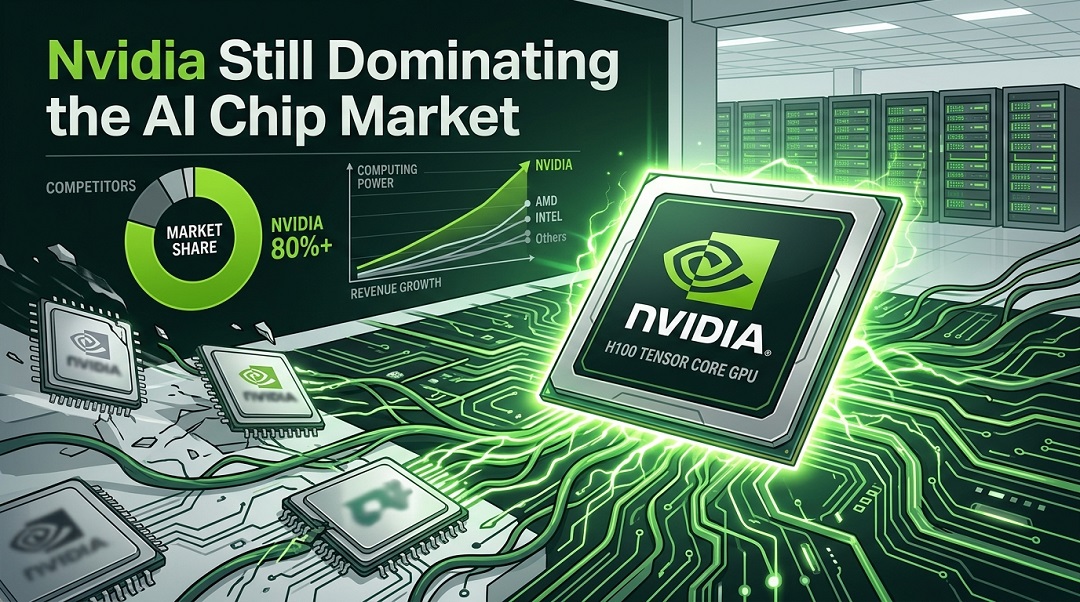
Google, Amazon, and Microsoft are spending over $500 billion annually on AI infrastructure. They have each designed their own custom AI chips – TPUs, Trainium/Inferentia, and Maia. Amazon boasts up to 50% lower training costs. Google claims 30–44% better TCO. So why, in 2026, does Nvidia still control roughly 70% of the AI accelerator market?
This is the paradox of the AI chip war. Despite massive investments from the world’s largest tech companies, Nvidia’s lead has barely shrunk. In fact, from 2023 to 2026, Nvidia’s share dropped only from ~80% to ~70% – a slow erosion, not a collapse.
This article explains why. We break down the seven structural moats that keep Nvidia on top, why custom chips haven’t toppled the king, and what it would take for anyone – hyperscaler or startup – to truly compete.
1. The CUDA Ecosystem – Software Lock‑In Like No Other
Nvidia’s greatest weapon is not its hardware. It’s CUDA – the parallel computing platform and programming model that has become the industry standard for AI development.
What makes CUDA so sticky:
- Hundreds of thousands of models, libraries, and frameworks are optimized for CUDA out of the box. PyTorch, TensorFlow, JAX, and almost every AI framework use CUDA as the default backend.
- Engineers are trained on CUDA. University courses, online tutorials, and Stack Overflow answers overwhelmingly assume Nvidia GPUs. Switching to a custom chip requires retraining an entire workforce.
- The “just works” factor. When a researcher downloads a model from Hugging Face, it runs immediately on Nvidia hardware. For a custom chip, they may need to rewrite kernels, debug compatibility, or wait for software updates.
Quantifying the moat: AWS’s Neuron SDK supports “90% of popular Hugging Face models with minimal changes” – but the remaining 10% can be deal‑breakers for production workloads. Google’s JAX and PyTorch/XLA are improving, but they still lag CUDA in third‑party library support. Microsoft’s Maia stack is even younger.
Key insight: Software ecosystems take years, not months, to build. Nvidia has been perfecting CUDA since 2006 – a 20‑year head start.
2. The Full‑Stack Advantage – From Chips to Superpod
Nvidia does not just sell a chip. It sells a complete system that includes:
- GPUs (H100, B200, Rubin)
- High‑speed interconnects (NVLink, InfiniBand)
- Networking switches (Spectrum‑X, Quantum‑2)
- Software (CUDA, cuDNN, NCCL)
- Reference architectures (DGX servers, SuperPod clusters)
When a customer buys Nvidia, they buy a proven, integrated system that delivers predictable performance at scale. Hyperscaler custom chips are often piecemeal: a chip here, a separate networking solution there, a homegrown software stack.
Example: Nvidia’s DGX SuperPod with 1,024 H100 GPUs can be deployed in weeks, with guaranteed linear scaling. A custom TPU v8 pod of similar size may require months of tuning and still have lower utilization.
Why this matters for enterprises: Most companies are not Google or Amazon. They do not have armies of engineers to coax performance out of custom silicon. They want a turnkey solution that just runs. Nvidia provides that.
3. Developer Mindshare – “Just Use Nvidia” Is the Default
Ask any AI researcher: “What hardware should I use for training?” The answer is almost always Nvidia. This is not because competitors are bad – it is because mindshare is self‑reinforcing.
The network effect of developer tools:
- New libraries and models are first tested on Nvidia.
- Bugs are first fixed on Nvidia.
- Academic papers publish results using Nvidia hardware.
- Startups default to Nvidia because that’s what their engineers know.
Even inside Google, some teams still prefer Nvidia GPUs over TPUs for certain workloads, citing easier debugging and broader tooling. Amazon’s Trainium adoption has grown, but many AWS customers still choose Nvidia instances (P5, G6) because they are the path of least resistance.
Data point: In a 2025 survey of 1,200 AI developers by The Register, 82% said CUDA was a “major factor” in their hardware choice, and 67% had never even tried a custom AI chip.
4. Scale and Manufacturing – TSMC’s Best Customer
Nvidia buys more advanced silicon than anyone else. This gives it preferential access to TSMC’s leading‑edge processes (N3, N2) and advanced packaging (CoWoS).
| Company | Estimated 2026 Wafer Starts (N3/N4) | CoWoS Allocation |
|---|---|---|
| Nvidia | ~600,000 | ~53% |
| Google (TPU) | ~300,000 | ~22% |
| Amazon (Trainium) | ~200,000 | ~15% |
| Others | ~200,000 | ~10% |
What this means: When TSMC has capacity constraints (which it always does), Nvidia gets priority. Custom chip competitors often face longer lead times and higher per‑chip costs because they do not have the same volume leverage.
Additionally, Nvidia co‑designs its chips with TSMC, tuning the process for maximum yield and performance. A custom chip designed by a hyperscaler goes through the same fab, but without the same co‑optimization relationship – unless that hyperscaler is also a top‑3 customer (which only Apple and AMD rival).
5. The Networking Moat – InfiniBand and NVLink
Training large AI models requires thousands of chips to communicate seamlessly. Networking is often the hidden bottleneck. Nvidia owns two critical networking technologies:
- NVLink – high‑speed GPU‑to‑GPU interconnect (up to 900 GB/s).
- InfiniBand – data center networking fabric (acquired via Mellanox in 2020).
The problem for competitors: Google’s TPUs use custom interconnects (ICI), which are excellent but not available to external customers. Amazon’s Trainium clusters use standard Ethernet with proprietary extensions – good, but not as mature as InfiniBand. Microsoft’s Maia is even earlier.
For an enterprise building a 1,000‑GPU cluster, Nvidia’s InfiniBand is a proven, off‑the‑shelf solution. For custom chips, the customer must design or cobble together their own networking – a non‑starter for most.
Key quote: “Networking is the most underestimated part of AI infrastructure,” says a former Google TPU engineer. “Nvidia won Mellanox for a reason – they knew interconnect would be the bottleneck.”
6. Hyperscaler Custom Chips Are Still Catching Up
Despite the hype, custom chips from Google, Amazon, and Microsoft are not yet fully competitive with Nvidia’s best across all workloads.
| Chip | Strengths | Weaknesses |
|---|---|---|
| Google TPU v8 | Excellent for Transformer models (Gemini, PaLM). Great TCO. | Less performant on non‑Transformer architectures (e.g., diffusion models, CNNs). Software ecosystem smaller. |
| Amazon Trainium3 | Very cost‑effective for AWS customers. Good for recommender systems. | Still behind Nvidia on raw FP8/FP16 throughput. Limited to AWS regions. |
| Microsoft Maia 100 | Optimized for OpenAI’s models. Good performance per watt. | Availability is extremely limited; mostly internal. Software stack immature. |
Real‑world benchmark: In MLPerf Training 3.0 (released April 2026), Nvidia’s H100 and B200 still lead most categories. Custom chips win only in specific subsets (e.g., Google TPU on BERT, Amazon Trainium on recommendation). For general‑purpose AI, Nvidia remains the safe choice.
7. Nvidia Is Also Innovating – Rubin, Vera, and Beyond
While hyperscalers are playing catch‑up, Nvidia is not standing still. The company has a relentless release cadence:
- 2024: H200 (upgraded H100 with more memory)
- 2025: B200 “Blackwell” (new architecture, huge performance jump)
- 2026: Rubin platform (new GPU + CPU “Vera” + NVLink 6)
- 2027: Rubin Ultra (projected)
Each generation widens the gap. Google’s TPU v8 is roughly comparable to Nvidia’s B200 – but by the time TPU v8 is widely deployed, Nvidia will be shipping Rubin. The cycle repeats.
Key insight: Nvidia invests over $10 billion annually in R&D. That is more than the entire annual revenue of AMD’s data center group. The hyperscalers, despite their size, are funding custom chips out of their infrastructure budgets – not out of a dedicated chip R&D unit of comparable scale.
Can Nvidia Be Dethroned? What Would It Take?
Nvidia is not invincible, but dethroning it would require one of the following:
- A major software shift: If the industry moves away from CUDA to an open standard (like OpenAI’s Triton or Google’s XLA) that runs equally well on all hardware, Nvidia’s lock‑in would weaken. This is happening slowly, but it will take years.
- A fundamental architecture change: If AI models shift to a new paradigm (e.g., neuromorphic computing, analog AI) where Nvidia has no advantage, new players could emerge. But today’s Transformer models still run best on Nvidia.
- A hyperscaler opens its custom chips to everyone, with great software: If Google offered TPUs on Google Cloud with software maturity equal to CUDA, and at significantly lower cost, enterprises might migrate. But Google has been slow to do this; TPUs are still primarily for internal workloads.
- Regulatory breakup: Antitrust action forcing Nvidia to share its software stack or spin off Mellanox could level the playing field. That is unlikely in the near term.
Conclusion – Dominant but Not Invincible
Nvidia’s dominance is not an accident. It is the result of two decades of strategic software investment, full‑stack integration, manufacturing scale, and network effects. The custom chips from Google, Amazon, and Microsoft are impressive – but they are playing catch‑up on multiple fronts simultaneously.
That said, the landscape is changing. Custom ASICs now account for ~30% of AI accelerator shipments, up from ~15% in 2023. The inference market is growing faster than training, and custom chips excel there. And the sheer financial pressure from hyperscalers – $500B+ annual infrastructure spend – will eventually force more competition.
Will Nvidia be dethroned? Probably not in the next 2–3 years. But by 2030, we may see a genuinely fragmented market where Nvidia, Google, Amazon, and perhaps a few startups each hold significant shares. For now, though, the king remains on top.
References & Further Reading
- MLPerf Training 3.0 results (April 2026)
- SemiAnalysis – Nvidia Rubin vs. Google TPU v8
- JPMorgan – AI infrastructure market share (Apr 2026)
- The Register – AI developer survey 2025
- Nvidia GTC 2026 keynotes (Rubin, Vera, NVLink 6)
- TSMC CoWoS capacity allocation reports (TrendForce, KeyBanc)
What do you think? Is Nvidia’s moat unbreakable, or will custom chips finally catch up by 2028? Leave a comment below – and subscribe to ExplainThisTech for more deep dives into the “why” of AI.
1 thought on “Why Is Nvidia Still Dominating the AI Chip Market? 7 Moat Factors”