
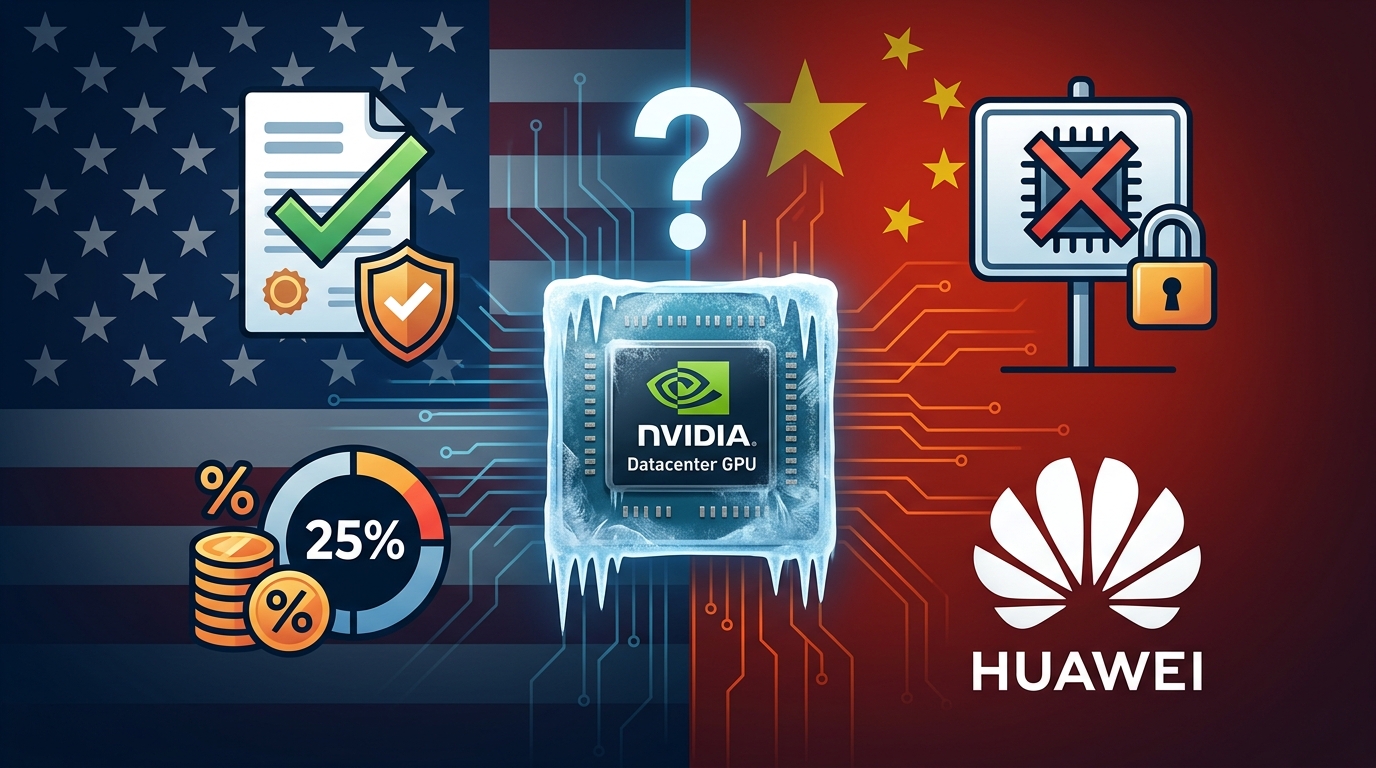
A Permission That Went Nowhere
On the surface, the news seemed like a dramatic thaw in the US-China chip war. In May 2026, reports emerged that the US Commerce Department had approved export licenses allowing about 10 Chinese companies — including Alibaba, Tencent, ByteDance, and JD.com — to purchase Nvidia’s H200 AI chips, the most advanced chip the US has permitted for export to China. Nvidia CEO Jensen Huang joined President Trump’s delegation to Beijing, fueling speculation of a major breakthrough.
The approval marks one of the biggest openings for advanced AI chip sales to China since Washington tightened semiconductor export controls. But here is what happened next: not a single chip has been delivered.
Chinese firms have reportedly pulled back after guidance from Beijing, with mounting pressure inside China to block or strictly vet orders. Washington’s permission has collided with Beijing’s distrust, a 25% US revenue-sharing fee, and a full-scale Chinese campaign to replace foreign chips with domestic alternatives.
This article explains why the H200 approval is not what it seems, what conditions the US attached, why China is saying “thanks but no thanks,” and what the stalled deal reveals about the future of the global AI chip industry.
Quick Summary – What Every AI Observer Needs to Know
| Question | Answer |
|---|---|
| What did the US approve? | Export licenses for about 10 Chinese firms (Alibaba, Tencent, ByteDance, JD.com) to buy Nvidia’s H200 chips, the second-most-powerful AI accelerator. |
| What are the conditions? | 25% revenue share to US government; physical transit through US territory for inspection; security certifications; caps of up to 75,000 chips per customer. |
| Have any chips shipped? | No. Nvidia has “not generated any revenue under the H200 licensing program”. |
| Why is China hesitating? | Beijing is pushing domestic AI chip adoption (Huawei Ascend, Alibaba’s in-house GPUs) and views importing Nvidia chips as a threat to its self-sufficiency strategy. |
| How is Huawei competing? | Huawei plans to ship about 750,000 Ascend 950PR chips in 2026, and Chinese tech giants have placed orders for hundreds of thousands. |
| What does this mean for Nvidia? | China once accounted for 13% of Nvidia’s revenue. The company can thrive without China, but the lost opportunity is massive. |
1: What the US Actually Approved (And What It Didn’t)
1.1 The H200: Powerful, But Not the Best
Nvidia’s H200 is the company’s current exportable flagship. Based on the Hopper enhanced architecture, it packs 141GB of HBM3e memory with 4.8TB/s bandwidth and 1.979 petaflops of half-precision compute power. It is a powerful chip — but it is not Nvidia’s best. That distinction belongs to the B200, based on the Blackwell architecture, which offers 30–40% higher compute density, more than double the memory bandwidth (8TB/s), and is optimized for ultra‑large‑scale model training. The B200 remains entirely off‑limits to China.
The approval therefore sends a signal: the US will allow China to access last‑generation hardware, but the technology frontier remains walled off.
1.2 Which Companies Were Approved?
According to Reuters, approved buyers include:
- Alibaba, Tencent, ByteDance, and JD.com as direct purchasers.
- Lenovo and Foxconn as approved intermediaries.
Each approved customer can purchase up to 75,000 chips under US license terms. For context, 75,000 H200 chips would represent a multi‑billion‑dollar order — enough to build or expand several major AI data centers. But those numbers are not the same as actual deliveries.
The US Conditions – A 25% Fee, Physical Inspection, and Security Guarantees
The approval is not unconditional. Washington attached a series of requirements that make the deal anything but straightforward.
2.1 Case‑by‑Case Review (January 2026 Rule)
On January 15, 2026, the Bureau of Industry and Security (BIS) changed its licensing policy for H200 and similar chips (AMD MI325X) from a “presumption of denial” to “case‑by‑case review”. This shift was described by BIS as “necessary to ensure the national security benefits” while allowing controlled commercial access. But it also created a bureaucratic maze: each shipment must undergo independent third‑party testing in the US to verify its performance and security.
2.2 Security Certifications
Chinese buyers must demonstrate that they have implemented “sufficient security procedures” and must guarantee the chips will not be diverted to military applications. Nvidia itself is required to certify that it maintains sufficient inventory within the US before shipping anything abroad.
2.3 The 25% Revenue Share
The most unusual condition is a 25% fee that the US government collects on H200 sales to China. Because US law prevents direct imposition of export fees, the arrangement requires that the chips physically pass through US territory — where the government can collect its cut.
This logistical detour has triggered deep anxiety within the Chinese government. According to sources speaking to Reuters, officials in Beijing fear potential tampering or hidden vulnerabilities introduced while the hardware sits on US soil. A Chinese media outlet reported that each H200 chip must undergo physical inspection by BIS on US territory before being cleared for shipment to mainland China.
2.4 What the US Gets Out of It
For Washington, the deal is designed as a win‑win‑win: the US collects a 25% tax on every chip sold, slows China’s progress toward full AI self‑sufficiency, and placates US tech giants that have lobbied for continued access to the world’s second‑largest AI market. But critics say the strategy is flawed. Chris McGuire, senior fellow for China and emerging technologies at the Council on Foreign Relations, warned: “Any deal that allows Nvidia to sell more chips to China means fewer Nvidia chips for US firms, and a smaller US lead in AI over China”.
Why China Is Saying “No Thanks” – Beijing’s Strategic Blockade
The most revealing part of this story is China’s response. Despite receiving US approval, no H200 units have reached Chinese shores. Nvidia confirmed that it has “not generated any revenue under the H200 licensing program” and does “not yet know whether any imports will be allowed into China”.
3.1 Beijing’s “Thanks, But No Thanks” Directive
Chinese firms have reportedly slowed purchases following guidance from Beijing, with mounting pressure inside China to block or strictly vet orders. US Commerce Secretary Howard Lutnick confirmed: “The Chinese central government has not let them, as of yet, buy the chips, because they’re trying to keep their investment focused on their own domestic industry”.
In other words, Beijing is actively discouraging purchases of foreign chips — even when those chips are legally available — to protect and nurture its domestic semiconductor industry.
3.2 Huawei’s Ascend 950PR: A Credible Alternative
China no longer views itself as powerless. Huawei’s Ascend 950PR chip has emerged as a legitimate — if not yet equal — alternative to Nvidia’s offerings.
According to Reuters, Huawei plans to ship about 750,000 Ascend 950PR chips in 2026, with mass production having started in April and shipments expected in the second half of the year. The chip is designed to excel at inference workloads — precisely the growing market segment where AI models are deployed to answer queries.
The 950PR has won over major customers. China’s three largest internet groups — Alibaba, ByteDance, and Tencent — have collectively placed orders for hundreds of thousands of Ascend 950 processors following the DeepSeek V4 launch. This is a dramatic shift from just a year ago, when Huawei struggled to persuade big tech firms to adopt its chips at scale.
3.3 DeepSeek V4: The Software Bridge
The key enabling factor is DeepSeek V4, a large language model released in April 2026. DeepSeek announced full adaptation of V4 to Huawei’s Ascend chip platform, marking the first time a major Chinese AI model completed full‑stack deployment — from training to inference — entirely on domestic chips. This breaks the CUDA monopoly: developers no longer need Nvidia’s software ecosystem to run advanced AI models.
DeepSeek V4 delivers up to 2.87 times the single‑card inference performance of Nvidia’s China‑specific H20 processor, with deployment costs about one‑tenth of comparable GPT‑based services. For Chinese firms weighing a switch away from Nvidia, the economics are compelling.
3.4 The Domestic Chip Mandate
China has pursued a strategy to expand domestically produced chips to achieve AI self‑reliance after US export curbs limited access to Nvidia technology. Chinese semiconductor companies such as Moore Threads, MetaX, and Huawei have filled gaps left by Nvidia and have recently shown rising revenue. Tencent’s Chief Strategy Officer James Mitchell said China‑made chips are “becoming more available each month”.
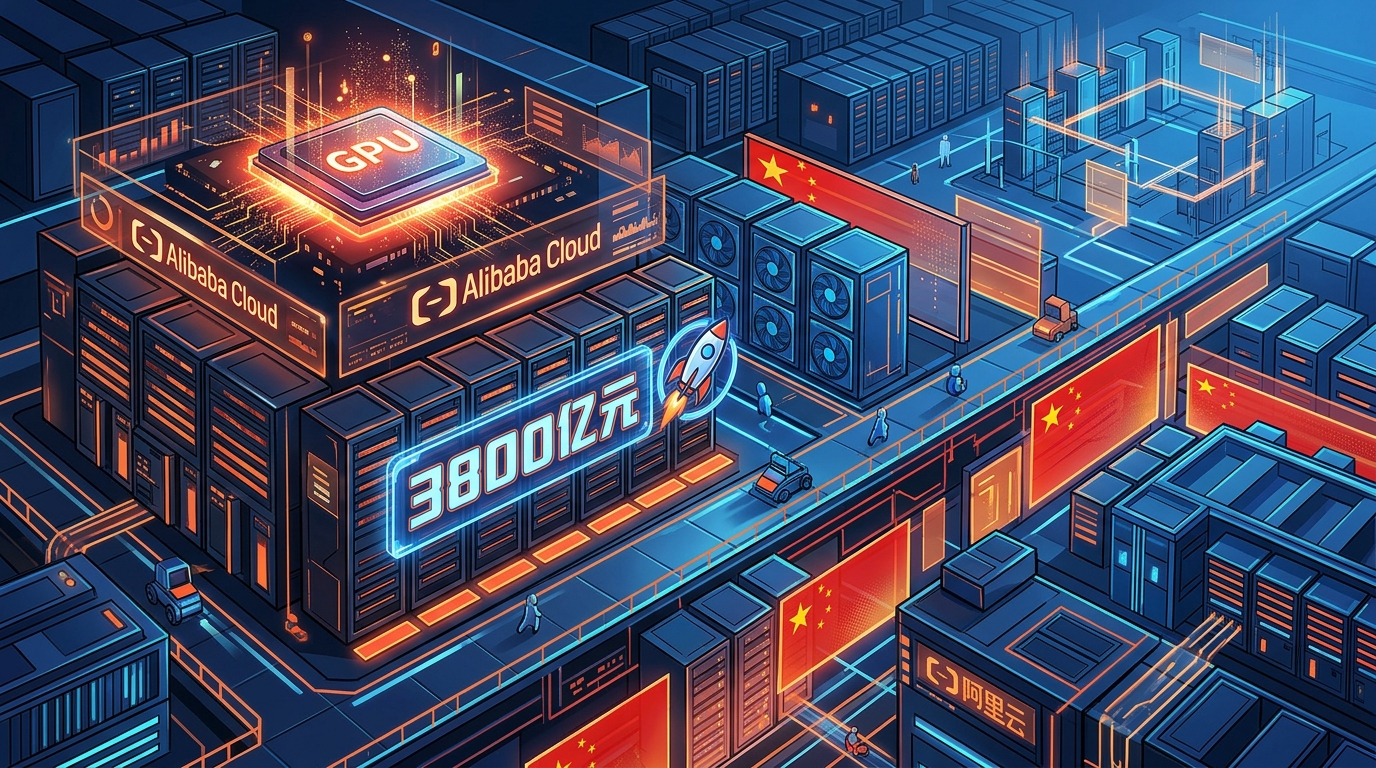
The push goes beyond voluntary adoption. Beijing has reportedly mandated that for every advanced Western chip imported, a domestic equivalent must be purchased in parallel — a “parallel purchase” policy that systematically favors local suppliers. Alibaba is also expanding use of its own semiconductors, deploying in‑house GPUs in data centers supporting its cloud business, and has reached mass production at scale.
3.5 Lingering Concerns: Capacity and Performance Gaps
Despite the momentum, significant challenges remain. DeepSeek acknowledged in its technical report that due to compute limitations, it cannot yet serve all customers; it expects to expand service only after more Huawei chips are delivered in the second half of 2026.
Moreover, the technology gap remains stark. Analyst estimates suggest Huawei’s upcoming Ascend 950 is expected to deliver only a fraction — approximately 6% — of the computing power of Nvidia’s next‑generation VR200. The shift to domestic chips is a long‑term strategy, not an overnight replacement.
The Stakes – What This Means for Nvidia, China, and the Global AI Industry
4.1 The Market Nvidia Lost
Before tighter US export curbs were introduced, Nvidia commanded nearly 95% of China’s advanced chip market. China once accounted for 13% of Nvidia’s revenue. CEO Jensen Huang has estimated that the Chinese AI market alone could reach $50 billion this year.
The good news for Nvidia is that it has proven it can thrive without China. Nvidia reported fiscal 2026 revenue of 215.9 billion, up 655.6% in May 2026, fueled by optimism around the H200 approvals—despite no actual revenue from the program.
The bad news is that the lost China opportunity is still massive, and every month of delay pushes Chinese firms further toward domestic alternatives. By the time Nvidia can sell freely again, Huawei may have built an ecosystem that no longer needs Nvidia at all.
4.2 The “Backfire” Argument
The US export controls were designed to cripple China’s AI progress. Instead, they have arguably accelerated it. The restrictions became a forcing mechanism for China to pour resources into domestic chip development, software ecosystems, and AI model optimization. As the New York Times noted, “While Washington’s export controls have slowed China’s chip development, they have added fuel to Beijing’s decade‑long push to make strategic technologies like semiconductors and AI entirely at home”.
The H200 approvals are a recognition of this reality. But they may have come too late to reverse the momentum.
4.3 Geopolitical Fragmentation
The most consequential long‑term implication is the potential fracture of the global tech ecosystem into two separate AI spheres: a US‑led ecosystem anchored by Nvidia, CUDA, and Western cloud providers, and a China‑led ecosystem anchored by Huawei, domestic chips, and a homegrown software stack.
Chris McGuire of the Council on Foreign Relations summarized the stakes: “Any deal that allows Nvidia to sell more chips to China means fewer Nvidia chips for US firms, and a smaller US lead in AI over China”. The US is effectively trading short‑term revenue for long‑term strategic advantage — a calculation that has drawn fierce criticism from Washington hardliners.
Frequently Asked Questions (FAQ)
Q1: Is the US‑China chip war over?
A: No. The H200 approval was a limited, conditional maneuver — not a surrender. The broader conflict over AI dominance is intensifying, with both sides building domestic capabilities and preparing for a long‑term technological rivalry.
Q2: Will Nvidia ever sell H200 chips to China in volume?
A: Possibly — but only if China allows it. Beijing’s current policy is to prioritize domestic chips, and Chinese firms are under pressure to comply. Nvidia has the licenses but not the customers. The ball is firmly in China’s court.
Q3: How is Huawei competing with Nvidia?
A: Huawei’s Ascend 950PR is now a credible alternative for inference workloads — the fastest‑growing segment of AI computing. With DeepSeek V4 fully adapted to its platform, Huawei has broken Nvidia’s CUDA monopoly. In raw compute, Nvidia still leads by a large margin, but for many Chinese companies, “good enough” is now acceptable.
Q4: What is the 25% fee?
A: A Trump‑negotiated arrangement where the US government collects 25% of revenue from H200 sales to China. Because direct export fees are legally restricted, the chips must physically transit through US territory, where the fee is collected. This transit requirement has heightened Chinese concerns about tampering or espionage.
Q5: How does this connect to your previous articles?
A: This is a direct sequel to our coverage of Nvidia’s dominance, HBM memory shortages, US‑China tensions, DeepSeek’s rise, and the neocloud revolution. The stalled H200 deal is a real‑world case study of every constraint and strategic shift we have explored.
Q6: Will Chinese firms ever buy Nvidia chips again?
A: Possibly — but in smaller quantities. The domestic AI chip industry still cannot fully meet China’s demand. Nvidia may still find a market for premium chips used in the most demanding training workloads. But the era of Nvidia commanding 95% of China’s AI chip market is over.
Q7: What does this mean for the price of AI compute?
A: In the short term, restricted supply may keep prices high. In the long term, the emergence of two competing AI ecosystems could drive innovation and lower costs — or raise them due to reduced economies of scale. The outcome is uncertain and depends on how the geopolitical rivalry evolves.
A Deal That Says More by Not Happening
The H200 approval appears to be a breakthrough. In reality, it is a snapshot of a deeper stalemate. The US has opened a narrow door, but China has chosen not to walk through it.
The reasons are not technical. The chips are ready. The licenses are approved. Nvidia’s CEO is shaking hands with presidents. Yet no silicon moves. Because Beijing has decided that the long‑term cost of dependency — on Nvidia, on US supply chains, on a foreign technology stack — outweighs the short‑term gain of buying the best chips available.
The H200 approval may be the last time the US offers China a seat at its AI table. Because China is building its own.
References & Further Reading
- Reuters – “US Clears H200 Chip Sales to 10 China Firms” (May 14, 2026)
- BIS Final Rule – License Review Policy Revision (January 15, 2026)
- TechRepublic – “US Approves Nvidia H200 Sales to China, But Shipments Remain Stalled” (May 15, 2026)
- AJU Press – “US Approves Nvidia H200 Sales to China, But No Deliveries Yet” (May 14, 2026)
- Livemint – “Nvidia Hits New Peak, Market Cap Crosses $5.6 Trillion” (May 14, 2026)
- Reuters – “Huawei’s New AI Chip Finds Favor With ByteDance, Alibaba” (March 27, 2026)
- SCMP – “China’s Chipmakers Rush to Embrace DeepSeek’s V4” (May 6, 2026)
- Xinhua News – “DeepSeek V4 Fully Adapted to Huawei Ascend” (May 8, 2026)
- Digital Today – “China’s Big Tech Accelerates Move Away From Nvidia” (May 15, 2026)
- Sunday Guardian Live – “US Approves Nvidia AI Chip Exports: Why Is China Hesitant?” (May 14, 2026)





Leave a Reply