
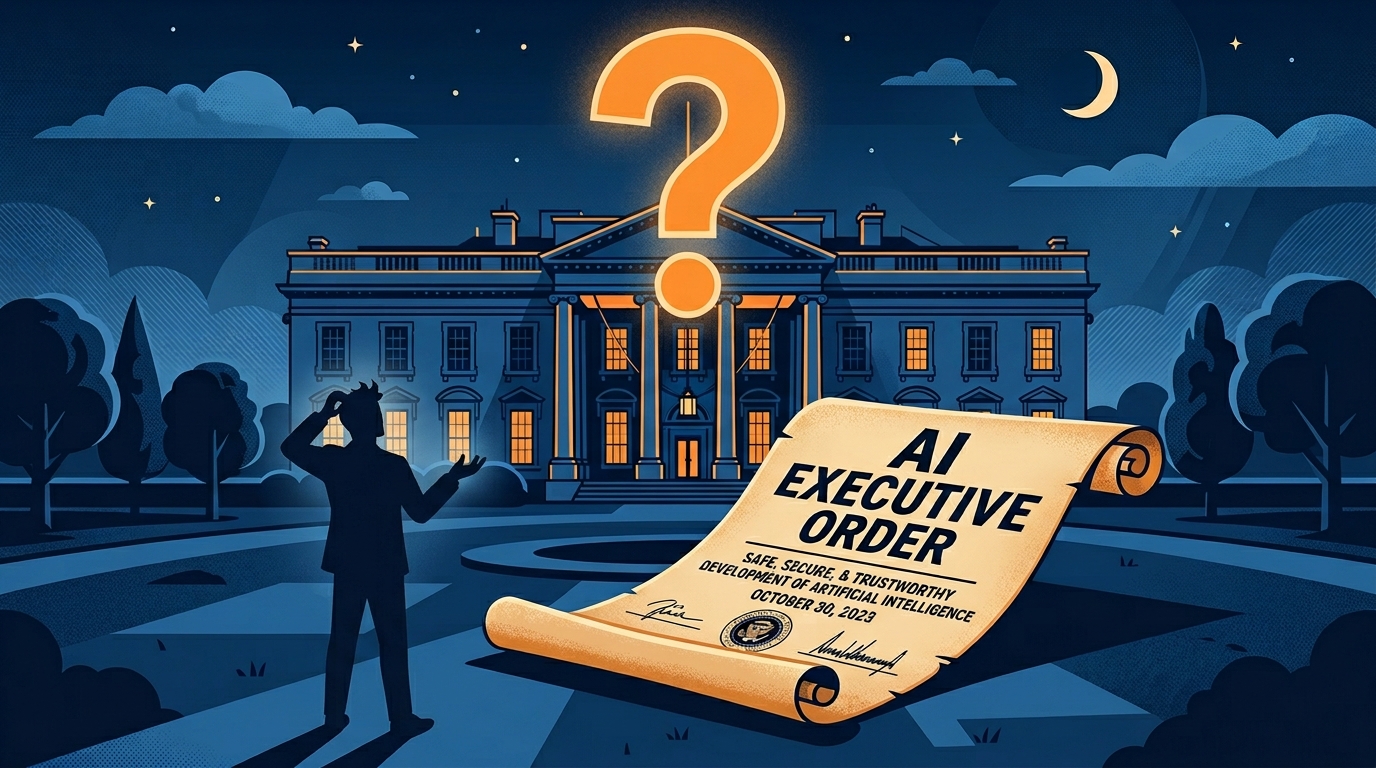
The Ceremony That Never Happened
Everything was set for a triumphant White House photo op. Leading AI executives had been briefed on the policy and invited to a Thursday signing ceremony in the Oval Office. The order was typed, the podium was ready, and staff had been prepping for weeks. Then, hours before the event, President Trump abruptly called it off.
“I didn’t like certain aspects of it. I postponed it,” Trump told reporters during a Thursday morning event at the White House, shortly after news of the delay broke. “I think it gets in the way of — you know, we’re leading China, we’re leading everybody, and I don’t want to do anything that’s going to get in the way of that lead.”.
The order would have given the federal government power to evaluate advanced AI models before their public release — a significant shift from the administration’s historically hands‑off approach. Instead, the White House’s abrupt reversal laid bare deep internal divisions over how, or even whether, to regulate the most transformative technology of the decade.
This article explains what was in the canceled AI executive order, why Trump pulled it at the last minute, who was pushing for it and who killed it, and what happens next for AI regulation in America.
What Was in the Canceled Executive Order
The order, which had been weeks in the making, represented a deliberate — though carefully limited — shift toward greater government oversight of AI.
The Voluntary Review Framework
The centerpiece of the order was a voluntary federal review process for the most advanced AI models. Participating AI companies would be asked to submit their models to the government anywhere from 14 to 90 days before public release.
Crucially, the order explicitly stated that it would not create a mandatory licensing or pre‑clearance regime. The draft text read: “Nothing in this section shall be construed to authorize the creation of a mandatory governmental licensing preclearance or permitting requirement for the development, release or distribution of new AI models.”.
Despite this assurance, Trump remained unconvinced. “I really thought that could have been a blocker,” he said, without specifying which components worried him.
Agencies Involved and the Goal
The review process would be coordinated by the White House’s Office of the National Cyber Director, with input from the Treasury Department, the National Security Agency, and other agencies. The primary goal: to identify any security vulnerabilities in advanced AI models and to patch problems in government systems, helping to protect banks, utilities, and other critical infrastructure from AI‑powered cyberattacks.
The order also would have directed the expansion of advanced AI use in national security systems and critical infrastructure.
What Prompted It: The Mythos Wake‑Up Call
The order stemmed from growing alarm within the administration about the cybersecurity risks posed by the latest generation of AI models. Those fears intensified just weeks earlier when Anthropic announced Claude Mythos, a new model that the company said could find software vulnerabilities and lead to a cybersecurity “reckoning.”.
In April, Treasury Secretary Scott Bessent and outgoing Federal Reserve Chair Jerome Powell convened an urgent meeting with Wall Street CEOs to warn them about the cybersecurity risks posed by Mythos. “This new Anthropic model is very powerful,” Bessent said at a CNBC forum. “Some banks are doing a better job in cybersecurity than others, and we want to have the ability to convene them.”.
The model’s ability to discover vulnerabilities with “excessive precision” had rattled both government officials and the private sector. The proposed executive order was meant to be the administration’s measured response.
Why Trump Pulled the Plug – The Last‑Minute Backlash
The collapse happened fast. Just hours before the ceremony — after White House officials had even held a morning phone call with reporters to preview the order — Trump made the call to delay.
The Anti‑Regulation Faction Wins Out
The main reason, according to sources familiar with the internal discussions, was simple: “He just hates regulation.”.
Behind the scenes, Trump, his AI adviser David Sacks, and some industry executives had been discussing the order. Sacks “also hated it,” one source told Axios. “The whole thing was unnecessary” and “just something doomers wanted,” the source added.
The cancellation reflected a decisive victory for the “accelerationist” camp within the administration — those who believe that any government intervention, even voluntary, could slow US innovation. For now, as one government official put it, “the accelerationists have won out.”.
Presidential Concerns
Trump’s own public statements echoed the same theme. He worried aloud that the order could slow American AI leadership, particularly in the race against China.
“We’re leading China, we’re leading everybody, and I don’t want to do anything that’s going to get in the way of that lead,” he told reporters. The president emphasized that AI is “causing tremendous good, and it’s also bringing in a lot of jobs” — and he wanted to ensure the executive order didn’t become “a blocker.”.
The Executive Attendance Fiasco
Adding to the chaos was a separate issue: the CEOs weren’t coming. The White House had invited the leaders of OpenAI, Google, Anthropic, Meta, and Microsoft — but only 24 hours before the event.
OpenAI’s Sam Altman had a scheduling conflict. Anthropic’s Dario Amodei and Meta’s Mark Zuckerberg also could not attend. Some companies sent lower‑level executives in their place. According to the New York Times, “AI companies were told Mr. Trump was not happy that many of their chief executives, who had been invited to the White House for Thursday’s signing, could not make it.”.
Questions Over Treasury’s Role
There were also substantive objections. One tech industry source told Axios that the order gave the Treasury Department an unusually prominent role in coordinating security vulnerabilities. “It’s not clear just objectively speaking why Treasury is involved and what is their substantive expertise in this area,” the source said.
The Internal White House Rift
The abrupt delay exposed a deepening split within the Trump administration over AI policy. On one side stand national security hawks alarmed by the potential of models like Anthropic’s Mythos to be misused for cyberattacks. On the other side are pro‑business aides, led by venture investor David Sacks, who argue that any government oversight will stifle innovation.
The National Security Case
Supporters of regulation point to the genuine danger posed by advanced AI models. Anthropic’s Mythos can identify software vulnerabilities with unsettling precision. OpenAI is also reportedly testing a similar model. Government officials, banks, and others worried that future AI models could find vulnerabilities that U.S. enemies would exploit.
The Innovation Case
Silicon Valley and its allies have pushed back forcefully. David Sacks has been one of the most prominent voices advocating AI‑friendly policies. On a recent podcast, he warned: “If an FDA‑style approval process is introduced, innovation could be severely damaged.” He added, “There is a very strong backlash inside Silicon Valley.”.
The Missing Middle Ground
The now‑delayed executive order was meant to be a middle ground—a voluntary framework that would allow the government to assess risks without imposing mandatory requirements. Some AI companies, including OpenAI and Anthropic, already voluntarily submit their models to the U.S. Center for AI Standards and Innovation for safety testing.
But even that voluntary approach was not enough to satisfy the anti‑regulation faction.
What Happens Next – Three Possible Scenarios
1. The Order Gets Rewritten (Most Likely)
The executive order is delayed, not dead. White House officials have indicated that the directive will likely be rewritten and signed at a later date, though “it was unclear if the wording and structure of the order would change.”.
The key question is who will dominate the rewrite: the national security hawks pushing for stronger oversight, or the accelerationists who want as little regulation as possible. If Sacks and his allies prevail, any future order will be even more voluntary — perhaps stripped of any meaningful government review.
2. The White House Abandons It Altogether
That outcome is less likely but possible. If Trump’s opposition hardened after the last‑minute cancellation, the White House might simply let the executive order die quietly. The administration could return to its default posture: a hands‑off approach that prioritizes US innovation above all else.
3. Congress Steps In (Unlikely in an Election Year)
With the president wavering, some in Congress might push for legislative action. But 2026 is an election year, and comprehensive AI legislation would be a heavy lift. More likely, Congress will wait to see what the White House does — or does not — produce.
What to Watch
The White House’s Office of the National Cyber Director has been teasing additional AI security initiatives in private conversations, separate from the delayed executive order. Those efforts could still move forward even if the order stalls.
Why This Matters – The Bigger Picture
The US‑China AI Race Hangs in the Balance
The debate over AI regulation in Washington is not abstract. It directly affects the country’s ability to compete with China. Trump’s core concern — that overregulation could cost the US its lead — is legitimate. But doing nothing also carries risks. If the US fails to establish reasonable guardrails, it could leave critical infrastructure vulnerable to AI‑powered attacks without a coherent national strategy.
The Voluntary vs. Mandatory Debate Will Not Go Away
Even with the executive order delayed, the underlying question remains: How should the government oversee AI? Europe is moving forward with the world’s first comprehensive AI law, the EU AI Act. China has its own regulatory framework. The US is falling behind — not in technology, but in governance.
The 2026 Election Factor
With midterm elections approaching, AI is becoming a political issue. MAGA activists, including former chief strategist Steve Bannon, have pushed for stronger government oversight of AI, creating an unusual alliance with national security hawks. The “accelerationists” currently have the upper hand, but public concern over AI safety is growing.
The Tech Industry Is Watching Closely
The outcome matters enormously for companies like OpenAI, Anthropic, Google, and Meta. A delayed or weakened executive order is a win for those who want minimal government intervention. But it also creates uncertainty — a clear regulatory framework, even if imperfect, is often better than none.
Frequently Asked Questions (FAQ)
Q1: Was the executive order canceled or just delayed?
A: The official term used by the White House was “postponed.” The order may be rewritten and signed at a later date, though it’s unclear when — or if — that will happen.
Q2: Would the order have forced AI companies to submit their models to the government?
A: No. The framework was described as voluntary. Companies that chose to participate would submit their models 14 to 90 days before release for security review. But Trump and his advisers still worried even that voluntary framework could “get in the way.”
Q3: Why was Anthropic’s Mythos model so important to this debate?
A: Mythos, announced in April 2026, demonstrated an ability to find software vulnerabilities with what officials called “excessive precision.” It raised alarms throughout the administration and the financial industry about the potential for AI‑powered cyberattacks.
Q4: Which tech CEOs were invited to the signing?
A: OpenAI’s Sam Altman, Google’s Sundar Pichai, Anthropic’s Dario Amodei, Meta’s Mark Zuckerberg, and Microsoft’s Satya Nadella were all invited — but only 24 hours before the event. Multiple CEOs could not attend, which reportedly frustrated the president.
Q5: Who is David Sacks, and why does he matter?
A: Sacks is a prominent venture investor serving as Trump’s AI adviser. He has been a vocal advocate for minimal AI regulation, warning that overregulation could damage US innovation. Sources told Axios that he “hated” the executive order.
Q6: Does this mean the US has no AI regulation at all?
A: Some voluntary safety testing already occurs through the Commerce Department’s Center for AI Standards and Innovation. However, there is no federal law or binding executive order requiring AI companies to submit to government review. The US remains far behind Europe and China in formal AI governance.
Q7: How does this connect to your article on Anthropic’s Mythos?
A: Directly. The Mythos model was the immediate catalyst for the proposed executive order. The administration’s fear about Mythos’s cybersecurity capabilities drove the push for government review. The order’s delay is, in part, a response to those same fears.
Q8: What happens next?
A: Expect internal White House fighting to continue. If the order is resurrected, it will likely be in a weaker form. If not, the administration may focus on narrower AI security initiatives that don’t require presidential sign-off. The 2026 elections will also shape the debate.
Conclusion – A Pivot, Not a Final Word
The last‑minute cancellation of the AI executive order was not a policy defeat. It was a statement of intent. For now, the Trump administration has chosen the path of least resistance: minimal government intervention, maximal industry freedom, and a bet that American innovation will outpace any security risk.
Whether that bet pays off — or whether a future AI‑powered cyberattack forces Washington’s hand — remains to be seen. One thing is certain: the debate over AI regulation is far from over. It has only just begun.
References & Further Reading
- POLITICO – “I didn’t like certain aspects’: Trump postpones AI executive order” (May 21, 2026)
- The New York Times – “Trump Cancels Signing of Executive Order Granting Oversight of A.I. Models” (May 21, 2026)
- USA Today – “Trump abruptly halts signing AI order citing concerns with overregulating” (May 21, 2026)
- Axios – “Why Trump’s AI executive order was pulled” (May 21, 2026)
- Associated Press – “Trump calls off AI executive order over concern it could weaken US tech edge” (May 21, 2026)
- FNNews – “Trump Abruptly Delays AI Regulation Executive Order… White House Rift” (May 22, 2026)
Leave a Reply