
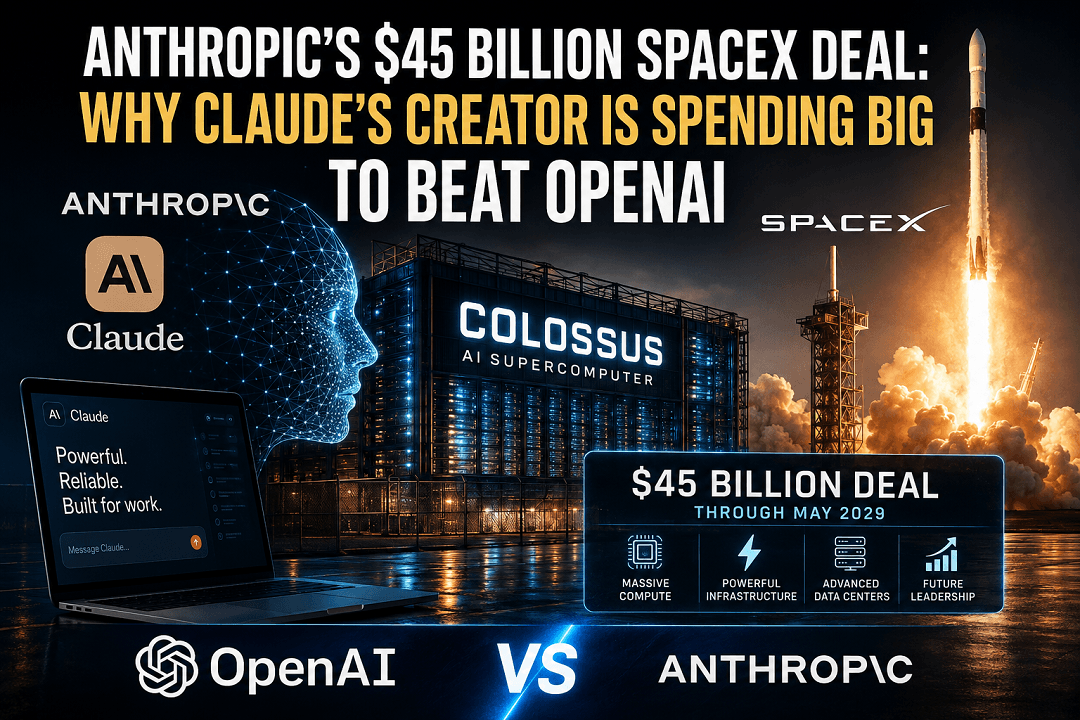
The artificial intelligence war is entering a new phase — and it is no longer just about building smarter chatbots.
In one of the most shocking developments in the AI industry so far, Anthropic, the company behind Claude AI, has reportedly agreed to spend around $45 billion on AI infrastructure connected to SpaceX’s massive “Colossus” computing facilities through 2029. The deal instantly became one of the largest known AI infrastructure agreements in history and highlighted a growing reality inside Silicon Valley: the future of AI may depend less on algorithms and more on who controls the world’s largest computing systems.
For years, the AI race focused mainly on model quality. Companies competed to create chatbots that could write better, reason faster, and understand human language more naturally. But as models become increasingly powerful, another factor has become even more important — compute power.
Today’s frontier AI systems require staggering amounts of hardware, electricity, cooling, and data-center capacity. Training a modern large language model can cost billions of dollars and consume enormous amounts of energy. In this environment, securing access to GPUs and AI infrastructure has become just as important as hiring top researchers.
Anthropic’s massive agreement with SpaceX signals that the AI war is transforming into an infrastructure arms race — and the company is willing to spend aggressively to challenge OpenAI’s dominance.
What Is Anthropic’s $45 Billion SpaceX Deal?
According to reports tied to SpaceX-related financial disclosures, Anthropic agreed to spend approximately $1.25 billion per month for access to large-scale AI computing infrastructure through May 2029. The total commitment could reach roughly $45 billion over the life of the contract.
The agreement reportedly gives Anthropic access to computing capacity at Colossus I and Colossus II, enormous AI-focused data-center facilities associated with Elon Musk’s expanding AI ecosystem. These facilities are designed to host massive clusters of advanced NVIDIA AI chips capable of training next-generation AI models at unprecedented scale.
Rather than simply buying software services, Anthropic is essentially purchasing industrial-scale computing power. That includes:
- GPU processing capacity
- AI training infrastructure
- High-performance networking systems
- Data-center resources
- Power and cooling systems
The sheer size of the deal stunned many industry observers because it demonstrates how expensive the frontier AI race has become. Spending billions annually on infrastructure would have sounded unimaginable just a few years ago. Today, it is becoming normal among top AI companies competing for leadership.
More importantly, the deal reflects a growing understanding within the industry:
AI companies that fail to secure enough compute capacity may fall behind permanently.
Who Is Anthropic and Why Is Claude Growing So Fast?
Anthropic was founded in 2021 by former OpenAI researchers, including CEO Dario Amodei and several colleagues who left OpenAI over concerns related to AI safety, governance, and long-term strategy.
The company quickly positioned itself as one of the strongest challengers to OpenAI. Its Claude AI models became especially popular among developers and enterprise customers because of their strong reasoning abilities, coding performance, and focus on safer AI behavior.
Over the past two years, Claude has evolved from a relatively unknown chatbot into one of the leading AI platforms in the world. Anthropic has secured major partnerships with companies such as Amazon and Google, while also attracting billions of dollars in investment funding.
The company’s growth has been extremely rapid. Reports suggest Anthropic is projecting enormous increases in revenue as businesses adopt AI tools for:
- Customer support
- Software development
- Enterprise automation
- Research assistance
- AI agents and workflows
This explosive demand creates a major challenge: Claude needs enormous amounts of computing power to keep improving and serving millions of users.
That is where the SpaceX infrastructure deal becomes critical.
Why AI Companies Are Desperate for Compute Power
One of the biggest misconceptions about AI is that the hardest part is writing the software.
In reality, the largest bottleneck today is hardware.
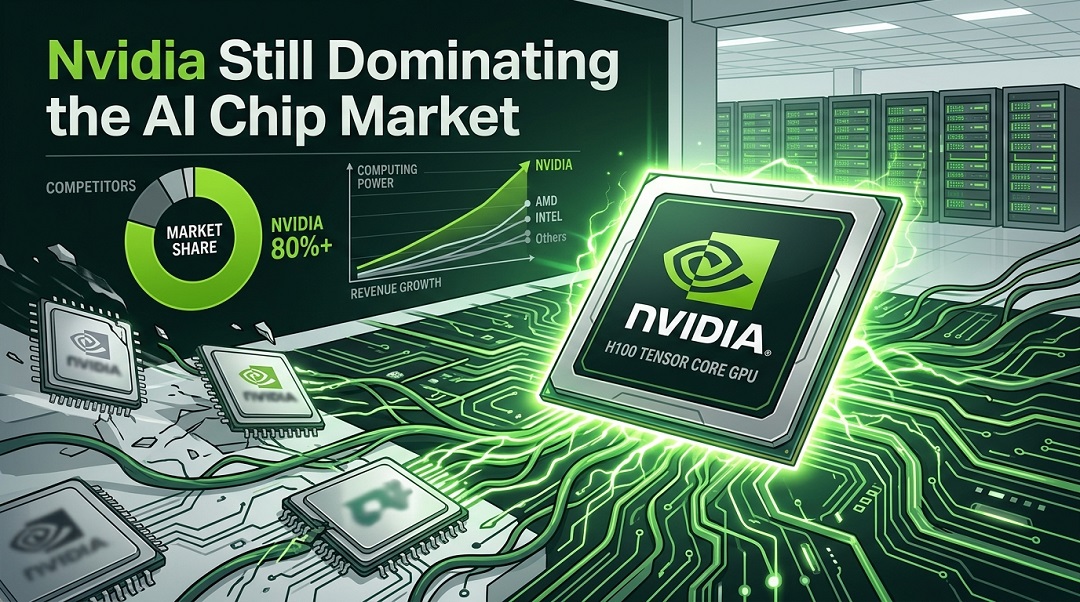
Training advanced AI systems requires huge numbers of specialized GPUs, particularly those made by NVIDIA. These chips are essential for handling the vast mathematical calculations involved in machine learning.
Modern AI models can require:
- Hundreds of thousands of GPUs
- Massive electricity consumption
- Sophisticated cooling systems
- High-speed networking infrastructure
- Continuous retraining operations
As a result, AI companies are now competing fiercely for access to compute capacity.
The problem is that advanced AI hardware remains limited in supply. NVIDIA’s most powerful AI chips are in extremely high demand, and building large data centers takes years. Even the world’s richest technology companies are struggling to secure enough infrastructure.
This scarcity has transformed compute into one of the most valuable assets in the technology industry.
Anthropic appears to believe that spending aggressively today is necessary to avoid falling behind tomorrow. If competitors gain a large compute advantage, they could potentially train more powerful models faster and dominate the market.
In other words, access to infrastructure may determine which AI companies survive.
How This Deal Helps Anthropic Compete With OpenAI
The rivalry between Anthropic and OpenAI is especially intense because the companies share common origins.
Several Anthropic founders previously worked at OpenAI before leaving to create a competing vision for AI development. Since then, the two companies have become major rivals in:
- Enterprise AI
- AI assistants
- Coding tools
- API platforms
- AI agents
Claude is increasingly viewed as one of the strongest alternatives to ChatGPT, especially among developers and businesses seeking advanced reasoning capabilities.
However, competing with OpenAI is incredibly expensive.
OpenAI benefits from major partnerships with Microsoft and access to vast cloud infrastructure resources. It has also been involved in massive AI infrastructure expansion projects designed to secure future compute capacity.
Anthropic’s SpaceX deal appears to be its answer to this challenge.
By locking in long-term access to powerful AI infrastructure, Anthropic gains several advantages:
- Faster training for future Claude models
- Ability to serve more enterprise customers
- Reduced risk of compute shortages
- Greater independence from competitors’ cloud systems
- Improved long-term scalability
The agreement also sends an important message to investors:
Anthropic is serious about becoming a permanent top-tier AI company.
Why SpaceX and Elon Musk Benefit From the Deal
The deal is not only important for Anthropic — it could also reshape the future of SpaceX and Elon Musk’s broader AI ambitions.
Traditionally known for rockets and satellites, SpaceX is increasingly connected to massive AI infrastructure projects through its expanding data-center ecosystem. The Colossus facilities are part of a larger trend in which technology companies are building gigantic AI supercomputing centers capable of supporting next-generation models.
For SpaceX, Anthropic’s agreement could create a major new source of long-term revenue.
AI infrastructure is becoming one of the fastest-growing businesses in the technology sector. Companies are willing to spend billions for guaranteed compute access, and providers capable of delivering that infrastructure may become extremely powerful.
There is also an ironic twist to the partnership.
Elon Musk’s own AI company, xAI, directly competes against Claude through its Grok chatbot platform. Yet SpaceX-linked infrastructure is still reportedly serving Anthropic.
This highlights how valuable AI compute has become. In the modern AI economy, infrastructure providers can profit even from companies competing against their own products.
Compute is becoming the oil of the AI age.
The Bigger Trend: AI Is Becoming an Infrastructure War
Anthropic’s agreement represents something much larger than a single business deal.
It reveals a major shift happening across the AI industry.
The early AI race focused primarily on:
- Better algorithms
- Smarter models
- Larger datasets
- Improved user experiences
Now the focus is increasingly shifting toward:
- Data centers
- Electricity supply
- GPU availability
- Semiconductor manufacturing
- Industrial-scale infrastructure
AI companies are beginning to resemble utility companies or industrial giants rather than traditional software startups.
The reason is simple:
Modern AI systems require physical resources at enormous scale.
Building frontier AI now depends on access to:
- Vast energy supplies
- Expensive chip manufacturing
- Global supply chains
- Large engineering operations
- Multi-billion-dollar financing
This trend favors companies with deep pockets and strong infrastructure partnerships.
As a result, the AI market may become increasingly concentrated among a handful of major players, including:
- OpenAI
- Anthropic
- Google DeepMind
- Meta
- xAI
Smaller startups may struggle to compete because the cost of training cutting-edge models continues to rise dramatically.
Risks and Concerns Around Massive AI Infrastructure Spending
Despite the excitement surrounding AI growth, these enormous infrastructure investments also carry major risks.
The first concern is financial sustainability.
Spending tens of billions of dollars on compute infrastructure only makes sense if AI companies can eventually generate enough revenue to justify the costs. Investors are betting that AI adoption will continue growing rapidly, but the long-term economics of the industry remain uncertain.
Environmental concerns are also becoming more serious.
Large AI data centers consume huge amounts of electricity and water. As companies expand their infrastructure globally, governments and environmental groups are increasingly questioning the sustainability of AI growth.
There are also geopolitical risks tied to semiconductor supply chains. Advanced AI chips rely on highly complex international manufacturing networks, and global tensions could disrupt future supply.
Finally, AI safety concerns continue to grow as models become more powerful. Critics argue that the rush to dominate the AI race may encourage companies to prioritize speed and scale over responsible development.
Conclusion
Anthropic’s reported $45 billion SpaceX infrastructure deal marks a turning point in the evolution of artificial intelligence.
The agreement shows that the AI race is no longer just about building the smartest chatbot. It is becoming a battle over who controls the world’s most powerful computing infrastructure.
For Anthropic, the deal represents a massive gamble that Claude can become a long-term rival to OpenAI and other industry giants. For SpaceX and Elon Musk’s broader ecosystem, it demonstrates how valuable AI infrastructure has become in the modern economy.
Most importantly, the partnership reveals a new reality about the future of AI:
The companies that dominate artificial intelligence may not simply be the ones with the best algorithms — but the ones capable of financing and controlling enormous industrial-scale computing systems.
In the AI era, compute power may become as important as intelligence itself.
FAQ
Why is Anthropic spending $45 billion?
Anthropic is reportedly spending around $45 billion to secure long-term access to AI computing infrastructure connected to SpaceX data centers. The company behind Claude AI needs enormous computing power to train future AI models, serve enterprise customers, and compete with major rivals like OpenAI. The deal highlights how critical GPUs, electricity, and AI infrastructure have become in the modern AI race.
What is the Colossus AI supercomputer?
Colossus is a massive AI-focused computing infrastructure project associated with Elon Musk’s expanding AI ecosystem. The facilities reportedly contain huge clusters of advanced NVIDIA GPUs designed for training frontier AI models. Anthropic’s agreement would give Claude access to large-scale compute resources capable of supporting next-generation artificial intelligence systems.
Is Anthropic competing with OpenAI?
Yes. Anthropic is widely considered one of OpenAI’s biggest competitors. The company was founded by former OpenAI researchers, including CEO Dario Amodei. Anthropic’s Claude AI models compete directly with ChatGPT in areas such as enterprise AI, coding assistants, reasoning capabilities, and AI agents.
Why do AI companies need so many GPUs?
Modern AI models require enormous amounts of mathematical processing power. GPUs, especially those produced by NVIDIA, are optimized for the parallel computations needed to train and run large language models. Advanced AI systems can require hundreds of thousands of GPUs working together across giant data centers.
What is AI compute infrastructure?
AI compute infrastructure refers to the physical systems needed to develop and operate artificial intelligence models. This includes:
- GPUs and AI chips
- Data centers
- Networking hardware
- Cooling systems
- Electricity supply
- Cloud computing platforms
As AI models become more advanced, compute infrastructure is becoming one of the most valuable assets in the technology industry.
Why are AI data centers so expensive?
AI data centers are extremely expensive because they require advanced hardware, massive energy supplies, cooling systems, and high-speed networking equipment. Building and operating large AI facilities can cost billions of dollars due to the price of GPUs, electricity consumption, land, maintenance, and infrastructure scaling. The rapid growth of AI has dramatically increased global demand for these specialized facilities.






Leave a Reply