
Last updated: May 21, 2026 | Reading time: 12 minutes
The Hidden Reason Your AI Agents Keep Breaking
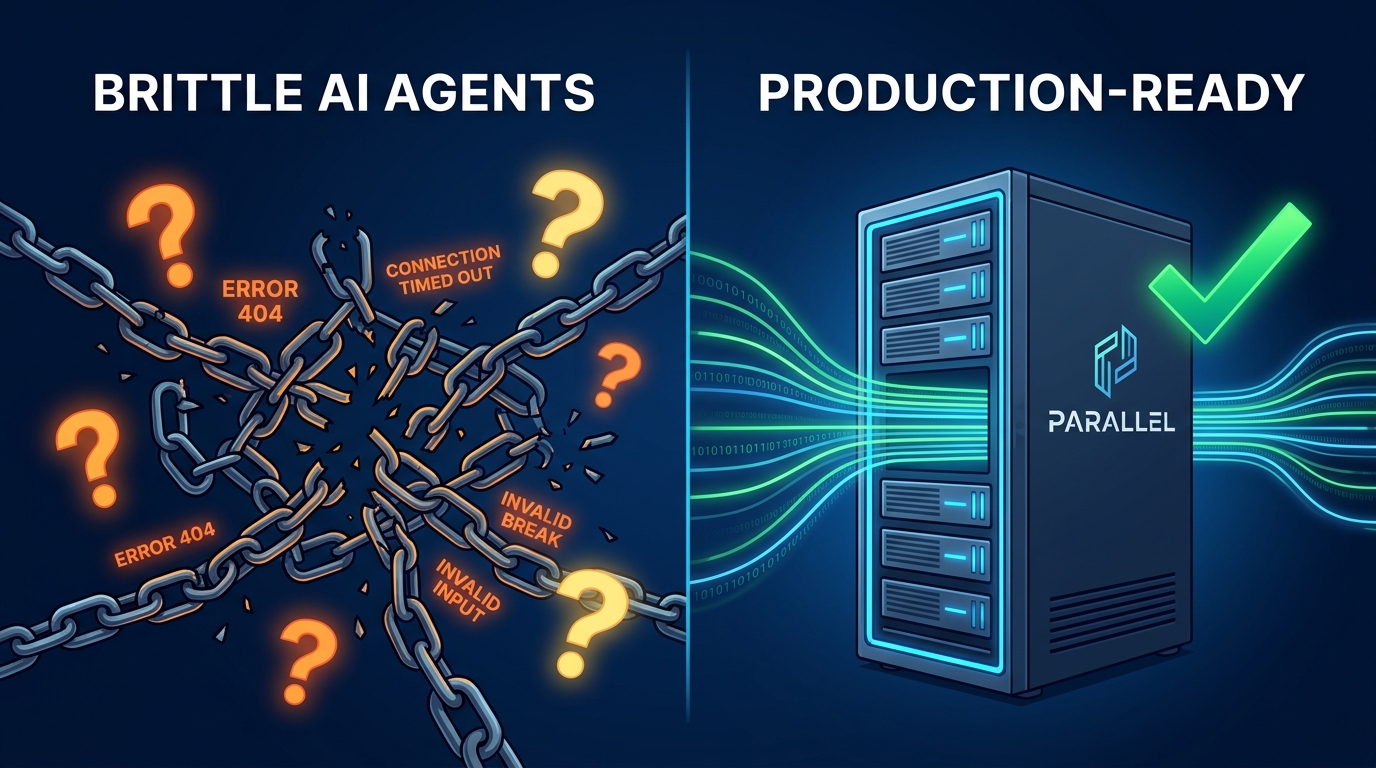
Building an AI agent is deceptively simple. In a demo, your agent can browse the web, extract data, and answer complex questions. But in production, it fails. Web pages change their structure. APIs return inconsistent data. The agent gets stuck in infinite loops or returns answers without citations. You fix one bug, and three new ones appear.
The problem is not the language model. The problem is infrastructure. The web was built for humans—designed to be clicked through, not called programmatically by AI. For an agent to function reliably at scale, it needs robust tools to search, retrieve, and structure live web data. It needs those tools to be fast, affordable, and, above all, dependable.
That is the gap a new class of startups is racing to fill. And one company is emerging as the clear leader.
Parallel Web Systems, founded by former Twitter CEO Parag Agrawal, is building the web infrastructure layer for AI agents. With over 230 million raised, a 2 billion valuation, and more than 100,000 developers using its products, Parallel is defining how enterprises move from brittle prototypes to scalable, production‑grade AI agents.
This article explains what Parallel does, why its approach is different, how companies are already using it, and why Parallel’s latest move—compensating publishers when AI agents use their content—could reshape the economics of the open web.
The Billion‑Dollar Problem Parallel Is Solving
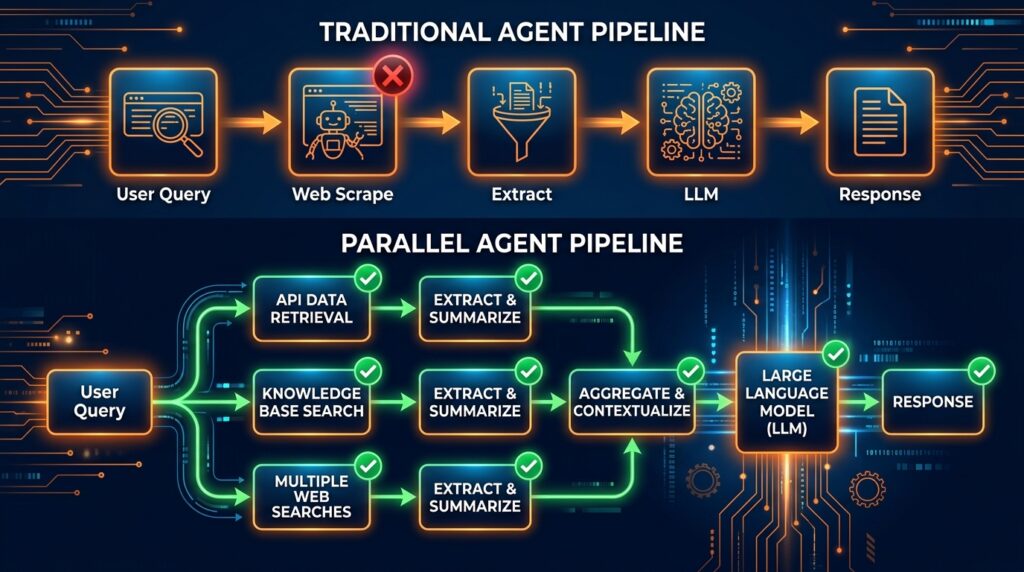
Most teams building AI agents start the same way: they pick a language model, chain together a few API calls, scrape a handful of web pages, write a prompt, and call it a day. The result is a brittle agent—one that works in a controlled demo but breaks the moment something changes.
Why Traditional Agent Building Fails
The web was not designed for machines. Websites are built with complex, nested HTML, ads, tracking scripts, and anti‑scraping mechanisms. A single CSS class name change can break an entire extraction pipeline. Rate limiting and IP blocking are common. And all of this happens without any visibility into why the agent stopped working.
For an agent to be reliable in production, it needs:
- Structured, token‑efficient access to web content—no extraneous HTML or tracking pixels
- Built‑in citation tracking, so every answer can be traced back to its source
- Parallel processing, so multi‑agent systems can run dozens of specialized agents simultaneously
- Continuous monitoring, to detect when relevant new information appears without polling the web constantly
Most teams try to build this infrastructure themselves. They waste months reinventing the wheel—only to discover that maintaining a production‑grade web pipeline is a full‑time job.
This is the gap Parallel fills.
Parallel’s Product Suite – Infrastructure Purpose‑Built for AI Agents
Parallel provides a suite of APIs designed specifically for AI agents. The company describes its mission as building “infrastructure for the web’s second user” —AI systems that rely on live internet data rather than static training data alone.
When we started the company, the prevailing view was that large language models would make the web obsolete. We believed the opposite: AIs would use the web far more than humans ever have.— Parallel on its website
The Core APIs
Parallel’s product suite includes five primary APIs, each solving a distinct part of the web access problem:
| API | Purpose | Key Feature |
|---|---|---|
| Search API | Token‑efficient web search | Returns ranked results with excerpts, no extraneous HTML |
| Extract API | Document parsing | Pulls clean text, images, and metadata from any URL |
| Task API | Deep, multi‑source research | Handles the full research pipeline—search, retrieval, ranking, compression—and returns structured outputs with citations |
| FindAll API | Entity discovery across the web | Finds all mentions of a person, company, or topic |
| Monitor API | Passive web monitoring | “A web search that’s always on”—agents get notified when new relevant information appears, without constant polling |
The Task API is particularly notable. It has been benchmarked against other providers and eliminates the need to build a pipeline that includes reasoning, search, retrieval, ranking, compression, and MCP tool call configuration. Instead of stitching together multiple services, developers get an end‑to‑end research engine with one API call.
The Monitor API, released in early 2026, represents a fundamental shift from pull to push. Instead of triggering a request with a query, agents can now passively watch for changes on the web. When a competitor launches a product or a regulatory filing appears, the agent is notified automatically—turning AI systems from reactive assistants into proactive intelligence engines.
Who’s Using Parallel – Real‑World Enterprise Adoption
Parallel’s customers range from AI‑native startups to Fortune 100 enterprises. The company’s API suite is already powering production‑grade agents in legal research, sales automation, property intelligence, and financial risk analysis.
Named Customers
Parallel’s publicly disclosed customers include:
| Customer | Industry | Use Case |
|---|---|---|
| Clay | AI‑powered prospecting | Claygent (its autonomous research agent) uses Parallel for web intelligence |
| Harvey | Legal AI | Blends internal data with live web context for complex legal reasoning |
| Sourcegraph | Code intelligence | Uses Parallel for research and knowledge automation |
| Notion | Productivity | Integrates Parallel for web‑powered AI features |
| Opendoor | Real estate | Uses Parallel for property research and market intelligence |
| Genpact | Professional services | Automates insurance claims processing (55% touchless) |
| Actively | Sales intelligence | Built AI agents that scan the web for buying signals, achieving 23% higher win rates |
Parallel also serves banks and hedge funds, though those customers have not been publicly named. In total, over 100,000 developers are currently using Parallel’s products.
The Genpact Case Study
Genpact, a global professional services firm, uses Parallel’s Task API to replace manual investigation and static tools with Meeting Assist—an automated, real‑time, account‑based AI system composed of multiple agents for intelligence on accounts, financials, competitors, decision makers, and buying centers. The result: 55% touchless processing for property contents claims.
The Actively Case Study
Actively builds per‑account AI agents that continuously scan the web for buying signals. CEO Mihir Garimella said: “Parallel has become core infrastructure for how we build and scale our agents.” Using Parallel, Actively helps sales reps achieve 23% higher win rates and 25% higher revenue per rep.
These case studies reveal a pattern: Parallel’s customers are not experimenting; they are running production agents at scale—in legal, finance, insurance, and sales.
Funding and Traction – Why Investors Are Betting Billions
Parallel’s rapid valuation growth reflects market confidence that reliable web infrastructure is the missing link in enterprise AI deployment.
The Series B was notable for several reasons. First, it valued Parallel at 2 billion just five months after its 740 million Series A, a staggering increase. Second, it was led by Sequoia, one of the most prestigious venture firms in the world. Third, all existing investors—Kleiner Perkins, Index Ventures, Khosla Ventures, First Round Capital, Spark Capital, and Terrain Capital—participated, signaling strong confidence from the company’s early backers.
The rapid valuation growth is even more striking given the legal turmoil that followed the end of Agrawal’s tenure at Twitter. After Elon Musk acquired Twitter, Agrawal and other top executives were fired. They sued, alleging that Musk failed to pay $128 million in severance they were owed. In October 2025, Musk settled the case for undisclosed terms. The strong investor confidence in Parallel represents a notable comeback for Agrawal.
Index – The “AdSense for the Agentic Web”
The web’s old economic model is failing in the age of AI agents. Traditionally, search engines indexed content for free, then sent human readers back to publishers, who monetized through ads and subscriptions. AI agents don’t work that way. They read the page, answer the question, and the human never arrives.
Seventy‑nine percent of major news sites now block at least one AI crawler. The licensing deals that do exist are flat fees, negotiated bilaterally, available only to content owners with the scale to get a meeting. That model leaves most publishers and creators out.
Parallel’s answer is Index, a platform launched in May 2026 to measure and compensate how AI agents use third‑party content. It uses Shapley value—a game theory concept—to estimate how much each source contributed to an AI agent’s completed task.
Instead of paying only for content access or citations, Index ties compensation to the actual value a source provided. A source that is unique, hard to replace, or used in high‑value agent work earns more.
How Index Works
| Step | Description |
|---|---|
| 1. Visibility | Any site owner can enter their domain at index.parallel.ai to see how Parallel’s agents are using their content—which queries it’s answering, how often it’s referenced, and how unique its contribution is. |
| 2. Value estimation | Compensation is calculated using Shapley value, measuring each source’s marginal contribution to the work an agent performs at the moment of inference. |
| 3. Automated payments | Participating publishers earn based on that contribution. The system first applies to AI agents using Parallel’s own tools, but is designed to work with agents built outside Parallel as well. |
Launch Partners
Index launched with a diverse set of partners across the web ecosystem:
- Publishers and distributors: The Atlantic, Fortune, PR Newswire
- Business and data intelligence providers: PitchBook, Enigma, RocketReach, ZoomInfo
- Independent creators: Alex Heath’s Sources, Packy McCormick’s Not Boring, Mario Gabriele’s The Generalist
Nicholas Thompson, CEO of The Atlantic, said: “AI agents are becoming the next major interface for accessing information, but the economics of the web have not caught up with that reality. Parallel is tackling this by creating a dynamic and scalable model for recognizing and compensating publishers.”
Why Index Is Different
OpenAI and other AI labs have signed fixed‑fee licensing deals with major publishers—the Associated Press, Axel Springer, News Corp. But Agrawal argues that model will not work for the AI agent age:
“If only a few large companies have access to the premium content and no one else does, how will anyone compete?”
Index is designed to be open, transparent, and scalable. Any publisher can join. Compensation is tied to value, not access. And the platform is intended to work across the entire AI agent ecosystem, not just Parallel’s tools.
Parallel vs. Competitors – Why It Matters
Parallel is part of a larger trend: the shift from single‑threaded AI assistance to orchestrated, multi‑agent workflows as the new enterprise baseline. Gartner predicts that by the end of 2026, 40% of enterprise applications will feature task‑specific AI agents—up from less than 5% in 2025.
But 40% of those agent projects will fail by 2027, often due to unreliable data access and integration challenges. That creates an urgent need for orchestration layers.
The Competitive Landscape
| Player | Approach | Parallel’s Differentiator |
|---|---|---|
| IBM watsonx Orchestrate | Full‑stack enterprise automation | Parallel focuses on web infrastructure, not full‑stack apps |
| Google Agent Development Platform | Vertex AI Agent Builder, Agentspace | Parallel is model‑agnostic—works with any LLM |
| Microsoft Copilot | Integrated into Office and Windows | Parallel specializes in web access, not productivity |
| LangGraph / CrewAI | Open‑source agent frameworks | Parallel provides production‑grade infrastructure, not frameworks |
Parallel occupies a distinct niche: it is the agent‑optimized web infrastructure layer, not a full‑stack application platform. It partners with existing enterprise systems rather than trying to replace them. This focus allows Parallel to solve the hardest problem in production AI—reliable, structured access to live web data—better than any general‑purpose platform.
The Future – What’s Next for Parallel
Parallel’s product roadmap is aggressive. The company plans to use its latest funding to build out a sales and marketing team, as well as grow its research and development function.
In the near term, expect:
- Expansion of Index to cover more categories of content, with self‑serve participation for any publisher
- Integration with more agent frameworks, so Parallel’s infrastructure works seamlessly with LangGraph, CrewAI, AutoGen, and others
- Geographic expansion, as enterprises outside the US seek reliable web infrastructure for their agents
Longer term, Index could evolve into the AdSense for the agentic web—a standard compensation mechanism that sustains the open web in an era where AI agents, not humans, are the primary consumers of content.
Frequently Asked Questions (FAQ)
Q1: Is Parallel a search engine?
A: Not in the traditional sense. Parallel does not serve ads or rank results for human users. Its APIs are designed exclusively for AI agents to access structured web data programmatically.
Q2: How does Parallel differ from a web scraper?
A: Web scrapers are brittle and require constant maintenance. Parallel’s APIs are purpose‑built for agents: they handle rate limiting, caching, structured output, and citations automatically.
Q3: Can I use Parallel with any language model?
A: Yes. Parallel is model‑agnostic. Its APIs can be used with GPT, Claude, Gemini, Llama, or any other LLM.
Q4: What is Shapley value, and why does Parallel use it?
A: Shapley value is a game theory concept for estimating how much each participant contributes to a collective outcome. Parallel uses it to determine fair compensation for publishers whose content contributed to an agent’s completed task.
Q5: Who are Parallel’s main competitors?
A: Parallel competes with in‑house web scraping pipelines, other web API providers, and some components of agent orchestration platforms. Its unique differentiator is its focus on production‑grade web infrastructure specifically for agents.
Q6: Is Index open to publishers outside the US?
A: Yes. Any site owner can enter their domain at index.parallel.ai to see how agents are using their content, regardless of location.
Q7: How does this connect to your articles on Perplexity and Apple’s iOS 27 AI features?
A: Directly. The shift to AI agents—whether in search engines like Perplexity, on‑device agents in iOS 27, or enterprise agents—requires exactly the kind of reliable web infrastructure that Parallel is building. Parallel is the plumbing that makes agentic computing possible.
Q8: How can a developer get started?
A: Visit parallel.ai to sign up for API access. The company offers a free tier and extensive documentation.
Conclusion – The Plumbing for the Agentic Web
The shift to AI agents is inevitable. By the end of 2026, nearly half of all enterprises will have deployed task‑specific agents. But those agents will only succeed if they have reliable access to the live web.
Parallel has identified and solved the hardest problem in production AI: giving agents structured, dependable access to the world’s largest unstructured dataset. Its APIs are already powering production‑grade agents in legal, finance, insurance, and sales. Its Index platform is building the economic infrastructure for the agentic web.
For enterprises looking to move beyond demos and into production, Parallel may well be the most important infrastructure company you have never heard of—yet.
References & Further Reading
- TechCrunch – “Parallel Web Systems hits $2B valuation five months after its last big raise” (April 29, 2026)
- IndexBox – “Parallel Web Systems Raises 100MSeriesBLedbySequoia,ValuationHits2B” (April 30, 2026)
- Fortune – “Parag Agrawal’s AI startup wants to pay publishers when AI agents use their work” (May 19, 2026)
- Parallel official blog – “Introducing Index by Parallel” (May 19, 2026)
- Parallel official website – Product APIs and documentation
- Startuprise – “Parallel Web Systems Raises $100M in Series A Funding” (November 2025)
- BW Businessworld – “Parag Agrawal‑founded Parallel Web Systems Secures $100 Mn In Series A Funding” (November 2025)
- Business Standard India – “Ex‑Twitter CEO Parag Agrawal’s AI startup hits $2B valuation” (April 30, 2026)
- Edgen – “前推特 CEO 旗下 AI 初创公司估值达 20 亿美元” (April 29, 2026)







Leave a Reply