
The $53 Billion Question
For decades, Alibaba was known as China’s e‑commerce giant — the company that built Taobao and Tmall, revolutionized online shopping, and created a payments empire. But something fundamental has shifted inside the Hangzhou headquarters.
Alibaba is no longer just an e‑commerce company that does cloud computing on the side. It is transforming into an AI-first infrastructure powerhouse, and it is spending an almost unimaginable amount of money to get there.
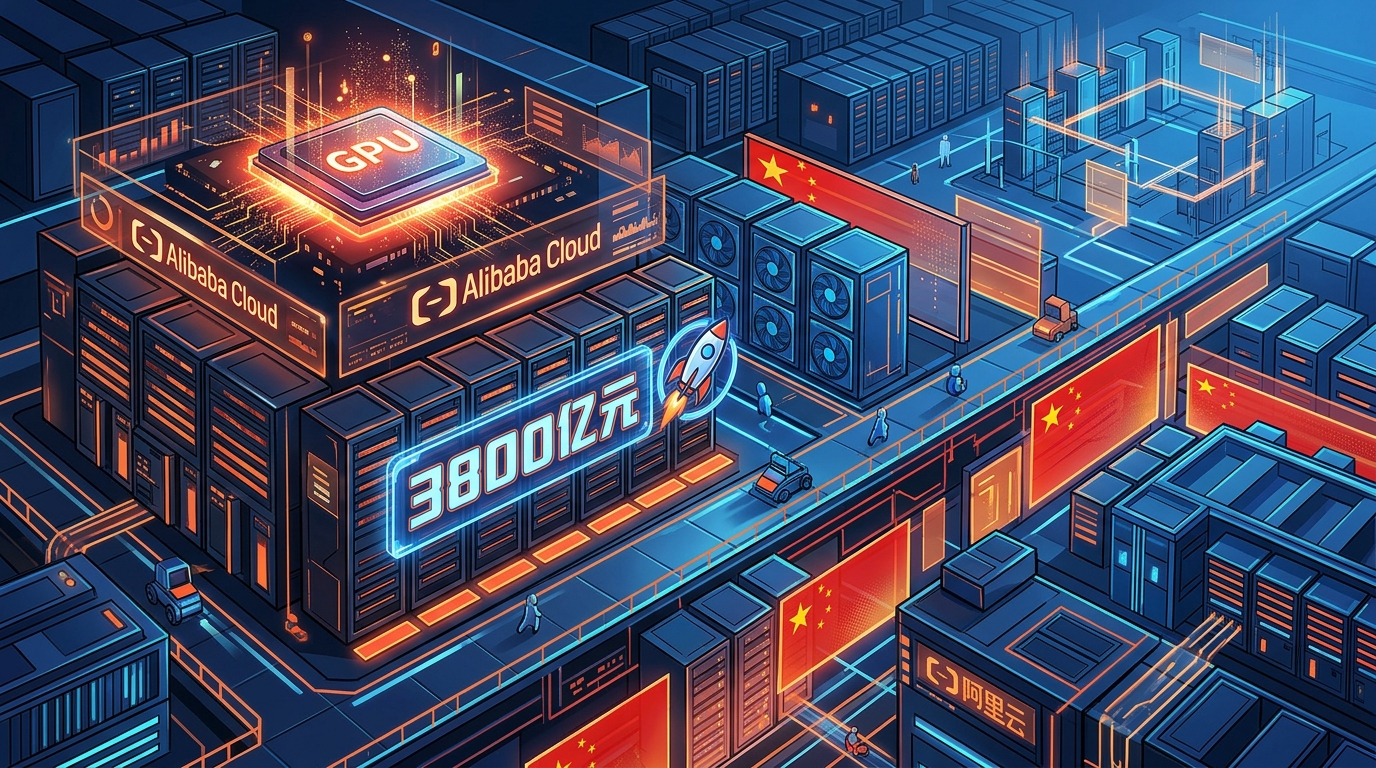
The company has pledged to invest well over 380 billion yuan (approximately 53 billion) over three years on cloud and artificial intelligence infrastructure—its largest-ever commitment to the sector, surpassing its total cloud and AI investments from the entire previous decade combined. CEO Eddie Wu has already indicated that capital expenditures will exceed the original 380 billion yuan figure, with some reports suggesting the final number could reach as high as 480 billion yuan (69 billion).
Why is Alibaba taking such a massive financial bet? And what does this spending spree reveal about the broader AI arms race reshaping the global technology landscape?
This article explains the strategic urgency behind Alibaba’s unprecedented investment, the physical constraints driving it, the economic logic that justifies the spending, and what it means for the future of AI in China and beyond.
Every Single GPU Is Running – The Capacity Crisis
The most immediate reason for Alibaba’s spending spree is stark: it has run out of compute capacity.
In a recent earnings call, CEO Wu Yongming made a striking admission: “I can tell you, every single card on our servers is running. Not a single card is idle.” He added that customer demand cannot be fully met, that “the queue is long,” and that model prices are likely to rise in the future.
This is not a marketing exaggeration. China’s token consumption — the fundamental unit of AI model usage — has exploded. According to data from China’s National Data Bureau, daily token demand surged from 100 billion in early 2024 to 140 trillion by March 2026 — a 1400‑fold increase in just over two years. China now accounts for 36% of global token consumption, surpassing the United States for three consecutive weeks.
Every major Chinese AI provider is feeling the squeeze. ByteDance’s Doubao model has become so overloaded that the company slashed free-tier access, reducing daily usage quotas and even canceling free video generation services for most users. Alibaba’s own Bailian MaaS platform is equally stretched, with customer numbers growing eightfold year-over-year and API token usage exploding.
This is not a problem of insufficient demand. It is a problem of insufficient supply. And supply cannot be turned on overnight.
Where the $53 Billion Is Actually Going
Alibaba’s investment is not a vague “digital transformation” slush fund. It is targeted at specific physical assets that will expand the company’s AI computing footprint.
AI Data Centers (The Largest Share)
The majority of the funding will go toward building new intelligent computing data centers (AIDCs) — facilities specifically designed for AI workloads, which are far more power‑intensive and cooling‑demanding than traditional server farms. Wu has stated that the scale of data centers Alibaba plans to build represents a tenfold increase compared to 2022 levels.
Notably, Alibaba has already been forced to get creative in meeting demand. According to industry reports, the company resorted to purchasing large quantities of consumer-grade graphics cards like the RTX 4090 to build inference clusters and supplement throughput — a workaround that highlights the severity of the supply shortage.
Self‑Developed AI Chips (Reducing Nvidia Dependence)
A second major spending category is Alibaba’s in‑house chip development, led by its semiconductor design subsidiary, T‑Head. On May 20, 2026, Alibaba unveiled its latest AI processor, the Zhenwu M890, which delivers three times the performance of its predecessor and is purpose‑built for AI “agents” — systems capable of carrying out complex, multi‑step tasks with minimal human oversight.
T‑Head has already shipped more than 560,000 Zhenwu units to over 400 external customers across 20 industries, including automakers and financial services firms. Moreover, T‑Head’s chips have also been deployed internally, powering Alibaba Cloud’s own operations. Over 60% of the company’s self-developed GPU compute capacity is already serving external commercial customers.
Alibaba has also outlined an aggressive multi‑year chip roadmap: the V900 is slated for the third quarter of 2027, with another threefold performance gain, followed by the J900 in the third quarter of 2028, establishing a sustained cadence of in‑house silicon upgrades.
Server Systems and Rack‑Scale Infrastructure
Alibaba also unveiled the Panjiu AL128 Supernode Server, a rack that packs 128 of the Zhenwu accelerators into a single unit, available immediately to Chinese enterprise customers through Alibaba Cloud’s Bailian platform. The move is designed to shorten the gap between ordering hardware and running AI workloads, lowering the barrier for domestic enterprises.
Why Now? The Convergence of Constraints
Several forces have converged to make this the moment for Alibaba to go all‑in.
1. The US Export Control Wall
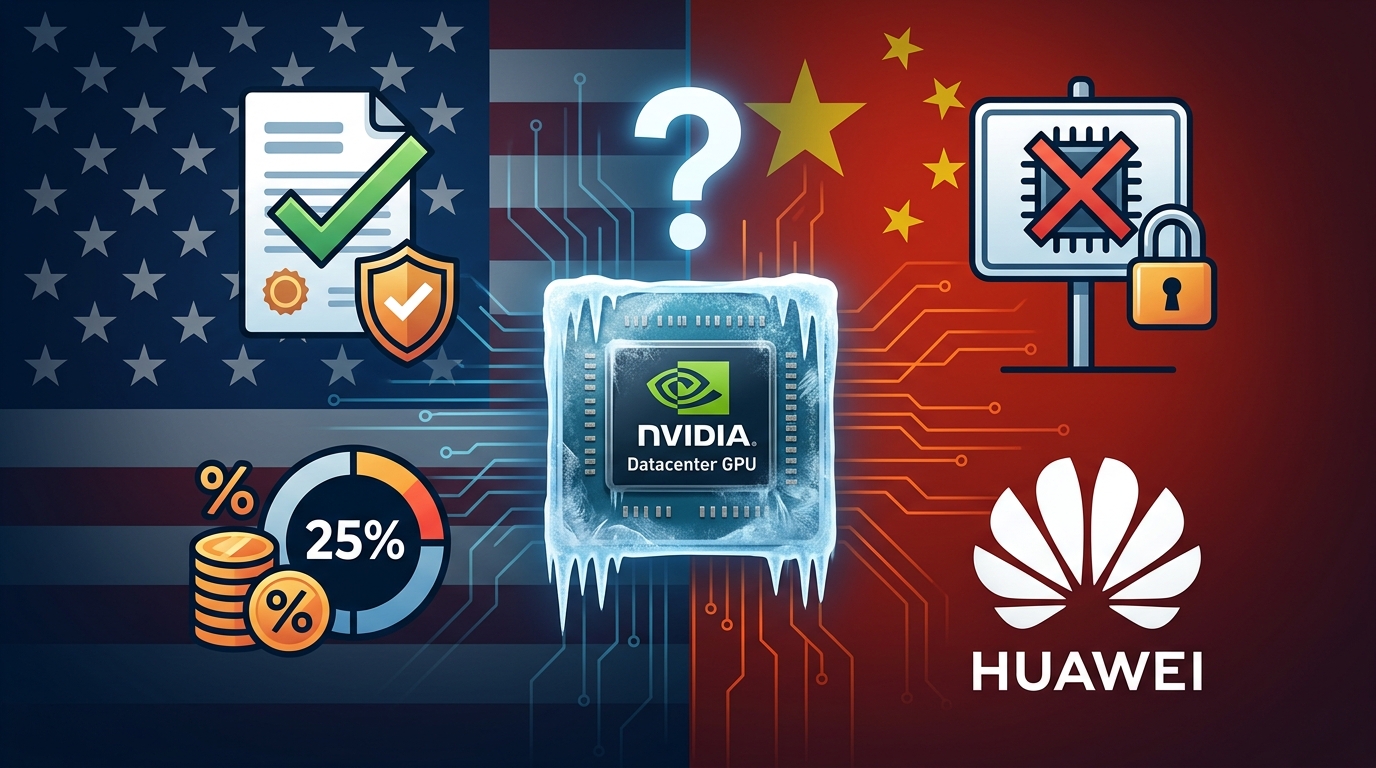
Since 2022, Washington has progressively tightened restrictions on China’s access to advanced AI chips from Nvidia and AMD. While some Chinese firms (including Alibaba) have received case‑by‑case approvals to purchase limited quantities of Nvidia H200 chips, actual deliveries remain stalled amid ongoing regulatory disputes.
This uncertainty has forced Alibaba to accelerate its domestic alternatives. The Zhenwu chip family is not merely a backup; it is a strategic necessity. And the threat of future restrictions is only intensifying, with the US recently issuing new rules dividing countries into three tiers for AI chip exports, placing China in the most restricted category.
2. The Agentic AI Wave
Alibaba’s chip and model announcements are specifically timed to the rise of agentic AI — autonomous software that can plan, act, and adapt across multiple steps. Both the Zhenwu M890 and the new Qwen 3.7‑Max model are optimized for this emerging workload.
Unlike simple chatbots, agentic AI requires massive memory bandwidth, real‑time coordination between models, and sustained performance over long‑running tasks. Qwen 3.7‑Max, for example, demonstrated the ability to operate continuously for 35 hours without performance degradation, using external software tools more than 1,000 times to complete a single assigned task.
This is the next frontier of enterprise AI, and Alibaba is positioning itself to own the infrastructure that powers it.
3. The “Sovereign AI” Push from Beijing
Behind Alibaba’s investment is a concerted national strategy. Beijing has made technology self‑sufficiency a core priority, and AI chips sit at the top of the list. The “parallel purchase” policy — which encourages or mandates that for every Western chip imported, a domestic equivalent be deployed — has created a captive market for local alternatives.
Alibaba is not just building chips for its own cloud; it is participating in a national project to reduce China’s dependence on foreign semiconductor supply. The timing of its May 20 chip announcement, just hours before Nvidia’s earnings report, was either coincidence or a deliberate signal: the era of uncontested Nvidia dominance may be ending.
The ROI Calculus – Why Alibaba Believes It Will Pay Off
Alibaba is spending billions in an environment of compressed profits. In its most recent quarter, the company’s adjusted EBITA fell 84.4% year‑over‑year, largely due to increased AI investment and aggressive marketing of its Qwen app.
So why is management confident that this will work?
The “No Idle Card” Certainty
Wu’s core argument is straightforward: demand is so enormous that every new server Alibaba installs will be fully utilized from day one. “Based on demand conditions over the next three to five years,” he told analysts, “the return on investment from the AI data centers we’re building is very certain.”
This is not speculative. Alibaba’s AI‑related product revenue has grown for eleven consecutive quarters at triple‑digit percentages. In the most recent quarter, AI revenue reached 8.97 billion yuan ($1.24 billion), accounting for 30% of Alibaba Cloud’s external revenue for the first time.
The company projects that AI model and application services will generate an annual recurring revenue run rate of 30 billion yuan ($4.2 billion) by the end of 2026, and that AI product revenue will surpass traditional cloud compute as Alibaba Cloud’s largest revenue line within approximately one year.
The MaaS (Model‑as‑a‑Service) Economics
Traditional cloud computing sells generic computing, storage, and networking. Alibaba’s AI services — delivered through its Bailian MaaS platform — sell model inference. And the margins are structurally higher.
Traditional SaaS services often struggle with limited enterprise willingness to pay. But MaaS is different. “As long as the value created by completing the task within the enterprise is greater than the token cost,” Wu argued, “then the demand for API tokens will be unlimited.”
Put simply, businesses will pay for AI if AI saves them money. And for an increasing range of tasks, it does.
The Rising Cost of Hardware as a Moat
Wu also noted that server replacement costs have risen by more than 100% compared to two years ago. This means that Alibaba’s existing installed base of compute capacity is becoming more valuable over time, not less. New entrants face higher barriers to building comparable capacity, giving incumbents like Alibaba a structural advantage.
The China AI Arms Race – Alibaba vs. The Field
Alibaba is not spending in a vacuum. Every major Chinese tech firm is also racing to build AI capacity.
ByteDance: The Aggressive Challenger
ByteDance (TikTok’s parent) has raised its 2026 AI infrastructure budget to over 200 billion yuan (28billion),a255 billion worth of domestic compute products. ByteDance’s Doubao App had 345 million monthly active users in the first quarter of 2026 and consumes over 120 trillion tokens daily — more than any other Chinese provider.
Tencent: The Cautious Competitor
Tencent is taking a more measured approach. Its capital expenditure increased 63% in the first quarter to 31.9 billion yuan, and Goldman Sachs projects that its annual spending could reach 165 billion yuan by 2027 — more than double 2025 levels. But Tencent has prioritized profitability over market share, with a slower pace of data center construction.
Alibaba’s Lead According to Analysts
Despite the competition, a May 2026 Morgan Stanley survey of 60 Chinese CIOs found that Alibaba is perceived as the biggest winner in the country’s AI race. The proportion of CIOs selecting Alibaba for AI deployment rose from 32% to 41%, while ByteDance trailed at 27%. DeepSeek’s momentum, conversely, has slowed sharply.
“With its full‑stack AI capabilities, Alibaba is poised to become the major winner in China’s AI landscape,” the Morgan Stanley analysts wrote.
Alibaba already holds a 32.8% market share of China’s cloud infrastructure market (Gartner data), and its “cloud + AI” integration — with 70% of API call customers also using its GPU compute — creates a powerful lock‑in effect.
How This Compares to the US AI Arms Race
Alibaba’s $53 billion three‑year commitment is not an isolated phenomenon. It is part of a global capital expenditure supercycle.
TrendForce reported in May 2026 that nine major cloud providers — Alphabet (Google), AWS, Meta, Microsoft, Oracle, ByteDance, Tencent, Alibaba, and Baidu — have collectively revised their 2026 capital expenditure estimates upward to approximately $830 billion, representing a 79% increase year‑over‑year.
The drivers are the same on both sides of the Pacific: skyrocketing AI demand, hardware component price inflation, and the urgent need to build new data center capacity.
| Company / Group | Key Commitment | Timeframe |
|---|---|---|
| Alibaba | 53B+(increasingtopossibly69B) | 2026–2028 |
| Microsoft | ~190Btotalbudget(with25B for component price increases) | 2026 |
| ByteDance | $28B (2026 only) | 2026 |
| Nine cloud providers (total) | ~$830B (collectively) | 2026 |
| Nine cloud providers (YoY growth) | +79% | 2026 |
The spending is staggering. But China’s investments face an extra headwind: restricted access to the most advanced Western chips. Alibaba is thus forced to spend more on domestic alternatives, which still lag in raw performance, or to divert capital to workarounds like consumer‑grade cards.
This tension, in turn, creates a structural disadvantage: S&P Global estimates that while China’s cloud giants are spending heavily, their investment returns will be lower and slower than those of US peers, due to the “lower availability of advanced chips.”
The Risks – What Could Go Wrong?
Alibaba’s $53 billion bet is not risk‑free.
Short‑Term Profitability Pressure
The company’s adjusted EBITA fell 84.4% year‑over‑year in the most recent quarter, directly due to increased AI spending. While management argues that this is a strategic investment, public markets may grow impatient if profitability does not recover within a reasonable timeframe.
The Hardware Risk
If the domestic AI chip ecosystem fails to keep pace with Western innovation — or if Chinese firms remain unable to access leading‑edge semiconductor fabrication equipment — Alibaba may find itself with expensive data center capacity running sub‑optimally efficient chips.
The Demand Elasticity Question
Wu’s argument that “token demand will be unlimited as long as value exceeds cost” rests on an assumption that cost structures will remain favorable. If inference costs rise substantially — due to power, cooling, or hardware scarcity — the value proposition may narrow.
The Regulatory Overhang
China’s tech industry has faced unpredictable regulatory crackdowns in the past. A shift in government policy around AI deployment, data sovereignty, or cross‑border computing could alter the demand landscape overnight.
Frequently Asked Questions (FAQ)
Q1: Is 53 billion Alibaba’s total AI spending?
A: No. The 53 billion (380 billion yuan) is the minimum committed over three years. CEO Wu has indicated that actual capital expenditures will exceed this amount. Some reports suggest the final figure could reach 480 billion yuan ($69 billion). Additionally, Alibaba has already spent approximately 120 billion yuan in the first year of the cycle.
Q2: How is Alibaba funding this massive investment?
A: Through a combination of operating cash flow, bond offerings, and strategic financial moves. Alibaba raised 3.2 billion through zero‑coupon convertible bonds in September 2025 and an additional 1.53 billion exchangeable bond offering in July 2025.
Q3: How does this compare to Alibaba’s past investments?
A: The 380 billion yuan commitment over 2026–2028 exceeds Alibaba’s total cloud and AI investments from the previous decade (2015–2025) combined.
Q4: Will Alibaba’s AI chips be sold to external customers?
A: They already are. T‑Head has shipped over 560,000 Zhenwu units to more than 400 external customers across 20 industries, including automakers and financial services firms. Alibaba Cloud also makes the compute capacity available through its Bailian platform.
Q5: What is the “parallel purchase” policy?
A: A Chinese government policy encouraging that for every advanced Western chip imported, a domestic equivalent must also be deployed. This creates a captive market for domestic chipmakers.
Q6: When will Alibaba’s AI chip roadmap deliver its next major upgrade?
A: The V900 is scheduled for Q3 2027, with a roughly threefold performance improvement over the M890. The J900 is scheduled for Q3 2028.
Q7: Is Alibaba abandoning Nvidia entirely?
A: No. Alibaba has received US approval to purchase Nvidia H200 chips, though actual shipments remain stalled. The company continues to use Nvidia hardware where available, but is systematically building domestic alternatives to reduce dependency.
Q8: What is the difference between Alibaba’s approach and Western cloud providers?
A: Western providers (AWS, Azure, GCP) can purchase the most advanced Nvidia chips freely. Chinese providers cannot. This forces Alibaba to spend more on domestic alternatives — which still lag in raw performance — or on workarounds like consumer‑grade cards. The result is lower investment efficiency, at least in the near term. However, if domestic chips catch up, Chinese providers could eventually emerge with a more self‑sufficient and geopolitically resilient stack.
Q9: How does this connect to your article on Alibaba’s new AI chip?
A: Directly. The Zhenwu M890 chip unveiled on May 20, 2026, is the hardware foundation for Alibaba’s infrastructure spending. The $53 billion investment creates the data centers and server systems that deploy these chips at scale.
Q10: What does “AIDC” stand for?
A: Intelligent Computing Data Center — a facility designed specifically for AI workloads, with higher power density, advanced cooling, and specialized networking. Traditional data centers are not designed to handle the demands of large‑scale AI training and inference.
Conclusion – The Biggest Bet in Alibaba’s History
Alibaba is not spending 53 billion because it wants to. It is spending 53 billion because it has to.
The demand for AI compute in China has exploded beyond all projections, and Alibaba’s existing capacity is saturated. Every GPU is running, every server is full, and customers are waiting in line. At the same time, US export controls have made access to Western chips uncertain and unreliable.
The only way forward is to build — to construct a domestic AI infrastructure stack from the ground up, encompassing chips, servers, data centers, and the software platforms that run on them.
Alibaba is betting that this investment will transform it from an e‑commerce and cloud company into the AI infrastructure backbone of China. The risks are real: profitability pressure, hardware performance gaps, regulatory uncertainty. But the alternative — standing still while ByteDance and Tencent race ahead — is not an option.
The AI arms race is not just about who builds the best model. It is about who controls the physical infrastructure that runs those models. And Alibaba has just placed the largest bet in its history on being that infrastructure provider.
References & Further Reading
- Reuters – “Alibaba unveils new AI chip in push for domestic alternatives” (May 20, 2026)
- Reuters – “Is Alibaba’s new AI chip timed to steal Nvidia’s thunder?” (May 20, 2026)
- Finimize – “Alibaba Unveils A New AI Chip To Power ‘Agent’ Software” (May 20, 2026)
- Mobile World Live – “Alibaba bolsters AI play with fresh chip, LLM” (May 20, 2026)
- Data Center Dynamics – “Alibaba considers increasing AI data center capex spend to $69bn” (Feb 2026)
- Edgen – “Alibaba to spend 380 billion yuan on AI data centers amid server crunch” (May 15, 2026)
- 163.com – “AI revenue hits triple-digit growth for 11 straight quarters” (May 13, 2026)
- 智通财经 – “No card is idle: Alibaba CEO on AI capacity” (May 14, 2026)
- TrendForce – “Nine cloud providers raise 2026 capex to ~$830 billion” (May 6, 2026)
- Morgan Stanley – AlphaWise China CIO Survey 2026 (May 4, 2026)
- S&P Global – “China cloud capex to exceed 260B yuan by 2027” (May 19, 2026)
- 经济日报 – “ByteDance raises 2026 AI budget to over 200B yuan” (May 11, 2026)



Leave a Reply