
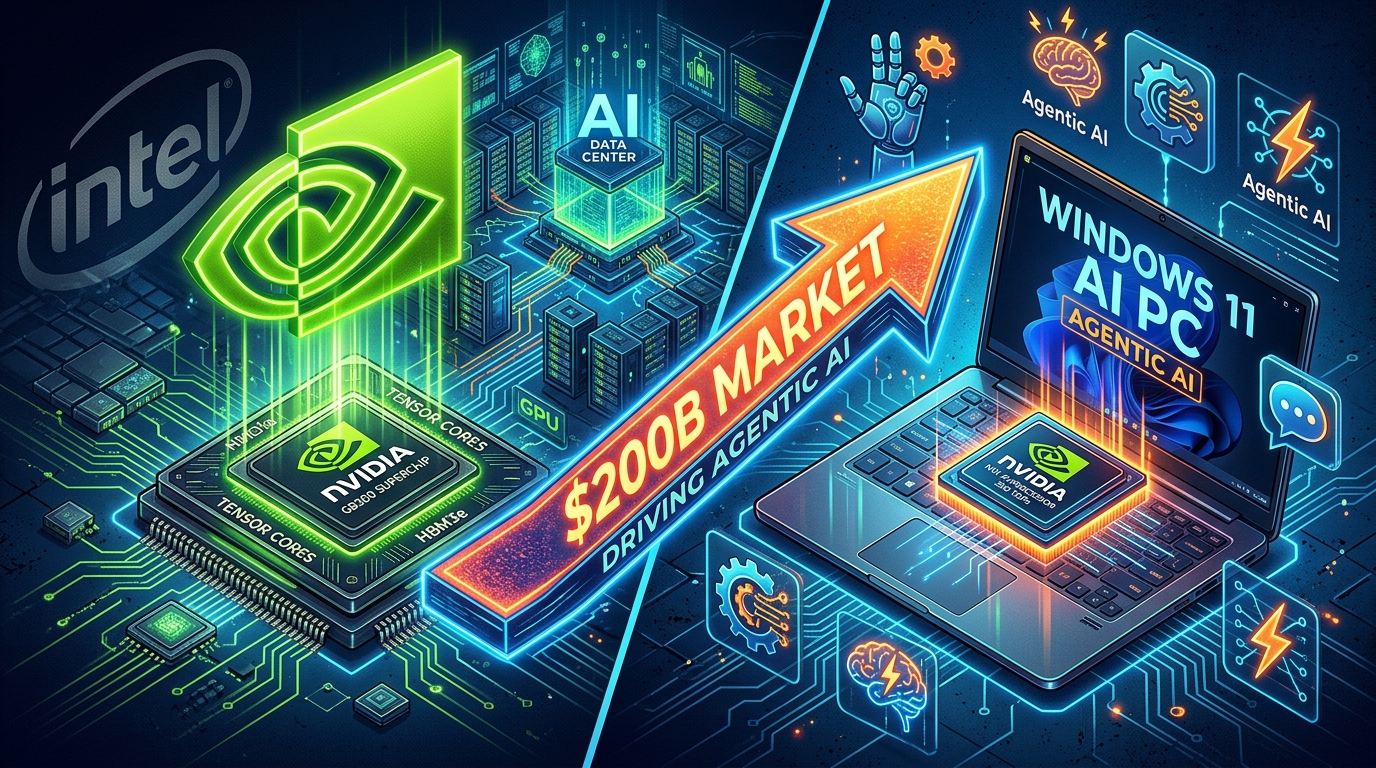
The social media silence from three of the biggest players in the tech world was broken at the same time this weekend, sending a simple but seismic message: “A new era of PC.” It wasn’t just hype. It was the first coordinated confirmation that Nvidia, the undisputed king of AI chips, is officially entering the PC processor market. The battle for the heart of your next computer has just begun—and the battlefield is no longer just silicon; it’s intelligence.
The 3,000-Word Strategic Shift: Why Nvidia Is Entering the PC CPU Market
For decades, Nvidia defined itself by graphics processing units (GPUs)—the chips that power everything from gaming rigs to the world’s largest AI models. Its dominance in AI data centers has made it one of the most valuable companies on the planet. Now, in a strategic pivot that could reshape the industry, Nvidia is taking on its former partners, Intel, AMD, and Qualcomm, by building central processing units (CPUs) for personal computers.
This is not a side project. CEO Jensen Huang has framed this as a core pillar of Nvidia’s future, a move to capitalize on the explosive rise of agentic AI and transform the PC from a tool into an intelligent, always-ready companion. The first salvo is the N1X processor, a system-on-a-chip (SoC) developed in secret for years in collaboration with MediaTek, set to be unveiled at Computex in Taipei. However, Nvidia has already signaled its broader ambition by announcing its data-center-grade Vera CPU, with CFO Colette Kress stating the company aims to become the “world’s leading CPU supplier.”
So why is the king of the AI data center suddenly storming the personal computer? Let’s break down the four strategic imperatives.
Agentic AI: The New Workload That Needs a New Brain
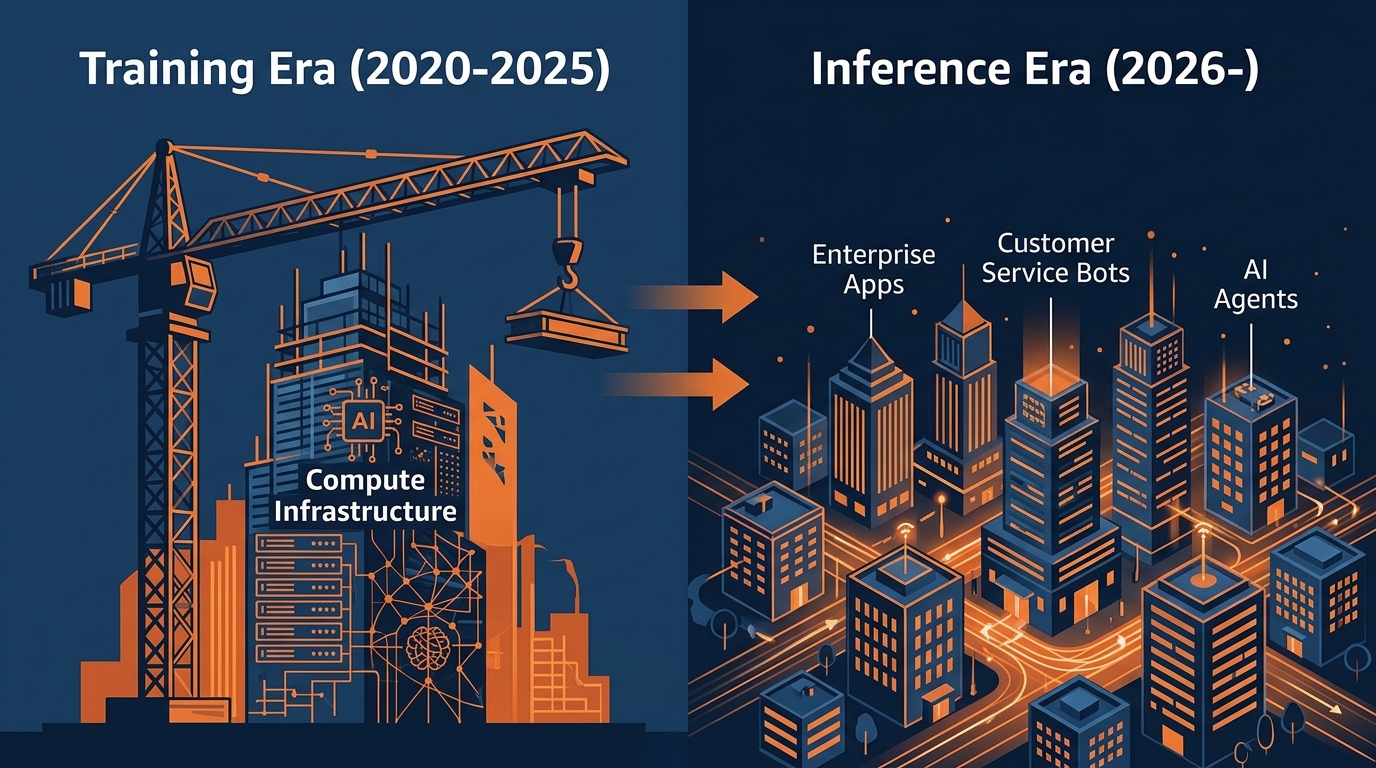
The term “agentic AI” refers to AI systems that can perform multi-step tasks autonomously, without constant human intervention—things like sorting emails, web research, or organizing files. For years, the AI discussion focused on training massive models, a job almost exclusively done by Nvidia’s GPUs in data centers. But now, the most important frontier is shifting to inference: the actual, everyday use of these models.
As Nvidia’s CFO has explained, these agentic tasks require a different kind of chip. While GPUs handle the heavy AI processing, the CPU is proving far more efficient at the orchestration, logic, and decision-making required to manage them. As Intel’s CEO Lip‑Bu Tan put it, the ratio of CPU to GPU usage in data centers has already shifted from 1:8 to 1:4 and could reach parity or better soon.
The N1X is designed for this new world. It’s a “SoC” (system-on-a-chip) that integrates a powerful CPU, an Nvidia Blackwell-class GPU, and a high-performance Neural Processing Unit (NPU) into a single, unified package. This allows AI models to run locally on the PC, rather than relying on the cloud, delivering faster responses, enhanced privacy, and lower cost. It’s the difference between asking for an answer and having a proactive assistant.
2️⃣ The $200 Billion Revenue Frontier
The PC processor market is not a mere side project for Nvidia; it represents a massive, untapped revenue stream. Nvidia’s CFO, Colette Kress, revealed to analysts that entering the CPU space unlocks a $200 billion Total Addressable Market (TAM)—a territory where the green team has historically had zero footprint. Driven by the explosive demand for AI infrastructure, Nvidia projects its CPU-specific revenue to scale rapidly, targeting near-term milestones that leverage its existing hardware ecosystem.
This move is a direct assault on the traditional duopoly of Intel and AMD. CEO Jensen Huang has made it clear that Nvidia aims to become a dominant architectural supplier across all computing tiers. The initial beachhead has already been established in the data center, where major hyperscalers like Amazon (AWS), Microsoft, and Google are integrating Nvidia’s ARM-based CPUs alongside their GPU clusters. Translating this enterprise dominance down to the consumer level with the rumored consumer architecture is the logical next step—capturing high-margin value from the cloud core to the edge of personal computing.
3️⃣ Software Control: The True Moat
Nvidia’s power isn’t just in its hardware; it’s in its CUDA software ecosystem, the industry standard for AI development. For years, this ecosystem has been tied to x86 CPUs from Intel and AMD, creating a bottleneck. By designing its own Arm-based CPU, Nvidia can create a tightly integrated, closed ecosystem from silicon to software.
This vertical integration mirrors Apple’s successful M-series chips. Nvidia can optimize every layer for its AI vision, removing inefficiencies and building an even more formidable competitive moat. The N1X is purpose-built for this—it’s part of Nvidia’s vision to define the “personal AI supercomputer,” moving the center of computing from a general-purpose CPU to a highly integrated AI SoC.
4️⃣ The PC Market Needs a Savior (And Nvidia Is Here)
While Nvidia predicts a massive new market, the overall PC market is struggling. Goldman Sachs forecasts a 10% decline in global PC shipments in 2026. The bright spot? AI PCs are the lone growth engine. AI-capable shipments are projected to reach 150 million units in 2026, a 59% market penetration. The N1X is hitting the market at the perfect time to ride this wave, positioning Nvidia as the premium solution for the new generation of high-performance devices.
The coordinated teaser from Nvidia, Microsoft, and Arm—a “cryptic” social media post with map coordinates pointing to Nvidia’s Computex keynote venue—is a power signal. It tells the world that this isn’t a niche experiment. The new “PC era” is Windows on Arm, powered by Nvidia. It’s a new challenger for Intel, a direct rival for AMD, a mortal threat to Qualcomm’s Windows exclusivity, and perhaps the most ambitious attempt yet to bring the power of the AI data center to the device on your desk.
What’s your biggest question about Nvidia’s PC chip? Would you like to know more about how the N1X’s gaming performance might stack up against AMD’s upcoming Strix Halo, or are you more curious about its impact on the future of Windows software compatibility?
❓ Frequently Asked Questions (FAQ)
Q1: What exactly is the Nvidia N1X processor?
A: The N1X is Nvidia’s first system-on-a-chip (SoC) designed for consumer Windows laptops. It integrates a 20-core Arm CPU (10 performance cores + 10 efficiency cores) with Nvidia’s Blackwell GPU architecture (with 6,144 CUDA cores), an AI accelerator (NPU), memory controllers, and I/O into a single, unified chip. It will be manufactured on TSMC’s cutting-edge 3nm process node.
Q2: How powerful is the N1X compared to Qualcomm’s Snapdragon X Elite and Apple’s M4?
A: Leaked benchmark results suggest the N1X engineering sample significantly outperforms Qualcomm’s Snapdragon X Elite in both single-core and multi-core tests, establishing it as the fastest Arm-based option for Windows PCs at that time. However, early leaks indicate its multi-core performance remains behind Apple’s M4, particularly its single-core score.
Q3: Who is Nvidia partnering with to make the N1X?
A: The N1X is the result of a strategic collaboration with MediaTek, a leading semiconductor company. Nvidia provides the CPU core design, GPU architecture, and AI prowess, while MediaTek contributes its system-on-chip integration expertise, supply chain management, and PC ecosystem relationships.
Q4: When will the first N1X laptops be available to buy?
A: While the official unveiling is expected at Computex 2026 at the end of May, actual availability is likely further out. Dell has confirmed it will showcase an XPS laptop prototype on May 31. However, reports suggest the first retail models may not ship until October 2026, with mass availability slipping into early 2027.
Q5: Why is Nvidia, known for its expensive data center GPUs, suddenly interested in PC processors?
A: This is a strategic move driven by several factors:
- Growth: The PC market is massive and represents a $200 billion total addressable market that Nvidia has never tapped before. The company has even set a goal of becoming the world’s leading CPU supplier.
- The Shift to Agentic AI: Nvidia’s CFO has identified that the CPU is crucial for the logic and orchestration required by “Agentic AI,” and a tightly integrated SoC can handle these tasks more efficiently than a discrete setup.
- Vertical Integration: Creating its own Arm-based ecosystem gives Nvidia full control over both hardware and software, much like Apple’s successful M-series strategy, building a more formidable competitive moat.
Q6: Is this the end of the Intel/AMD dominance in PCs?
A: Not immediately, but this is the most significant challenge to their dominance in decades. For the first time, a company with Nvidia’s resources and AI expertise is directly targeting the laptop market. The N1X will be a major test for x86 architecture, especially as the industry shifts toward AI-powered PCs. Notably, Nvidia is not building a new version of Windows; a major update to Windows 11 will run on the N1X, with Windows 12 still not planned for this year.
Q7: How much will an N1X laptop cost?
A: Pricing for the first wave of laptops is expected to be in the 1,000 to 1,500 range, positioning them in the premium segment of the market.
Q8: How does this fit with Nvidia’s goal to be the leading CPU supplier?
A: Nvidia’s ambition to dominate the CPU market is not a distant dream. CFO Colette Kress recently stated the company aims to become the “world’s leading CPU supplier.” The N1X is the first consumer-facing step in that plan. The company already has its Vera server CPU for data centers, and this consumer chip completes its strategy to be a total computing platform provider. Goldman Sachs forecasts that total CPU demand could grow from 3.7 million units in 2026 to 16.3 million by 2028, driven by AI needs.
Sources & Further Reading
1. Key News & Announcements
- TechPowerUp (May 30, 2026): “Microsoft and NVIDIA Jointly Tease Possible N1X Debut as a ‘New Era of PC’” [0†L16-L20]
- MyDrivers (May 30, 2026): “英伟达、微软联合宣布:NVIDIA N1X处理器来了!” (Chinese) [0†L21-L24]
- ITHome (May 30, 2026): “非 Win12:微软下周将升级 Win11,携手英伟达开启 PC 新时代” [6†L20-L23]
- Tom’s Hardware (May 29, 2026): “Nvidia and Microsoft tease ‘a new era of PC’ ahead of Computex 2026” [4†L17-L23]
- PCWorld (May 29, 2026): “Dell confirms Computex 2026 XPS laptop with Nvidia N1X chip” [6†L4-L6]
2. Analyst Reports & Market Data
- Forbes (March 16, 2026): “The Arm Invasion: Nvidia Targets $200 Billion PC Market With N1X Chips” [1†L34-L35]
- Futurum Group (May 22, 2026): “NVIDIA Q1 FY2027: CPU Upside and Data Center Diversification” [5†L4-L8]
- Goldman Sachs: PC CPU market forecasts referenced in multiple reports [5†L16-L17]
3. Technical Analysis & Benchmarks
- SweClockers (June 10, 2025): Leaked N1X benchmark results [3†L5-L8]
- 163.com (June 15, 2025): N1X vs. Apple M4 Max benchmark comparison [3†L28-L30]
4. Partnership Details
- Business Standard (Feb 25, 2026): Nvidia’s partnership with MediaTek [1†L24-L30]
- Forbes (March 16, 2026): “The Arm Invasion: Nvidia Targets $200 Billion PC Market With N1X Chips” (also covers MediaTek collaboration) [1†L34-L36]
5. Strategic Shift & AI PC Context
- Economic Daily News (2026-05-21): Analyst commentary on Nvidia’s CPU strategy [5†L22-L27]
- KuCoin News (May 21, 2026): “Nvidia Projects $20B in CPU Revenue by 2026, Targets Intel and AMD” [5†L9-L12]











Leave a Reply