
The latest wave of iOS 27 leaks paints a picture of Apple’s most aggressive AI overhaul yet. The central theme is clear: Apple is turning the iPhone into an AI agent platform, moving beyond simple voice commands to a system that can create, automate, and act on your behalf.
Here is what you need to know about the key upgrades and what they say about Apple’s broader strategy.
🎨 AI‑generated wallpapers
Personalization is the most visible change. iOS 27 will integrate an AI‑powered wallpaper generator into the existing Image Playground framework. When you go to change your wallpaper, you will be able to type a description, and the AI will generate a matching image on the fly. The generator reportedly uses improved AI image models that deliver more realistic and detailed results than previous versions.
📝 AI writing tools & grammar check
Productivity gets a significant upgrade. Apple is adding a system‑wide AI grammar checker that works across any text input field, along with new writing tools such as a “Help Me Write” button that appears when you activate Siri while typing. These features are designed to help you edit and refine text directly inside the apps you already use.
🧠 Natural language shortcuts
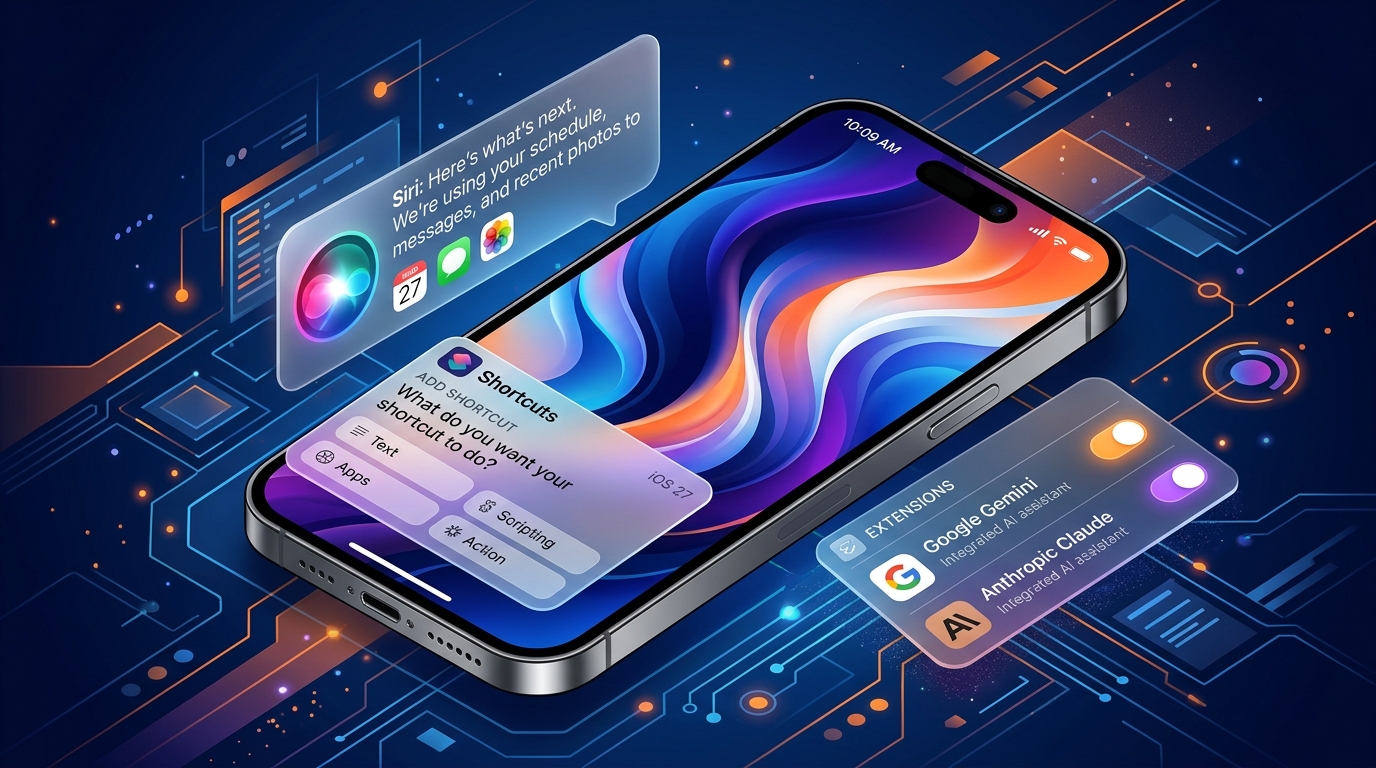
The Shortcuts app is being completely reimagined with AI. Currently, building a shortcut requires manually assembling actions step by step. In iOS 27, you will be able to create automations simply by describing what you want to do in plain English a natural language interaction. When you open the Shortcuts app, you will be presented with a prompt asking, “What do you want your shortcut to do?” The AI then generates the workflow automatically. This change turns Shortcuts from a “power‑user tool” into a mainstream productivity feature.
🗣️ The completely rebuilt Siri: an always‑on agent
The biggest change lies beneath the surface. Apple has been quietly rebuilding Siri from the ground up for years, and iOS 27 will finally debut the new version. The updated Siri is described as an “always‑on agent” that can tap into personal data and take action across apps. It will be able to understand information from your emails, messages, photos, calendar events, and files, and use that context to answer questions and perform tasks naturally. The assistant is also moving away from being a voice‑only service and will adopt a ChatGPT‑style conversational interface.
📱 A standalone Siri app
For the first time, Siri will have a dedicated app on the iPhone, iPad, and Mac. The app will feature a chatbot‑style interface with conversation history, support for file uploads, and the ability to pin important conversations. While you can still summon Siri with a voice command or button press, the standalone app gives you a persistent place to manage your interactions with the assistant.
🔓 “Extensions” and third‑party AI models
Perhaps the most strategic move is Apple’s decision to open its AI platform. iOS 27 will introduce a new mechanism called “Extensions,” which allows users to choose from multiple third‑party AI services to power Apple Intelligence features. The capability will likely appear as a toggle in the Settings app, letting you switch between Apple’s own models and services such as Google Gemini and Anthropic Claude. This marks a major departure from Apple’s traditionally closed ecosystem and positions the iPhone as a neutral platform for AI services, giving users choice and reducing Apple’s dependence on any single AI provider.
👁️ Visual intelligence upgrade
iOS 27 will also expand Visual Intelligence, an AI feature that understands what your camera sees. New capabilities will include scanning nutrition labels to automatically log food intake into the Health app and capturing and storing information from business cards. These features are expected to run largely on‑device, preserving privacy by not sending sensitive information to external servers.
🖼️ Image Playground and Genmoji updates
Apple is adding more creative AI tools. Image Playground, the image generation feature, will receive new editing capabilities and a broader range of styles. Genmoji, the custom emoji feature, will become more proactive, generating emoji suggestions based on your photos and typing habits.
🧠 The “agentic” strategy: turning the iPhone into an AI platform
Taken together, these features reveal Apple’s larger ambition. The company is not just adding AI features to its apps; it is turning the operating system itself into an AI agent platform.
- Contextual intelligence is the core promise. The rebuilt Siri is designed to use personal data to act across apps, effectively becoming a digital agent that understands your schedule, relationships, and priorities.
- Choice is a key pillar. By opening iOS to third‑party AI models, Apple is admitting that it cannot win the AI race alone and is instead becoming the orchestrator of AI services on its platform.
- Simplicity is the user‑facing goal. The natural language Shortcuts feature and the AI wallpaper generator are both designed to lower the barrier to entry for AI‑powered creation and automation.
When compared to Google’s new Gemini Spark announced just a day earlier, the contrast is telling. Google’s agent runs in the cloud 24/7 and costs $100 per month, whereas Apple is embedding its agent into the device and into the operating system itself. Google wants you to pay for an AI agent; Apple wants you to buy an iPhone.
⏳ The “beta” reality
Reports indicate that the new Siri and Apple Intelligence features may still be labeled as “beta” at launch, suggesting that the company is still ironing out performance issues. However, Apple is committed to a September release timeline, and the WWDC 2026 keynote on June 8 is expected to offer the first public preview.
🏁 Conclusion: the dawn of agentic iOS
iOS 27 is a reset. Apple is turning the iPhone into an AI‑first platform where creation, productivity, and automation are all powered by AI agents that you can control, customize, and even choose from competing providers. The “Search or Ask” gesture, the rebuilt Siri, the standalone app, and the third‑party Extensions all point in the same direction: the future of the iPhone is not in the apps you download, but in the intelligence that lives inside the operating system itself.









Leave a Reply