
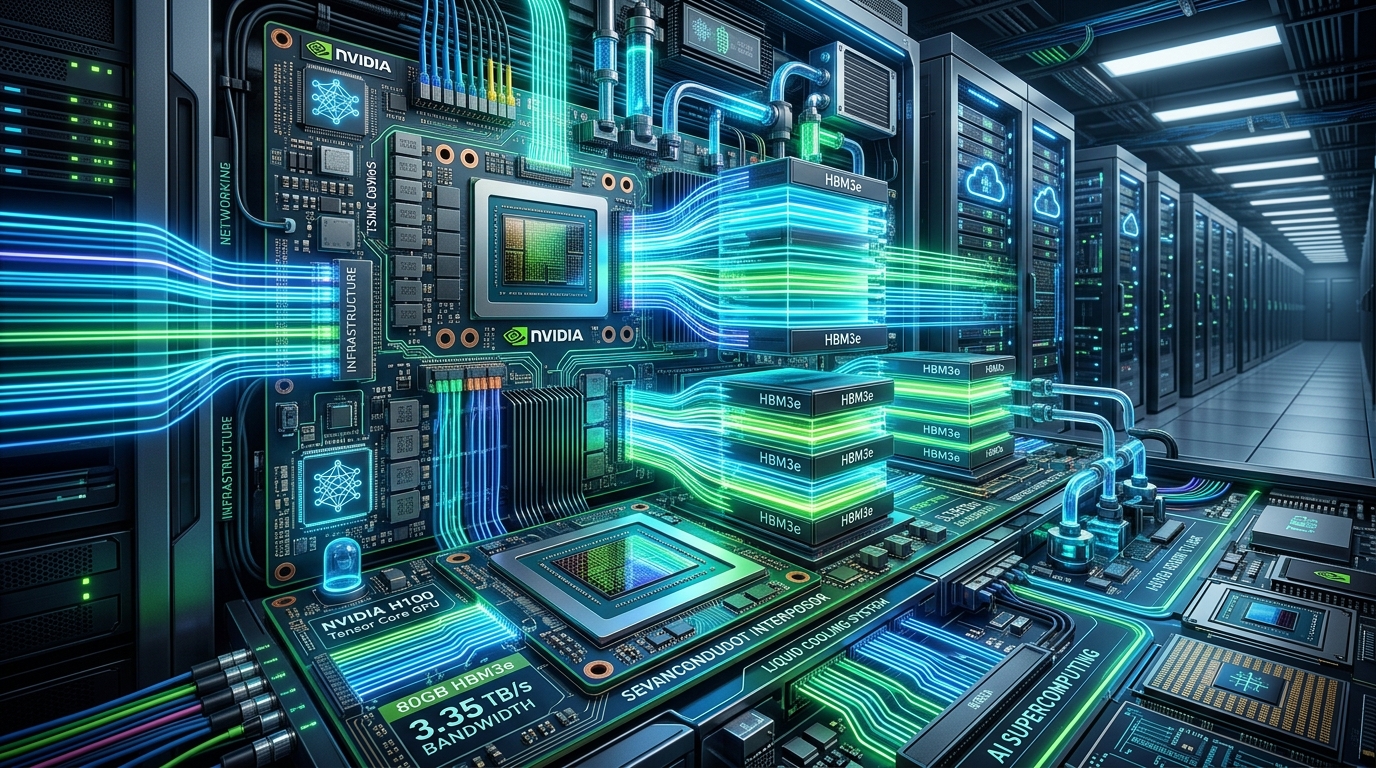
The Invisible Technology Powering the AI Boom
When people talk about artificial intelligence, they usually focus on flashy products like ChatGPT, Claude, Gemini, or powerful NVIDIA GPUs. But behind the scenes, another technology has quietly become one of the most important bottlenecks in the entire AI industry:
High-Bandwidth Memory, better known as HBM.
Today, HBM is arguably more strategically important than GPUs themselves. Without enough HBM, even the world’s most advanced AI chips cannot operate at full performance. This has transformed memory manufacturers like SK Hynix, Samsung, and Micron Technology into some of the most critical players in the AI supply chain.
The global race for AI dominance is no longer just about building faster processors. It is increasingly about securing enough advanced memory to feed those processors with data fast enough.
In many ways, HBM has become the new oil of the AI era.
What Is HBM Memory?
HBM, or High-Bandwidth Memory, is a specialized type of ultra-fast memory designed for extremely data-intensive workloads like:
- artificial intelligence,
- machine learning,
- supercomputing,
- and high-performance graphics.
Unlike traditional DRAM memory, HBM stacks multiple layers of memory vertically using advanced 3D packaging technology. These stacked memory layers sit extremely close to the GPU or AI accelerator, dramatically increasing data transfer speeds while reducing power consumption.
The result is:
- much higher bandwidth,
- lower latency,
- and greater efficiency.
This is critical because modern AI models process enormous amounts of data simultaneously.
Without HBM, today’s frontier AI systems simply would not function efficiently.
Why AI Models Need So Much Memory Bandwidth
Modern AI models are fundamentally different from traditional software.
Large language models like ChatGPT or Claude constantly move huge amounts of data between:
- GPUs,
- memory,
- networking systems,
- and storage infrastructure.
The bottleneck is often not raw computing power — it is how quickly data can move.
AI training requires GPUs to process:
- trillions of parameters,
- enormous datasets,
- and billions of mathematical operations every second.
If memory cannot supply data fast enough, GPUs sit idle waiting for information.
That creates a major problem:
expensive AI chips become underutilized.
HBM solves this issue by delivering enormous memory bandwidth directly next to the GPU.
For example:
- NVIDIA’s H100 GPUs use HBM3 memory
- Blackwell GPUs use next-generation HBM3E
- Future Rubin systems are expected to rely heavily on HBM4
As AI models continue growing larger, memory bandwidth is becoming just as important as compute power itself.
Why HBM Became the Biggest AI Bottleneck
The AI boom created a problem the semiconductor industry was not prepared for.
Demand for HBM exploded far faster than manufacturing capacity could scale.
HBM is extremely difficult to produce because it requires:
- advanced semiconductor packaging,
- precision stacking technology,
- cutting-edge fabrication,
- and extremely low defect rates.
Only a small number of companies in the world can manufacture advanced HBM at scale.
Currently, the major suppliers are:
- SK Hynix
- Samsung
- Micron
Among them, SK Hynix emerged as the early leader in HBM3 and HBM3E production, giving it a dominant position in the AI supply chain.
The shortage became so severe that:
- HBM supply reportedly sold out through 2026
- AI companies began fighting for allocation
- NVIDIA started influencing supplier production decisions
- hyperscalers rushed to secure long-term contracts
In some cases, memory availability became more important than GPU availability itself.
Why NVIDIA Depends on HBM So Much
NVIDIA may dominate AI chips, but its growth increasingly depends on memory suppliers.
Modern NVIDIA AI accelerators are designed around enormous memory bandwidth requirements. GPUs like the H100 and Blackwell systems rely heavily on HBM to maintain performance at scale.
Without sufficient HBM:
- GPUs cannot reach full utilization
- AI training slows down
- cloud deployments get delayed
- revenue growth becomes constrained
This is why NVIDIA has reportedly pressured suppliers to increase HBM production aggressively.
Industry reports suggest NVIDIA pushed Samsung to repurpose conventional DRAM lines toward HBM manufacturing because AI demand became so intense.
The company understands a crucial reality:
the AI race is now constrained by memory supply chains.
The Strategic Importance of SK Hynix, Samsung, and Micron
The AI boom has dramatically reshaped the semiconductor industry hierarchy.
For years, memory manufacturers were viewed as cyclical commodity businesses. AI changed that completely.
Now:
- SK Hynix became one of the world’s most strategically important AI suppliers
- Samsung is rapidly expanding HBM investments
- Micron is aggressively scaling advanced memory production
HBM carries:
- higher profit margins,
- stronger pricing power,
- and long-term strategic importance.
The companies controlling advanced memory production suddenly hold enormous leverage over the future of AI infrastructure.
Why HBM Is So Expensive
HBM is significantly more expensive than conventional memory because the manufacturing process is incredibly complex.
Producing advanced HBM requires:
- vertical memory stacking,
- Through-Silicon Vias (TSVs),
- advanced packaging,
- thermal optimization,
- and tight integration with GPUs.
In addition, AI demand is overwhelming supply.
This imbalance allows suppliers to command premium pricing.
As AI adoption accelerates globally, HBM pricing has surged, and lead times have stretched dramatically.
For many AI companies, securing HBM allocation is now as important as securing GPUs themselves.
Could HBM Shortages Slow Down the AI Boom?
Possibly.
One of the biggest risks facing the AI industry today is that infrastructure demand may grow faster than semiconductor manufacturing capacity.
AI companies are spending hundreds of billions of dollars on:
- GPUs,
- AI data centers,
- networking infrastructure,
- and cloud expansion.
But none of it matters if enough HBM cannot be produced.
This creates several major risks:
- delayed AI deployments,
- rising hardware costs,
- constrained cloud capacity,
- and slower AI scaling.
Some analysts now believe HBM may become the single biggest limiting factor in the expansion of frontier AI systems.
Why Hyperscalers Are Watching HBM Closely
Major cloud companies including:
- Amazon
- Microsoft
- Meta
are all racing to secure long-term HBM supply.
These companies understand that future AI leadership depends not only on software, but also on controlling physical infrastructure:
- chips,
- memory,
- power,
- networking,
- and manufacturing capacity.
Some hyperscalers are even developing their own AI accelerators partly to reduce dependence on NVIDIA’s supply chain constraints.
However, even custom AI chips still require advanced memory.
That means HBM remains central to the entire AI ecosystem.
Could New Technologies Replace HBM?
Eventually, perhaps.
Researchers are exploring:
- optical interconnects,
- next-generation packaging,
- new memory architectures,
- and alternative AI hardware designs.
But in the near future, HBM remains irreplaceable for frontier AI workloads.
Its combination of:
- bandwidth,
- efficiency,
- density,
- and scalability
makes it uniquely suited for large-scale AI systems.
For now, the AI industry cannot function without it.
Frequently Asked Questions (FAQ)
What does HBM stand for?
HBM stands for High-Bandwidth Memory, a specialized type of ultra-fast memory used in AI accelerators and high-performance computing systems.
Why is HBM important for AI?
HBM allows GPUs and AI chips to process enormous amounts of data quickly. Without high memory bandwidth, advanced AI systems would suffer major performance bottlenecks.
Which companies make HBM memory?
The major HBM manufacturers are:
- SK Hynix
- Samsung
- Micron Technology
Why is HBM in short supply?
HBM is difficult and expensive to manufacture. The AI boom caused demand to surge much faster than production capacity could expand.
Does NVIDIA manufacture HBM?
No. NVIDIA designs GPUs, but HBM memory is supplied by companies like SK Hynix, Samsung, and Micron.
What is the difference between HBM and regular RAM?
HBM is stacked vertically and placed very close to the GPU, allowing much higher bandwidth and lower power consumption compared to traditional DRAM memory.
Conclusion – The Real Fuel Behind Artificial Intelligence
The AI revolution is often described as a battle over algorithms, chatbots, and GPUs.
But behind every powerful AI system lies an invisible dependency:
memory bandwidth.
HBM has quietly become one of the most strategically important technologies in the global AI economy. It determines:
- how fast AI models train,
- how efficiently GPUs operate,
- and how quickly the industry itself can scale.
As artificial intelligence grows more powerful, the companies controlling advanced memory production may become just as important as the companies designing the AI chips themselves.
In the AI era, compute power alone is no longer enough.
The future may belong to whoever controls the memory feeding the machines.








Leave a Reply