
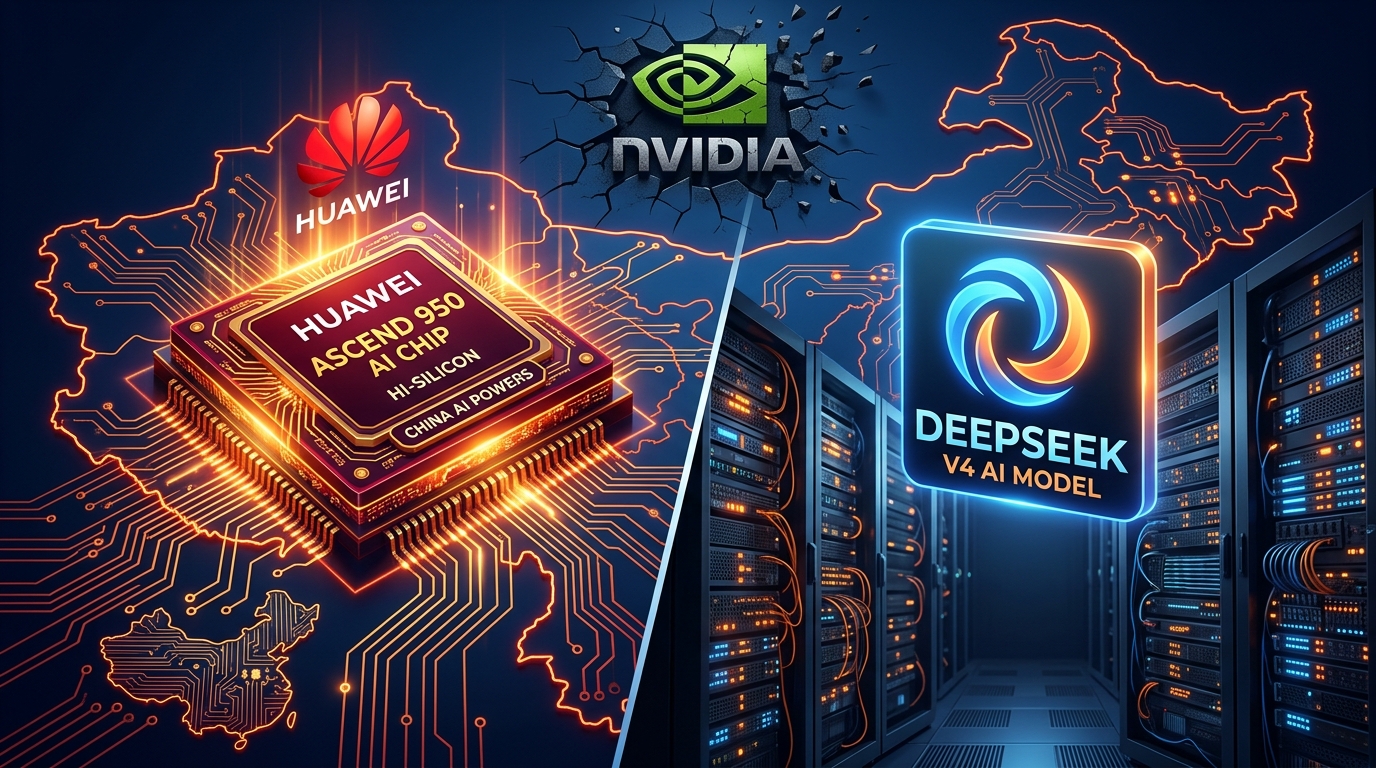
For two years, the US strategy was clear: restrict China’s access to advanced AI chips, slow its AI progress, and preserve America’s technological lead. Export controls on Nvidia’s top‑end processors were designed to deny China the hardware needed to train cutting‑edge models.
By early 2026, however, the outcome was not what Washington expected. China did not retreat. It accelerated.
The nation has poured billions into a domestic ecosystem that now threatens to challenge Nvidia on its home turf. Huawei’s latest Ascend chip has entered mass production, major Chinese internet firms are placing hundreds of thousands of orders, and DeepSeek’s V4 model has proven that China can run frontier AI without Nvidia hardware.
This article explains the strategy behind China’s rapid chip ascendancy, the technical breakthroughs that made it possible, the economic forces driving it, and why US export controls may have backfired.
Quick Summary – What You Need to Know
| Question | Answer |
|---|---|
| What chip is powering China’s AI push? | Huawei’s Ascend 950PR, which entered mass production in March 2026. An upgraded 950DT is planned for Q4 2026. |
| How many chips will Huawei ship this year? | Approximately 750,000 units of the 950PR in 2026. |
| What is the self-sufficiency rate for AI chips in China? | 41% in 2026, up from just 10% in 2021. Morgan Stanley projects this will reach 85% by 2030. |
| How much revenue will Huawei generate from AI chips? | Approximately 12billionin2026,a607.5 billion in 2025. |
| What made the shift possible? | DeepSeek V4, released in April 2026, is fully optimized for Huawei’s Ascend chips, proving a complete Chinese AI stack can work at scale. |
| What is the “Parallel Purchase” policy? | A Chinese government mandate requiring that for every advanced Western chip imported, a domestic equivalent must be deployed. |
| Why are Chinese tech giants buying Ascend chips? | ByteDance (TikTok), Tencent, and Alibaba have scrambled to place orders after DeepSeek V4 demonstrated the viability of domestic hardware. |
The US Strategy That Backfired
The US semiconductor export control regime, first imposed in 2022 and progressively tightened, was built on a simple theory: restrict access to the world’s most advanced chips, and China’s AI ambitions will stall. The logic was straightforward – deny frontier hardware, slow down China’s AI development.
What happened instead was different.
Denied access to Nvidia’s best GPUs, Chinese firms were forced to build their own alternatives. Huawei’s Ascend series emerged as the flagship domestic alternative, with SMIC manufacturing chips using processes once considered beyond its reach. The Huawei‑SMIC partnership effectively became the backbone of China’s AI independence drive.
Restrictions have, paradoxically, accelerated the very self-sufficiency they were designed to prevent.
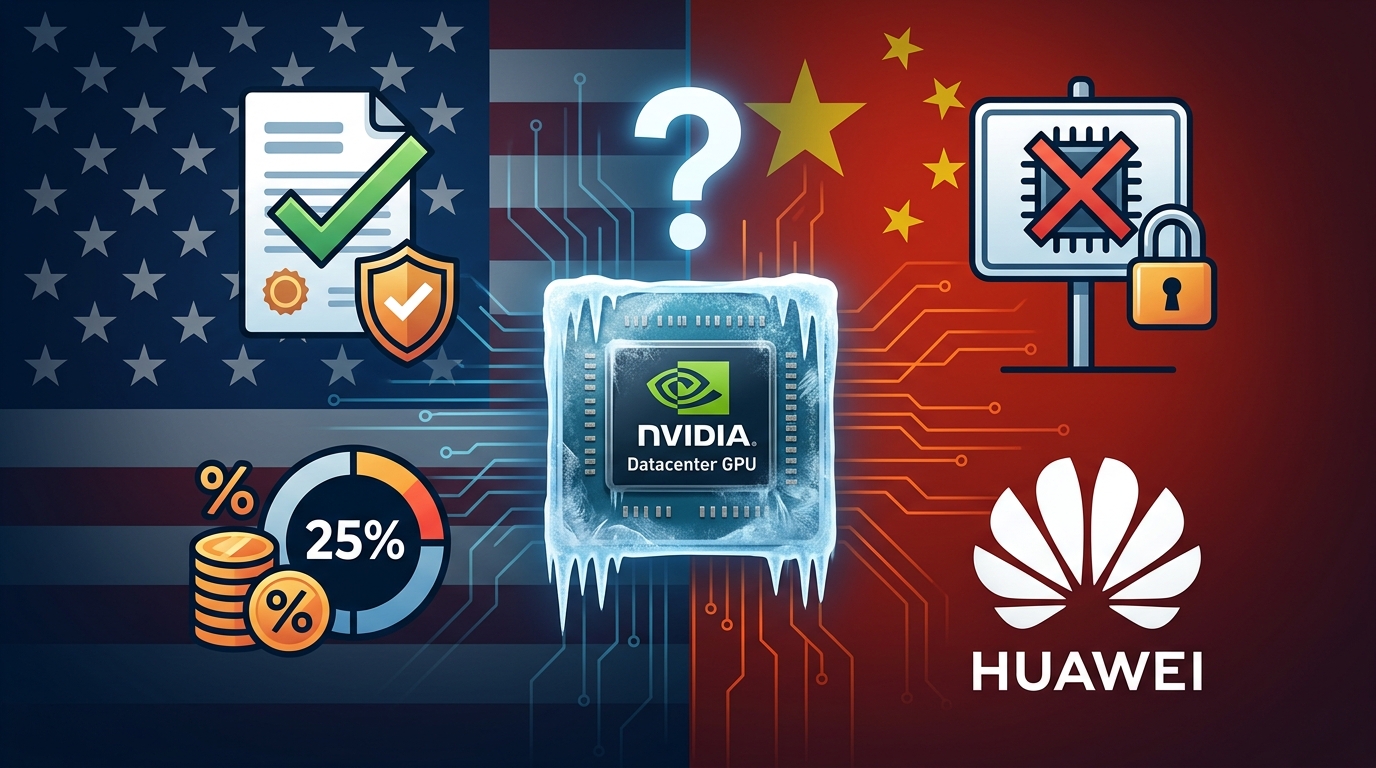
In early 2026, the Biden‑era “presumption of denial” policy was formally replaced. The US Bureau of Industry and Security (BIS) issued a final rule, effective January 15, 2026, revising the license review policy for advanced computing chips destined for China and Macau – moving from a presumption of denial to a case‑by‑case review under strict conditions. Eligible chips included Nvidia’s H200 and AMD’s MI325X, but only when accompanied by rigorous certifications concerning US supply, third‑party testing, and end‑use safeguards. A 25% tariff on advanced chip imports was also imposed.
Yet even this relaxation has not translated into shipments. The H200 has still not reached Chinese shores, stuck in regulatory limbo as Beijing and Washington remain at odds over the conditions governing its sale. Chinese firms are no longer waiting.
Huawei’s Ascend 950PR – The Nvidia Challenger
At the heart of China’s homegrown AI push is Huawei’s Ascend 950PR, the company’s latest AI processor. According to sourcing for the Financial Times, the chip entered mass production in March 2026 and has already captured the majority of orders for the year.
Huawei plans to ship approximately 750,000 units of the 950PR in 2026, with mass production beginning in April and full‑scale shipments ramping up in the second half of the year. An upgraded version, the Ascend 950DT, is slated for release in the fourth quarter of 2026.
The performance numbers are compelling. The 950PR significantly outperforms Nvidia’s H20 – the most powerful chip Nvidia was permitted to sell in China before Beijing blocked its import last year. While it still trails the American firm’s H200, ongoing regulatory disputes have delayed H200 shipments, opening a critical window for Huawei.
A key technical differentiator sets the 950PR apart from other domestic chips: it is the only Chinese processor supporting a technique that processes AI calculations in a more compressed numerical format, allowing it to handle more computations per second at a lower cost. This gives it a distinct competitive edge in the local market.
The financial trajectory is equally striking. Based on orders already secured, Huawei expects AI chip revenue to reach approximately 12 billion in 2026, a 607.5 billion increase in 2025.
DeepSeek V4 – The Software That Broke CUDA’s Monopoly
Hardware alone does not make an ecosystem. For years, Nvidia’s CUDA software platform locked developers into its hardware, creating a moat that proved nearly as formidable as the chips themselves. China needed its own “killer app” to prove that domestic hardware could compete.
That app arrived on April 24, 2026, when DeepSeek released preview versions of its V4 model series – V4‑Pro (higher‑end performance) and V4‑Flash (faster, cost‑optimized). Both models support a 1‑million‑token context window, nearly a tenfold increase from earlier versions, enabling far more advanced long‑context tasks.
Crucially, Huawei confirmed within hours of the preview that V4 is fully supported on its Ascend 950‑based supernode clusters, and that its chips were used for part of Flash’s training. “Through close technical collaboration … the entire Ascend supernode product line now supports the DeepSeek‑V4 series models,” Huawei said.
Unlike earlier DeepSeek releases that primarily ran on Nvidia’s CUDA framework, V4 was validated on both Nvidia GPUs and Huawei Ascend NPUs using a fine‑grained expert parallelism scheme. This marks a strategic shift away from American semiconductor dependence and toward China’s homegrown AI gear.
The performance on Huawei hardware is notable: Ascend 950 supernodes achieve low‑latency inference of 20ms for DeepSeek V4‑Pro and 10ms for DeepSeek V4‑Flash. DeepSeek expects pricing for the Pro model to drop sharply once Ascend 950 supernodes are deployed at scale in the second half of 2026.
DeepSeek did not specify whether V4 was also trained on Nvidia chips (its earlier V3 and R1 models were built using Nvidia hardware). But the company faces its own compute restrictions under US export controls, making the embrace of domestic chips both a strategic necessity and a competitive advantage.
Beyond Huawei, other Chinese chipmakers – including Moore Threads, Cambricon, and Iluvatar CoreX – have also announced support for DeepSeek V4, indicating a broader ecosystem shift away from Nvidia.
The Great Chinese Tech Pivot
The software breakthrough triggered an immediate hardware buying frenzy.
ByteDance (TikTok), Tencent, and Alibaba – China’s three largest internet firms – have all reached out to Huawei about new chip orders. The scramble underscores how DeepSeek’s V4 release has turbocharged demand for domestic AI hardware, with US export controls continuing to restrict access to Nvidia’s most advanced processors.
Within hours of DeepSeek’s announcement, major cloud platforms acted:
- Alibaba Cloud made DeepSeek V4 available on its Bailian platform on the day of release.
- Tencent Cloud launched V4 preview services on its TokenHub platform on the same day, deploying the model on both domestic nodes and its Singapore international gateway.
The rapid deployment means millions of users and developers can now access V4, sharply increasing processing demand – and therefore demand for Ascend 950 chips.
For Huawei, this represents a major breakthrough after years of struggling to win large orders from China’s tech sector. Customer testing of the 950PR went well in early 2026, with firms including ByteDance and Alibaba planning orders after samples were distributed in January.
Huawei is not alone. Chinese semiconductor companies such as Moore Threads, MetaX, and Cambricon have filled gaps left by Nvidia and have recently shown rising revenue. Alibaba is also expanding the use of its own in‑house GPUs in data centers supporting its cloud business.
The Self-Sufficiency Numbers That Should Worry Nvidia
For years, China’s chip independence seemed aspirational – a policy goal without a realistic timeline. No longer.
New data from Morgan Stanley shows that China’s GPU self‑sufficiency ratio – the share of domestic AI chip demand met by locally produced chips – has already crossed 41% in 2026, up from roughly 20% in 2023. That is a doubling in just three years, and a quadrupling from where things stood in 2021.
More strikingly, Morgan Stanley projects this ratio will climb to approximately 85% by 2030. At that level, China would be meeting nearly all of its own AI chip demand without relying on foreign supply. The projection is not a fringe estimate – the trend line is already moving steeply. Between 2021 and 2025, the self‑sufficiency ratio rose modestly, as the domestic chip ecosystem was still maturing. The projected acceleration from 2026 onward reflects the compounding effect of years of investment now coming online: new fabs, more refined domestic tooling, and a growing software ecosystem around chips like the Ascend series.
An 85%‑self‑sufficient China is one that can train and run frontier models without worrying about US supply chains or export rule changes. For Nvidia, which once commanded over 90% of the Chinese AI chip market, the shift is existential. Its remaining share is under assault from a coordinated national effort to push it out.
The “Parallel Purchase” Policy – Beijing’s Quiet Engine
Behind the market shifts lies a deliberate government strategy.
China has pivoted toward a “Parallel Purchase” policy, mandating that for every advanced Western chip imported, a domestic equivalent must be deployed. This fundamentally alters the global supply chain for artificial intelligence. At the same time, Chinese authorities are reportedly drafting quota frameworks to cap domestic purchases of Nvidia’s H200 chips, leaning on a formal approval regime rather than a blanket prohibition.
The government’s role extends beyond mandates. The Chinese government has moved to subsidize manufacturing inefficiencies, viewing domestic chip production as a matter of national security rather than short‑term profit. This state‑backed commitment creates a floor for domestic chipmakers – even if yields are lower than Western fabs, production continues.
Within this framework, Beijing has effectively communicated to large tech firms that importing Western chips must be paired with domestic purchases. Alibaba, ByteDance, and Tencent are complying not just because the technology is ready, but because the policy demands it.
The Supply Reality – Production Constraints Remain
Despite the momentum, significant challenges remain.
US restrictions on advanced chipmaking equipment still limit China’s production capacity. Huawei’s plan to ship 750,000 950PR units in 2026 is ambitious. DeepSeek itself has acknowledged that supply constraints will persist until production ramps up in the second half of the year. DeepSeek also noted that it cannot yet serve all customers due to limited Ascend 950 availability.
The technology gap is also real. Analyst estimates suggest Huawei’s Ascend 950 delivers only a fraction – approximately 6% – of the computing power of Nvidia’s next‑generation VR200. Huawei’s CANN software platform, while improving, still trails Nvidia’s CUDA in developer tools, documentation, and ease of use.
Moreover, the advanced 5nm‑class processes used for the Ascend 950 are manufactured by SMIC, which relies on stretched DUV multi‑patterning due to the denial of ASML’s EUV lithography machines. Industry analysts estimate SMIC’s yields at a modest 30‑40% – far below the 80%+ achieved by TSMC. The Chinese government continues to subsidize these inefficiencies, viewing 5nm production as a national security priority.
These are not minor hurdles. But they are being addressed with state‑backed determination that Western competitors cannot easily match.
What This Means for the Global AI Industry
China’s emerging self‑sufficiency will reshape the AI hardware market in several fundamental ways.
Two Diverging AI Stacks
The world is splitting into two distinct AI ecosystems: a US‑led stack anchored by Nvidia and CUDA, and a China‑led stack anchored by Huawei, Ascend, and a growing domestic software ecosystem. For developers and enterprises outside China, the US stack will remain dominant. For China, the domestic stack will increasingly become the default.
Price and Availability
China’s domestic chip supply will insulate its AI industry from US export volatility. Chinese firms will not face the GPU shortages that periodically disrupt Western cloud providers. Meanwhile, a second major AI hardware market will support price competition that could eventually benefit global buyers.
Nvidia’s China Dilemma
Nvidia faces a narrowing window to maintain relevance in China. The company has won approvals for H200 exports and can theoretically sell, but actual shipments remain stalled amid regulatory disputes. Each month of delay pushes Chinese customers further toward domestic alternatives. By the time the regulatory fog clears, the market may have moved on.
A Forced Accelerant for Chinese Innovation
US export controls intended to cripple Chinese AI have instead become a powerful forcing mechanism. Denied access to Western chips, Chinese engineers have built their own – under the pressure of necessity, moving faster than they likely would have in a more permissive environment.
Frequently Asked Questions (FAQ)
Q1: Is Huawei’s Ascend 950 as powerful as Nvidia’s latest chips?
A: Not yet. Analysts estimate the Ascend 950 delivers approximately 6% of the raw compute power of Nvidia’s next‑generation VR200. However, inference workloads (where AI models are deployed to answer queries) are becoming the dominant use case – and in that domain, the gap is much narrower. Huawei is also using system‑level integration to compensate for per‑chip deficits.
Q2: Why are Chinese tech giants buying Huawei chips if they are less powerful?
A: Availability, cost, and policy. Nvidia chips are caught in regulatory limbo, while Huawei chips are available now. The “Parallel Purchase” policy also requires domestic purchases alongside any Western imports. Additionally, DeepSeek V4 has proven that domestic hardware can deliver acceptable performance for production workloads.
Q3: Can Huawei scale production fast enough?
A: This is the biggest unknown. US restrictions on chipmaking equipment limit expansion. SMIC’s yields on advanced nodes are estimated at 30‑40%, far below TSMC’s 80%+. However, the Chinese government is subsidizing production as a national security priority, which may allow Huawei to scale despite inefficiencies.
Q4: What is the “Parallel Purchase” policy?
A: A Chinese government mandate requiring that for every advanced Western chip imported, a domestic equivalent must be deployed. It is designed to accelerate domestic adoption while still allowing limited access to Western technology.
Q5: What is DeepSeek V4, and why does it matter?
A: DeepSeek V4 is a frontier AI model released in April 2026. It is significant because it is fully optimized to run on Huawei’s Ascend chips, proving that a complete Chinese AI stack – from chip to model – can work at scale. This demonstration triggered a surge in domestic chip orders.
Q6: Will US export controls be tightened further?
A: Possibly. In early 2026, the US also issued regulations dividing countries into three tiers for AI chip exports, with China in the most restricted category. However, the effectiveness of further controls is diminishing as China builds its own capabilities. Some analysts argue that controls are now locking in China’s technological independence faster than they are slowing its progress.
Q7: How does this connect to your earlier article on US H200 approvals?
A: Directly. The US approved H200 exports to China but imposed a 25% fee and security certifications. However, those chips have not actually shipped. The delay – combined with China’s own parallel purchase requirements – has created an opening for Huawei to fill the gap. This article explains the domestic alternative that is taking root while H200 shipments remain stalled.
Q8: What happens next?
A: Expect continued expansion of Chinese domestic chip capacity, accelerating adoption by major Chinese tech firms, and a widening gap between US and Chinese AI hardware ecosystems. If self‑sufficiency reaches 85% by 2030 as projected, Nvidia’s presence in China may become minimal, replaced by a homegrown industry built under the pressure of US restrictions.
Conclusion – The Self‑Sufficiency That Was Meant to Be Prevented
The US strategy to slow China’s AI progress by restricting chip exports has produced a result that few anticipated. Far from crippling Chinese AI, the restrictions have become its accelerant.
Huawei’s Ascend 950 series is now in mass production. DeepSeek has proven that Chinese hardware can run frontier AI models. The country’s largest tech firms are placing massive orders for domestic chips. Self‑sufficiency has doubled in three years and is projected to reach 85% by 2030.
The H200 approvals were meant to be a breakthrough – a controlled re‑opening of the door. But China has chosen not to walk through it. Because Beijing has decided that the long‑term cost of dependency on US chips outweighs any short‑term gain from buying the best hardware available.
The world is now watching two parallel AI ecosystems emerge. One led by the United States, the other by China. Neither is going away. And the Chinese one is now being built on silicon that was never supposed to exist.
References & Further Reading
- Financial Times / Investing.com – “Huawei targets AI chip revenue up 60% in 2026, challenging Nvidia” (May 2026)
- Reuters – “Big Chinese tech firms scramble to secure Huawei AI chips after DeepSeek V4 launch” (April 29, 2026)
- Reuters – “DeepSeek previews new V4 model, runs on Huawei chips” (April 24, 2026)
- Morgan Stanley – China AI chip self‑sufficiency research (May 2026)
- US Bureau of Industry and Security (BIS) – Final rule on advanced computing chip exports, effective January 15, 2026
- Wedbush Securities – “Silicon Sovereignty: How Huawei and SMIC are neutralizing US export controls in 2026” (January 28, 2026)
- Tom’s Hardware – “Huawei braces for $12 billion in AI chip revenue driven by homegrown AI model demand” (May 5, 2026)
- Business Times Singapore – “Big Chinese tech firms scramble to secure Huawei AI chips” (April 29, 2026)
- VOA Chinese – “The toughest AI chip ban in history” (May 2026)






Leave a Reply