
Last updated: May 18, 2026 | ⏳ Reading time: 15 minutes
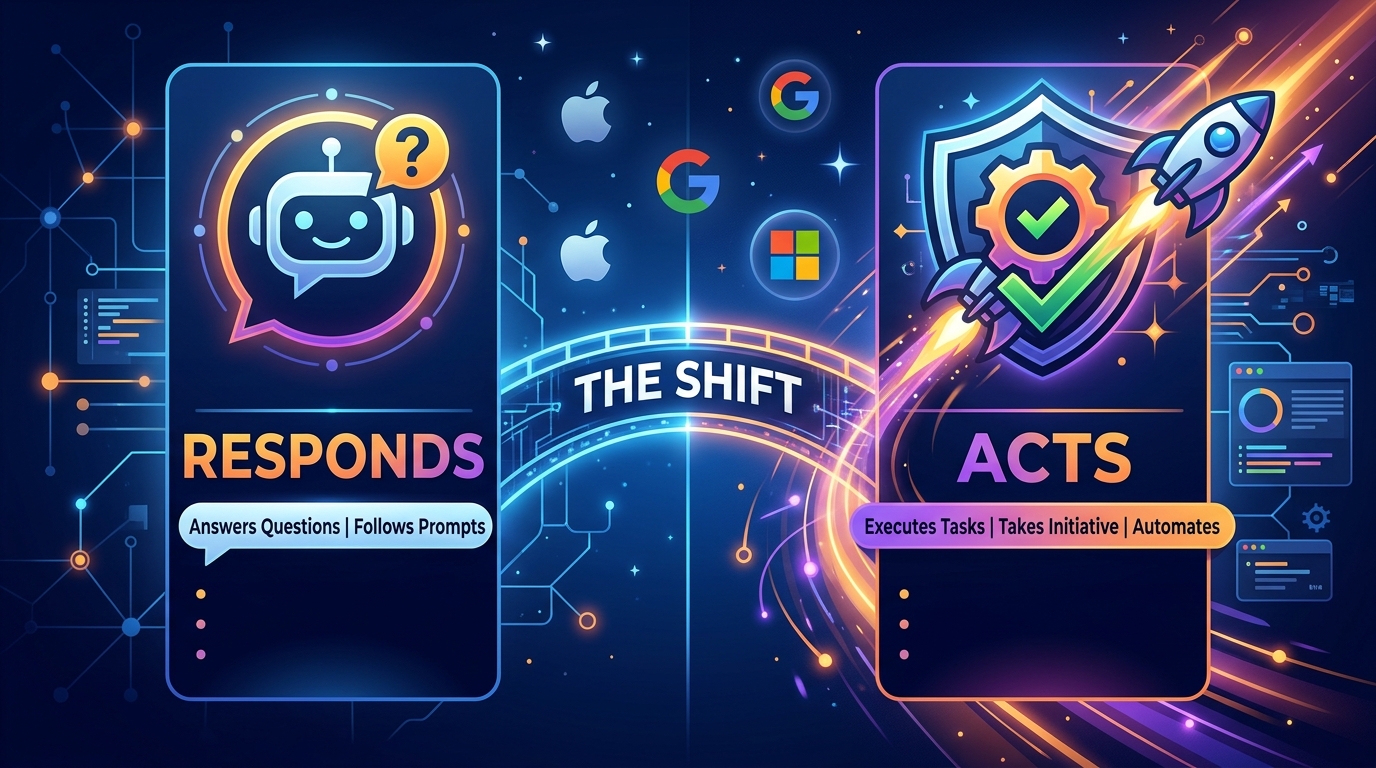
If you have used ChatGPT, Claude, or Gemini, you know what a chatbot does. You ask a question. It answers. You ask another question. It answers again.
But a quieter, more profound shift is happening in AI labs and data centers. Industry leaders are pouring billions into building something that does not just talk—it acts. These are AI agents, and they represent the most significant change in enterprise computing since the move to the cloud.
Every major technology company is building them. Apple is rebuilding Siri from the ground up to become an “always-on agent”. Google is creating an entire “agentic ecosystem” designed to become the operating system of the enterprise. Microsoft is betting that agents will make up 20% of every workforce within years.
This article explains why AI agents are different from chatbots, how the big three tech giants are approaching them, and what this means for the future of work and technology.
What Exactly Is an AI Agent?
An AI agent is an autonomous, goal-driven system that can reason through complex tasks, decide which tools or APIs to use, and execute actions across multiple applications with minimal human intervention.
If a chatbot is like a receptionist who answers questions, an AI agent is like a proactive employee who reads your email, researches the market, books your flights, and sends you a calendar invite—without you lifting a finger.
Several fundamental characteristics distinguish agents from simple chatbots:
- Autonomy & Initiative: Chatbots wait for prompts. Agents can break down a stated goal into multiple steps and execute them without being told what to do next. A single goal can turn into several smaller actions, and the agent handles each one in sequence. Give a chatbot a three‑step task and it will likely stop after the first step; an agent can carry out all three before asking for new instructions.
- Tool Use & Multi‑step Execution: Chatbots are limited to generating text or, at best, making simple API calls. Agents are designed to plan, act, and observe. They can write code, call external services, interact with other agents, and adapt when things go wrong. This allows them to complete tasks that span across apps—pulling data from an email, analyzing it in a spreadsheet, and drafting a summary in a document.
- Memory & Personalization: Chatbots typically remember only the current session. Agents can maintain context over long‑running projects, recall past decisions, and personalize actions based on your work history, related files, meetings, and communications.
- Governance & Observability: Because agents can take real‑world actions, they need guardrails. Enterprise agents operate with approvals, audit logs, role‑based access controls, and runtime monitoring. Everything an agent does is traceable and reversible.
The short version, as the Slack team put it: chatbots respond, agents resolve.
The Market Explosion: Why the Race Is Happening Now
The shift from chatbots to agents is not theoretical. It is happening at extraordinary speed.
In 2025, the market for AI agents was worth 8.03 billion. By 2026, it is expected to reach 11.78 billion, a compound annual growth rate of nearly 47%. By 2034, the market could balloon to $251 billion.
Gartner predicts that spending on agentic AI will reach nearly $202 billion in 2026—141% more than in 2025. By 2027, spending on agentic AI will outpace spending on chatbots and virtual assistants.
Enterprise adoption is accelerating even faster. Gartner forecasts that 40% of enterprise applications will feature task‑specific AI agents by the end of 2026, up from less than 5% just one year earlier. IDC projects that the number of global 2000 agents will grow tenfold by 2027, and the number of token and API calls will grow a thousandfold. By 2029, more than 1 billion AI agents will be in use worldwide—40 times the number in 2025.
This is not a niche trend. It is a fundamental restructuring of how software is built and used.
Apple’s Approach: The Always‑On Personal Agent
Apple’s strategy is the most personal of the three: transform the device in your pocket into an AI agent that works across your entire digital life.
The centerpiece is a completely rebuilt Siri, which Apple has been working on for years under internal code names. According to plans revealed by multiple sources, the new Siri is moving away from being a voice assistant and becoming an “always-on agent” that can tap into personal data and take action across apps.
The user interface makes this agent instantly accessible. In iOS 27, users will be able to swipe down from the top center of the screen anywhere in the operating system to reveal a “Search or Ask” bar in the Dynamic Island. This turns every app into an AI entry point. Whether you are reading an email, scrolling social media, or composing a note, the agent is one swipe away.
Under the hood, Apple is relying on a framework called App Intents, which allows Siri to do more than just open apps—it can now manipulate them at a granular level. Older versions of Siri could open a spreadsheet; the new agent can edit its cells, apply formulas, and email the results.
When an agent handles a request, users can swipe down on its floating results card to enter a threaded conversation mode, where they can continue the dialogue, ask follow‑up questions, and see inline cards for weather, notes, and upcoming appointments.
Apple is also opening its AI platform to third‑party providers through a mechanism called Extensions. The company has signed a deal with Google to use a Gemini‑based model for some Apple Intelligence features, and is testing integration with Anthropic’s Claude.
All of this is designed to keep users inside the Apple ecosystem rather than defecting to ChatGPT or Gemini. The new Siri is not just catching up—it is setting a new standard for what a personal AI agent can be.
Google’s Approach: The Enterprise Agent Operating System
Google is taking a fundamentally different approach. While Apple focuses on the individual user, Google is building an agentic operating system for the enterprise.
At Google Cloud Next 2026, the company unveiled the Gemini Enterprise Agent Platform, a complete management platform for building, deploying, orchestrating, governing, and monitoring AI agents. The platform moves beyond isolated chatbots to enable teams of agents that collaborate across the enterprise.
The shift is dramatic. Earlier versions of Gemini Enterprise were essentially enterprise chat applications. The new platform is not just a tool for humans—it is an infrastructure for agents.
Google has also launched the Gemini Enterprise Agent Ready (GEAR) program, a destination for learning, building, deploying, and scaling AI agents powered by the new Google Skills platform. The company is positioning itself to become the “Windows of the agentic era” —the control plane through which enterprises manage their digital workforces.
Google has not abandoned consumer agents entirely. The company has integrated Gemini AI into Chrome with a massive context window, allowing it to read entire web pages and assist with browser tasks. But the real focus is on the enterprise.
By shifting focus toward tools like the Jules coding agent and Gemini Code Assist, Google is prioritizing the transformation of the global software industry over the convenience of automated web browsing. Project Jarvis, which was designed to operate within Chrome by interpreting screenshots and executing mouse clicks, has faced significant hurdles; the world of software engineering offers a controlled environment with clear rules and an immediate return on investment.
Google’s ambition is clear: when every enterprise runs hundreds or thousands of AI agents, Google wants to be the operating system that manages them all.
Microsoft’s Approach: The AI Coworker
Microsoft is taking the most aggressive stance on agents in the workplace. The company predicts that agents will make up 20% of every team in the near future.
The centerpiece of Microsoft’s strategy is Copilot Cowork, a feature designed to execute multi‑step, persistent tasks within documents, spreadsheets, presentations, and emails, and to manage these tasks over extended periods. Unlike a chatbot that responds to a single prompt and stops, Copilot Cowork can take on ongoing projects. It can build a briefing plan for an upcoming meeting, break the request into tasks, and carry out the work from start to finish. All actions are trackable, reversible, and aligned with the context of the user’s recent work.
To centralize management and governance of AI agents, Microsoft has launched Agent 365, a unified control plane that provides IT and security leaders with a single place to observe, secure, and govern every agent operating across the organization.
Microsoft is also pursuing a multi‑model strategy. Copilot Cowork leverages Anthropic’s Claude agent technology, marking the first time this model has been embedded directly into Microsoft 365 Copilot. The platform can select the best AI model for any given task, automatically applying the right model grounded in enterprise context and protected by Microsoft’s security controls.
The company has also integrated agentic capabilities directly into core Microsoft 365 applications. In Word, Excel, PowerPoint, and Outlook, Copilot can create, edit, and refine content within the environment where users are already working—adding formulas in Excel, producing slides in PowerPoint conforming to organizational standards, or drafting emails in Outlook.
Microsoft’s long‑term vision is that the interface to everything becomes a conversation. As one Microsoft executive put it, the era of application‑centric workflows is ending as companies move to an “agent‑centric system of work.” The ultimate expression of that shift: the only app people ever have to open is Copilot.
Real-World Impact: How Agents Are Being Used Today
These strategies are not speculative. Across industries, AI agents are already delivering measurable results.
At Tata Steel, the company has rolled out over 300 specialized AI agents within nine months, streamlining workflows such as invoice processing, GST classification, and contract analysis. By automating repetitive tasks, Tata Steel is reallocating workforce capacity toward higher‑value strategic roles.
At Oracle, the company launched 12 autonomous AI applications for finance and supply chain operations. These agents can make and execute decisions within business processes without human intervention—a significant departure from traditional AI assistants that merely recommend actions. A Collectors Workspace agent lowers days sales outstanding by automatically managing collection activities. A Claims Settlement Workspace handles exception‑heavy settlement processes that typically require significant manual review.
NeuBird’s AI Site Reliability Engineering agent resolved 230,000 alerts autonomously in 2025, saving 12,000 engineer hours and $1.8 million in engineering spend.
In customer service, AI agents resolve up to 40% of inquiries across chat, email, and voice channels. Organizations implementing autonomous AI systems report 28% improvement in issue resolution time and 19% increases in first‑contact resolution rates.
Across finance, manufacturing, IT operations, and customer support, the pattern is the same: agents are not just helping humans work faster—they are beginning to work alongside them as digital colleagues.
What’s Next: The Five Stages of Agentic AI
Gartner has outlined a five‑stage roadmap that describes how agentic AI will become integrated into enterprise systems.
The first stage, already underway, involves embedded AI assistants within applications. These tools help boost productivity but still require direct human supervision. Gartner warns that this stage has seen “agentwashing,” where tools are branded as agents despite lacking meaningful autonomy.
By 2026, Gartner expects a second stage: task‑specific AI agents that can complete well‑defined business processes independently, such as generating reports, managing transactions, or coordinating workflows. Security, compliance, and governance are crucial as companies delegate more responsibility to these systems.
The third stage, projected for 2027, involves collaborative AI agents that work together within applications to complete complex tasks. This requires interoperability standards and strong controls to avoid unintended outcomes.
By 2028, enterprises may begin to experience ecosystems of AI agents that operate across applications. This could fundamentally change how users interact with enterprise systems, replacing traditional user interfaces with workflows orchestrated by agents. At this stage, companies may need new business models and ethical frameworks to manage the interactions between autonomous systems.
The final stage, anticipated by 2029, is democratized agentic AI, where knowledge workers will be able to create and guide AI agents customized for organizational needs. Gartner expects at least half of knowledge workers to participate in developing or managing AI agents by that time.
The Challenges Ahead
The transition to agentic AI is not without risks. Gartner warns that by the end of 2027, more than 40% of agentic AI projects may be put on hold because prices are rising, business value is unclear, or there are insufficient risk controls.
Governance is the biggest hurdle. Agents can make mistakes, take unintended actions, or operate in ways that violate compliance requirements. Enterprises need robust frameworks for approving agent actions, auditing their decisions, and intervening when things go wrong.
There is also the risk of fragmentation. With multiple vendors building agent platforms, the industry faces interoperability challenges. Google is building its ecosystem. Microsoft is building another. Apple is building a third. How these agent systems will work together—or whether they will work together at all—remains an open question.
Conclusion: The Age of the Agent Begins
We are at a turning point in the history of computing. For three decades, the dominant paradigm has been application‑centric—you open a program, you use its features, you close it. The next era will be agent‑centric—you state a goal, and a team of digital workers, in coordination with your human colleagues, makes it happen.
Apple is building the personal agent that lives on your phone. Google is building the enterprise platform that orchestrates thousands of agents across your organization. Microsoft is building the AI coworker that sits alongside your human team.
Each approach is different. But all three point in the same direction: the future of software is not something you operate. It is something that operates for you.
The chatbots answered. The agents act. And that difference is about to change everything.


Leave a Reply