
Last updated: May 8, 2026 | Reading time: 11 minutes
Introduction – An Unusual Deal
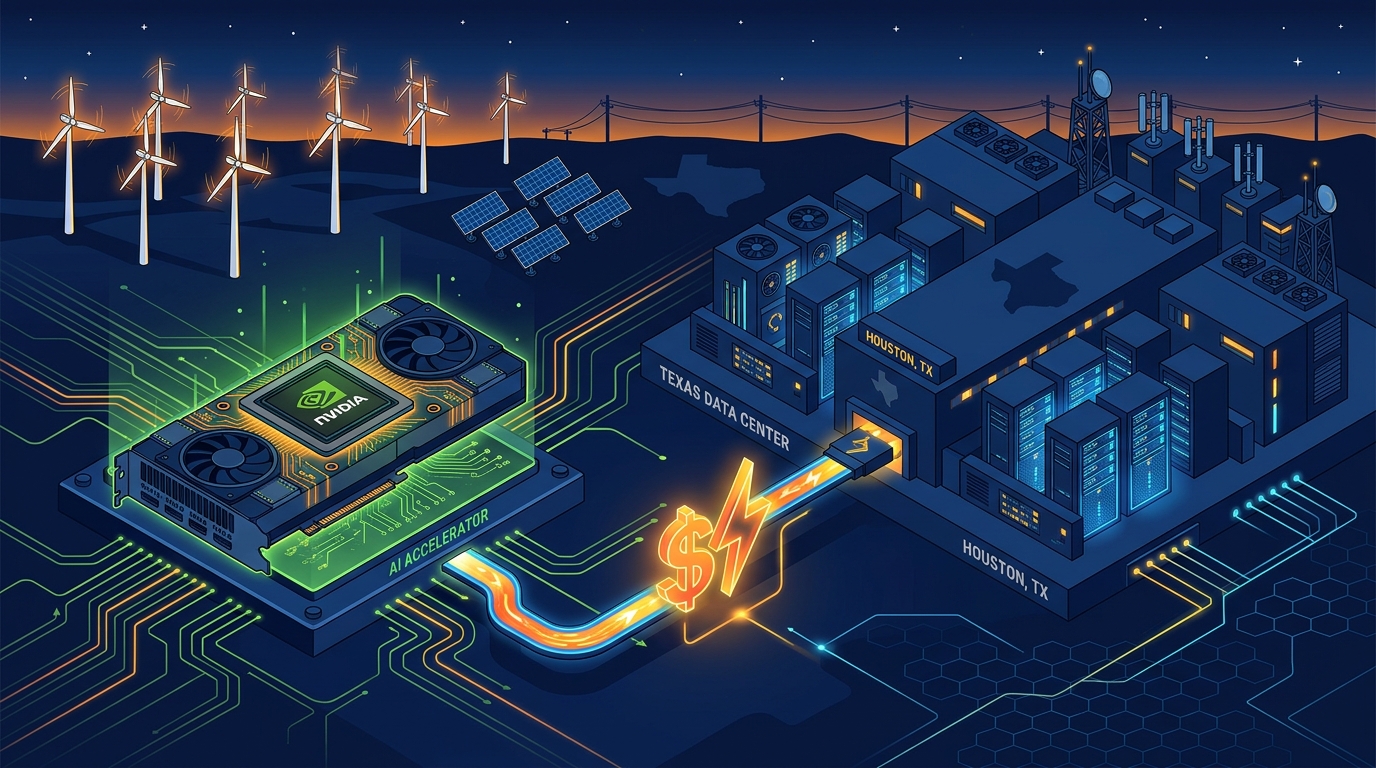
On May 7, 2026, Nvidia announced a surprising two‑part deal with IREN, a former Bitcoin miner turned AI cloud provider:
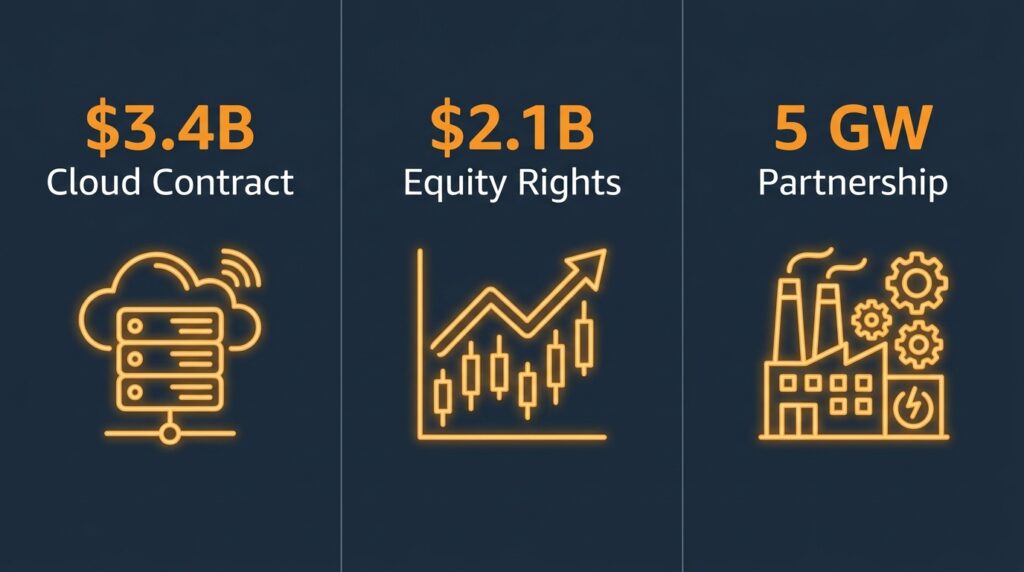
- $2.1 billion potential equity investment (right to buy up to 30 million shares at $70 each)
- $3.4 billion, five‑year managed cloud services contract for Nvidia’s internal AI workloads
At first glance, this seems odd. Nvidia is the world’s largest AI chip maker, with gross margins above 70%. Why would it pay another company billions of dollars to run its own chips? And why invest directly in a data center operator?
The answer reveals a fundamental shift in the AI industry: Nvidia is no longer just a chip designer. It is becoming an AI infrastructure financier and capacity guarantor.
This article explains the strategic logic behind the IREN deal, what Nvidia gains, what IREN gains, and why this is part of a larger pattern that will reshape how AI data centers are built and funded.
Quick Summary: What the Deal Actually Is
| Component | Value | Terms | Purpose |
|---|---|---|---|
| Managed cloud contract | $3.4 billion | Five‑year | Nvidia pays IREN to run Nvidia GPUs for its own internal AI workloads (training, inference, R&D) |
| Equity investment | Up to $2.1 billion | Five‑year right to buy 30M shares at $70/share ($0.70 pre‑split equivalent) | Conditional on regulatory approval and IREN meeting performance milestones |
| Strategic infrastructure partnership | 5 GW pipeline | Joint deployment of Nvidia DSX‑aligned AI factories | Flagship: 2 GW Sweetwater campus in Texas, plus sites in Canada, Australia, and the UK |
Key date: May 7, 2026 – announcement made after market close.
1. The Capacity Problem – What Nvidia Can’t Solve Alone
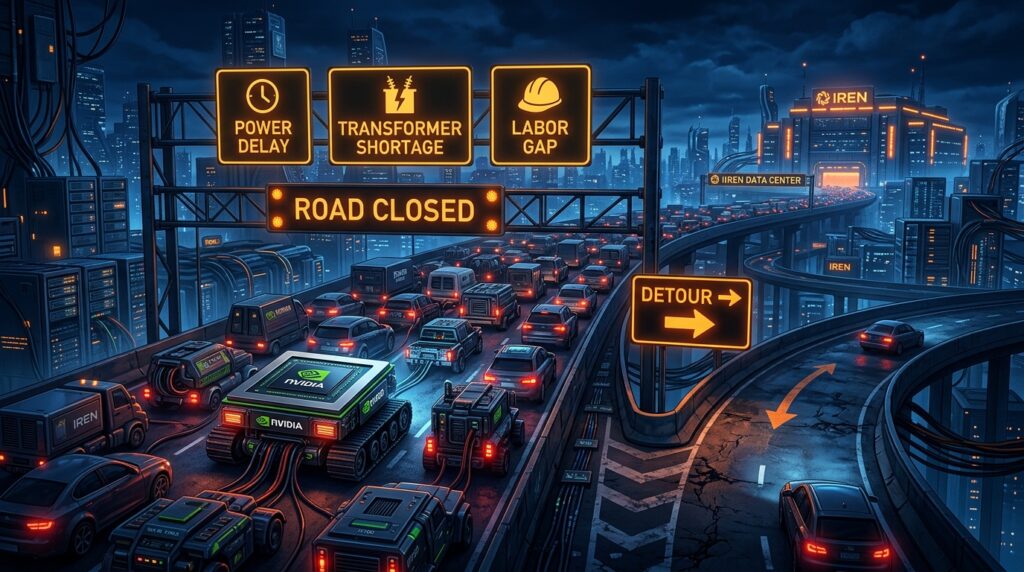
As we explained in our earlier article, “Why AI & Cloud Infrastructure Demand Is Outpacing Supply”, the AI build‑out is throttled by five physical constraints:
- Power grid interconnection (3–8 year wait times)
- Transformer and switchgear shortages (24+ month lead times)
- Skilled labor gaps (95% of data center builders report shortages)
- Water and cooling infrastructure limits
- Semiconductor packaging bottlenecks (CoWoS)
Nvidia can design the best chips in the world, but it cannot build data centers fast enough to deploy them. Even its own internal AI workloads – training new models, running inference for its own products – face capacity shortages.
The IREN deal is Nvidia’s direct response: instead of waiting for hyperscalers (Google, Amazon, Microsoft) to build out capacity, Nvidia will partner with specialized data center operators to secure guaranteed capacity for its own needs.
2. What Nvidia Gets – Guaranteed Capacity and a Pipeline to 5 GW
The IREN deal gives Nvidia three critical things:
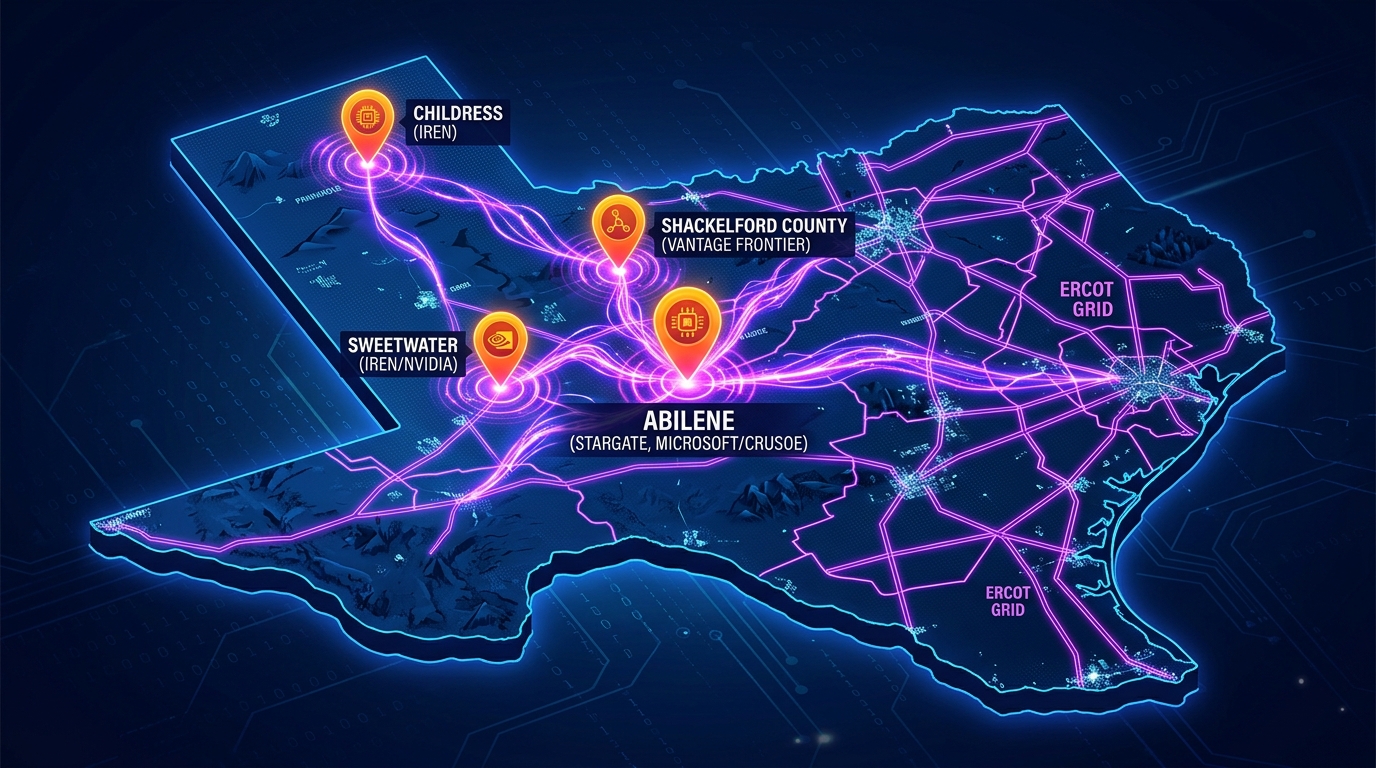
A) Immediate capacity: 60 MW in Childress, Texas
IREN’s Childress site (near Abilene) is already operational. Under the $3.4 billion cloud contract, Nvidia gains access to ~60 MW of GPU capacity for its own internal workloads – not for resale. This is effectively Nvidia renting time on its own chips, but operated by IREN’s team.
Why would Nvidia pay for this instead of running its own data centers? Because building new capacity would take 2–4 years. IREN already has the power, land, cooling, and permits. Nvidia gets capacity now.
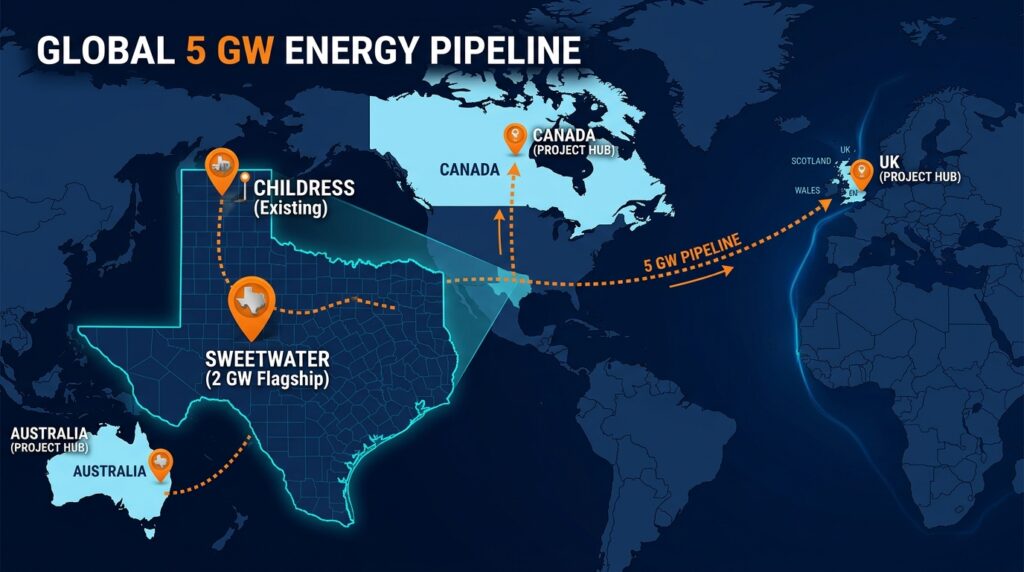
B) A 5 GW pipeline, including the 2 GW Sweetwater flagship
The strategic partnership commits both companies to jointly develop up to 5 gigawatts of Nvidia DSX‑aligned AI factories across IREN’s global pipeline:
- Sweetwater, Texas – a massive 2 GW campus (the flagship)
- Other IREN sites – Childress (existing expansion), Canada, Australia, and the UK
For context, 5 GW is roughly the output of five large nuclear reactors. This is not a small project – it is a multi‑year, multi‑billion dollar infrastructure build‑out.
C) A hedge against hyperscaler competition
Google, Amazon, and Microsoft are all building their own AI chips. Over time, they may reduce their Nvidia purchases. By securing its own dedicated data center capacity through partners like IREN, Nvidia ensures it has a place to deploy its chips even if the hyperscalers become competitors rather than customers.
3. What IREN Gets – Validation, Scale, and a Turnkey AI Software Stack
IREN’s journey is remarkable. Three years ago, it was a mid‑tier Bitcoin miner. Today, it is a key Nvidia partner. The deal gives IREN:
A) Validation of its pivot to AI
IREN has been quietly building AI‑ready data centers while most miners focused on crypto. This deal is the ultimate endorsement: Nvidia has chosen IREN as a strategic partner, not just a customer.
B) Financial firepower
The $3.4 billion cloud contract provides predictable, long‑term revenue – a foundation for raising additional debt and equity to fund the 5 GW pipeline. The potential $2.1 billion equity investment (if Nvidia exercises the warrants) would give IREN even more capital.
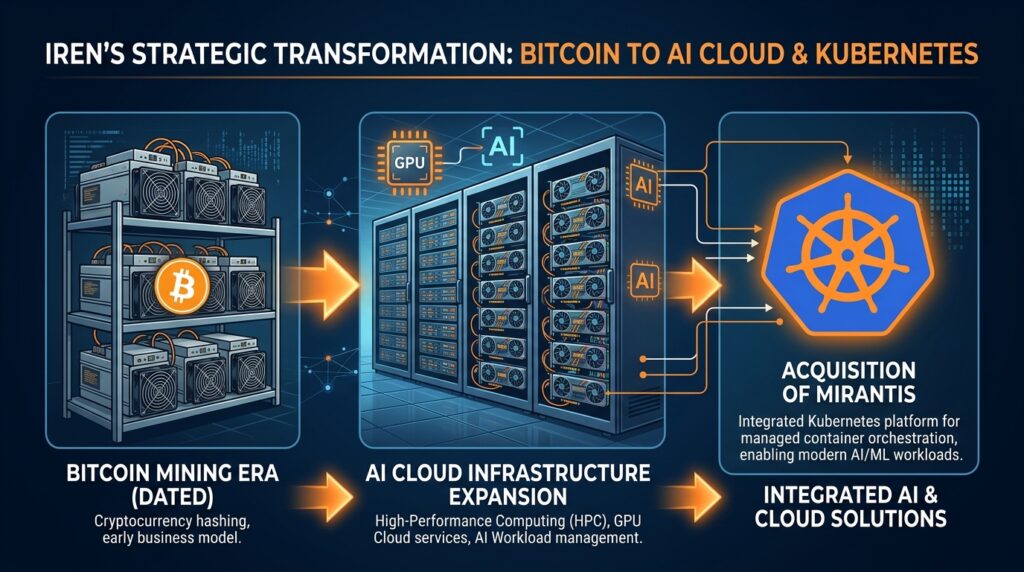
C) Software capability via Mirantis
The same week as the Nvidia deal, IREN acquired Mirantis, a well‑known Kubernetes platform. This is critical because:
- Managing thousands of GPUs for AI workloads requires sophisticated orchestration.
- Mirantis gives IREN the software stack to offer managed AI cloud services, not just raw compute.
- This makes IREN more valuable to both Nvidia and future enterprise customers.
Key insight: IREN is no longer a commodity power‑shed operator. It is becoming a full‑stack AI cloud provider with its own software and data center infrastructure.
4. The “Full‑Stack Moat” – Nvidia’s Expanded Strategy
In our earlier article, “Why Is Nvidia Still Dominating the AI Chip Market?” , we described Nvidia’s moat as including:
- CUDA software ecosystem
- Full‑stack integration (chip → server → networking → cooling)
- Developer mindshare
- Scale and manufacturing
- Networking (InfiniBand, NVLink)
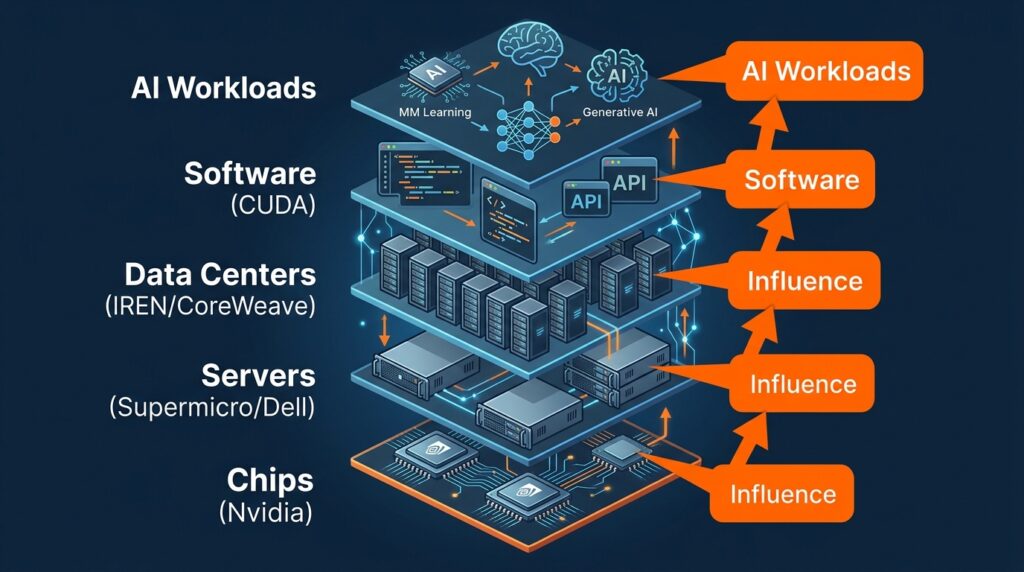
The IREN deal adds a new layer to the moat: data center capacity ownership/partnership.
Nvidia cannot legally own and operate its own utility‑scale data centers in many jurisdictions (regulatory, tax, and utility reasons). But it can partner with operators like IREN, CoreWeave, and Nebius to effectively control the capacity.
What Nvidia is building:
- Chips: Nvidia designs and sells.
- Servers: Partners like Supermicro, Dell, HPE build Nvidia‑certified systems.
- Data centers: Partners like IREN, CoreWeave, and Nebius operate Nvidia‑aligned AI factories.
- Software: CUDA and the AI Enterprise stack run across all of it.
By controlling the financial and technical relationships at every layer, Nvidia ensures that its chips are the only logical choice for anyone building large‑scale AI infrastructure.
5. Why This Is a Template – The CoreWeave and Nebius Deals
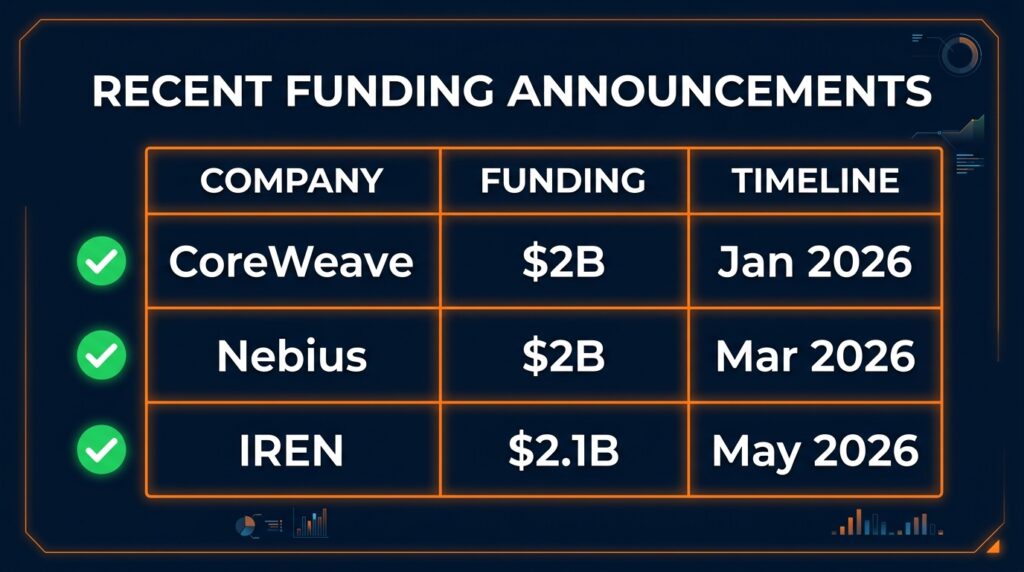
The IREN deal is not an isolated event. It follows a clear pattern:
| Partner | Date | Investment Amount | Type |
|---|---|---|---|
| CoreWeave | January 2026 | $2 billion | Equity investment + cloud contract |
| Nebius (ex‑Yandex) | March 2026 | $2 billion | Equity investment + cloud contract |
| IREN | May 2026 | Up to $2.1 billion | Equity rights + $3.4B cloud contract |
What all three have in common:
- Each is a specialized data center operator, not a hyperscaler.
- Each has existing power and land – the scarce resources.
- Nvidia gets capacity now via cloud contracts.
- Nvidia gets future capacity via equity‑backed partnerships.
- Nvidia does not take operational control – it stays a partner, not a utilities company.
This template allows Nvidia to scale its own internal AI capacity without becoming a data center developer. It also gives Nvidia a seat at the table for up to 10+ GW of new AI factory capacity over the next 5 years.
6. What This Means for the AI Infrastructure Market
The Nvidia‑IREN deal (and the pattern it represents) has several implications:
For Nvidia
- Reduces reliance on hyperscalers for its own internal compute needs.
- Creates a new revenue stream – equity upside from successful partners.
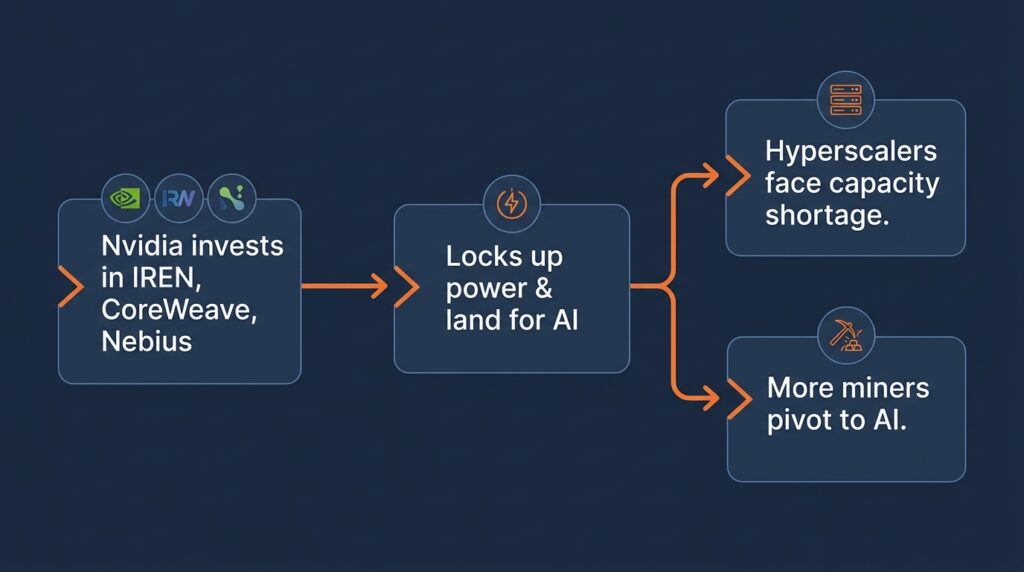
- Locks up scarce power and land that competitors might have used.
For Data Center Operators
- Pivoting from crypto to AI is now a validated business model. IREN’s stock surged on the news.
- Expect more miners to follow (Hut 8, Bitfarms, Cipher) and to announce similar partnerships.
- Operators with existing power contracts are now strategic assets.
For Hyperscalers (Google, AWS, Microsoft)
- They face new competition for power and land. If Nvidia partners lock up 5+ GW, that capacity is not available to hyperscalers.
- Nvidia’s own cloud demand will grow, potentially competing with their AI services.
For Regulators
- Antitrust scrutiny may increase. Nvidia is using its chip dominance to secure downstream capacity – similar tactics have attracted regulatory attention in the past.
- The EU and US may review these partnership structures.
Frequently Asked Questions (FAQ)
Q1: Why doesn’t Nvidia just build its own data centers?
A: Nvidia is a chip designer, not a utility company. Building and operating data centers is capital‑intensive, slow (3–8 years for grid interconnection), and requires a different skill set. Partnering with specialists is faster and more efficient.
Q2: Is Nvidia becoming a cloud provider?
A: Not directly. The managed cloud services it buys from IREN are for Nvidia’s own internal workloads – training its own models, running inference for its own products. It does not resell that capacity to third parties. However, its partnerships with CoreWeave and others could evolve into broader cloud offerings.
Q3: How does this affect the supply of GPUs for startups?
A: In the short term, it may reduce available capacity, because Nvidia is essentially “reserving” GPU time for itself. In the long term, the new capacity built by IREN and other partners will increase total supply.
Q4: What is “DSX‑aligned” in the announcement?
A: DSX is Nvidia’s reference architecture for AI factories – a standardized design for power, cooling, networking, and server layout. “DSX‑aligned” means IREN’s facilities are built to Nvidia’s specifications, ensuring optimal performance and compatibility.
Q5: Is the $2.1 billion investment guaranteed?
A: No. Nvidia has the right to buy up to 30 million shares at $70 each over five years, subject to regulatory approval and IREN meeting certain performance milestones. It is not an upfront cash payment.
Q6: What happens to IREN’s Bitcoin mining operations?
A: IREN continues to mine Bitcoin but is pivoting most of its capacity to AI. The Childress site is already dual‑use. The Sweetwater 2 GW campus will be primarily AI.
Q7: How does this connect to your earlier article on AI infrastructure constraints?
A: Directly. The power, labor, and transformer shortages we described are the reason Nvidia is doing these deals. IREN already has power and permits – the scarcest resources. Nvidia is buying access to those resources rather than building from scratch.
Q8: Will other chip makers (AMD, Intel) copy this strategy?
A: Possibly. AMD has less cash and a smaller market cap, but it could partner with mining operators. Intel has its own data center business but may also seek partnerships. However, Nvidia’s financial scale gives it a unique advantage.
Conclusion – Nvidia, the Infrastructure Financier
The IREN deal is not about chips. It is about power, land, and time.
Nvidia cannot wait 3–8 years for new grid connections. It cannot solve the transformer shortage or the skilled labor gap. But it can pay operators who already have those resources to run Nvidia hardware for Nvidia’s own needs.
This is a pragmatic, defensive move. By locking up 5 GW of capacity through partners like IREN, CoreWeave, and Nebius, Nvidia ensures that its internal AI workloads – the training of its own models, the inference for its own products – have a home, even as hyperscalers build their own chips and compete for the same limited resources.
Nvidia is no longer just a chip designer. It is becoming an AI infrastructure financier and orchestrator. And the IREN deal is a perfect example of this new strategy in action.
References & Further Reading
- Reuters – “Nvidia to invest up to $2.1 billion in IREN as part of AI data center deal” (May 7, 2026)
- Bloomberg – “Nvidia’s $5.5 Billion Bet on AI Data Centers Shows New Strategy” (May 8, 2026)
- IREN investor presentation – “Strategic Partnership with Nvidia” (May 2026)
- CoreWeave – “Nvidia Strategic Investment Announcement” (Jan 2026)
- Nebius – “Nvidia Investment and Partnership” (Mar 2026)
- The Information – “Nvidia’s Quiet Campaign to Lock Up Data Center Capacity” (May 2026)
If you found this explainer useful, check out our related articles:
👉 Why AI & Cloud Infrastructure Demand Is Outpacing Supply (5 Constraints)
👉 Why Is Nvidia Still Dominating the AI Chip Market? (7 Moat Factors)
👉 Why Google, Microsoft, and Amazon Are Building Their Own AI Chips (6 Reasons)
📬 Subscribe to ExplainThisTech for more “why” breakdowns of the technology shaping our world.


Leave a Reply