
Editors’ note: This article is updated for 2026. The lines are blurring, but the distinction between chatbots and AI agents is the single most important concept in enterprise AI today.
You have asked a chatbot to reset a password. You have asked a search engine to summarize a document. But when you ask an AI to write a 10-page report, pulling data from your CRM, checking it against the latest market trends, and emailing the draft to your manager, you are no longer chatting.
You are delegating. This shift from conversation to completion is the core distinction between a Chatbot and an AI Agent.
For years, the lines have been blurry. A “smart” chatbot and a “simple” agent can feel similar. But failing to recognize the strategic difference is now a major business risk. Gartner predicts that by the end of 2026, 40% of enterprise applications will be integrated with task-specific AI agents—a massive jump from less than 5% in 2025. In other words, the age of the AI digital worker has arrived.
This article breaks down the key differences in architecture and autonomy, explains why this shift is accelerating, and gives you a practical guide to choosing the right tool for your needs.
🤖 Quick Verdict: Chatbots vs. AI Agents (2026)
| Feature / Capability | Chatbot (e.g., Customer Support) | AI Agent (e.g., Digital Coworker) |
|---|---|---|
| Primary Function | Responds to user input within a conversational flow | Executes tasks autonomously to achieve a goal |
| Core Operation | Reactive & Scripted: Follows predefined intents or a conversation tree | Proactive & Goal‑driven: Plans, acts, and iterates using a plan–act–observe loop |
| Reasoning & Logic | Minimal; uses pattern matching or simple API calls | Complex; uses LLMs for reasoning, planning, and tool selection |
| Tool Usage | None or very limited (e.g., check weather, set a timer) | Full integration: can use APIs, search the web, run code, and operate other software |
| Governance | Light controls (content filtering) | Heavy controls: needs approvals, audit logs, RBAC, and runtime monitoring |
| Cost | Low (per API call or subscription) | Higher (compute-intensive, but high-value) |
| Best For | FAQ, basic customer service, lead qualification | Automating multi‑step business processes, research, data analysis |
The Architectural Difference: From Conversation to Completion
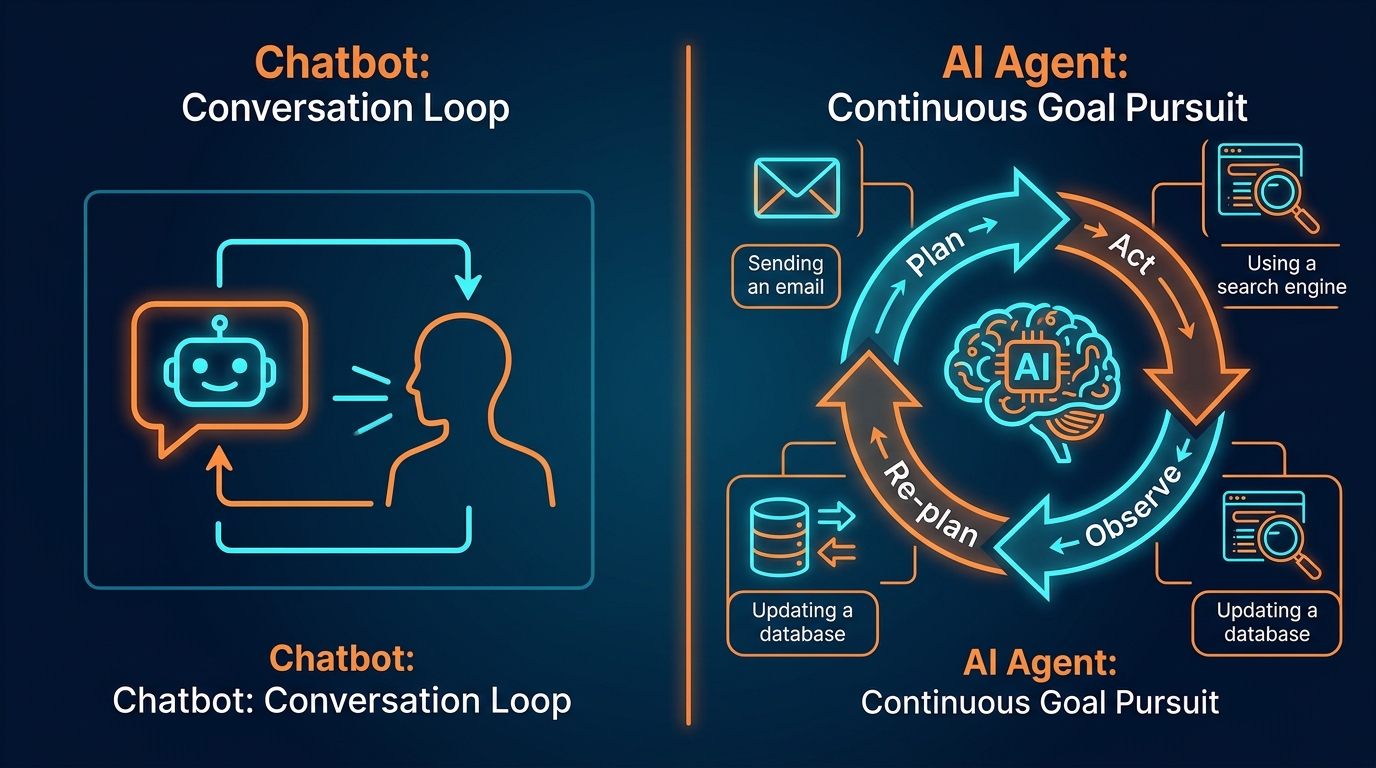
A chatbot is a read‑only system. It interprets your input and generates a text-based response. Its job ends when the answer is delivered. It can answer an email, but it cannot send it.
An AI agent, by contrast, is a read‑write system. It is designed to operate within a loop: it reasons about a goal, calls external tools (APIs, databases, web browsers), observes the results, and then re-plans based on what it learned—continuing this cycle until the task is complete. It does not just answer; it acts.
🔄 The Agentic Loop
A standard chatbot follows a linear path: Query → Retrieve → Respond.
An AI agent operates on a recursive loop:
- Plan: Decompose a complex objective into a series of logical steps.
- Act: Execute the first step by calling a tool (e.g.,
search_web,write_to_db,send_email). - Observe: Receive the result of that tool call.
- Re‑plan: Based on the outcome, decide the next step. If a tool fails, it can adapt and try a different approach. This loop repeats until the original goal is met or a critical error occurs.
From Scripts to Reasoning: The Intelligence Gap
There is no single definition, but the industry generally sees a spectrum of automation. The simplest chatbots follow rigid scripts, known as intents, for basic FAQs. Next are generative AI chatbots, which use LLMs to answer freely formulated questions.
The critical leap to an AI agent is its ability to use tools and to reason about how to achieve a goal. An agent is not just a more advanced chatbot; it represents a different architectural paradigm, moving from a conversational interface to an autonomous task executor.
Governance: The Feature That Defines the Enterprise Agent
The most significant difference for enterprises is governance. A rogue AI agent can be disastrous.
Because an agent can take real-world actions (sending emails, updating databases, transferring money), enterprise AI agents require vastly different control mechanisms. These include audit trails to track every action, RBAC (Role-Based Access Control) to limit permissions, runtime monitoring to watch for anomalies, and approval workflows where an agent must request permission before executing sensitive actions.
This need for governance is why you will rarely see fully autonomous agents in highly regulated environments without “human-in-the-loop” oversight.
Why the Shift to Agents Is Accelerating Now
If agents have been theoretically possible, why is 2026 the breakout year for enterprise adoption?
The answer is maturity. The necessary infrastructure has finally coalesced: Large Language Models (LLMs) are now reliable enough for multi-step reasoning, cloud APIs are abundant and standardized, and vendors are releasing robust agent frameworks. Forrester has identified “Agentic AI” as a key trend, noting that 2026 is the year enterprises are moving beyond isolated pilots to strategic deployment.
Gartner’s forecast is clear: spending on agentic AI is skyrocketing, expected to surpass spending on traditional chatbots by 2027. Meanwhile, overall AI spending is also growing at an explosive rate, projected to reach $2.59 trillion in 2026, a 47% increase over 2025.
Chatbot vs. AI Agent: A 2026 Practical Guide for Enterprises
When deciding what to build or buy, ask these questions. For high-volume, low-risk interactions like customer support triage, a Generative AI Chatbot is often the best choice. For automating a multi-step business process, like “analyze quarterly reports and draft a summary email,” choose an AI Agent.
If you are building a customer-facing FAQ bot, stick with a chatbot. If you are building an internal tool to automate a complex business workflow, use an AI agent. Your choice ultimately hinges on the complexity of the task and the level of acceptable risk.
Frequently Asked Questions (FAQ)
Q1: Is ChatGPT a chatbot or an AI agent?
A: ChatGPT (in its standard form) is a chatbot. It excels at conversation and reasoning but cannot autonomously execute a multi-step plan. ChatGPT with “Plugins” or “Actions” enabled behaves more like an agent, as it can use external tools to complete tasks.
Q2: When should I use an AI agent instead of a chatbot?
A: Use a chatbot for information delivery, FAQ, and low-risk Q&A. Use an AI agent when you need to automate a workflow that requires taking action on other systems (e.g., creating a Jira ticket, updating a database). Always consider the cost vs. value, as agents are more expensive to run.
Q3: Are AI agents safe for enterprise use?
A: With the right governance in place (audit logs, RBAC), yes. Without it, they are a significant risk. Enterprise-grade agent platforms are building these controls in from the ground up.
Q4: What does “agentic AI” mean?
A: It refers to AI systems (agents) that can pursue complex goals with a degree of autonomy, using reasoning and tool use, to act on a user’s behalf.
Q5: What are some real-world examples of AI agents?
A: An AI agent can act as a research assistant that searches the web, summarizes findings, and compiles a report; a sales agent that qualifies leads by checking a CRM, searching LinkedIn, and drafting personalized emails; or an IT helpdesk agent that diagnoses an issue, resets a user’s password, and creates a ticket for unresolved problems.
Conclusion: The Future Is Not a Chatbot
The age of the simple conversational bot is not over. It has a clear, valuable place in customer service. But the real economic engine of the 2026 enterprise will be the AI agent. It is the difference between a tool that talks and a tool that works.
From your company’s analytics, it is clear that your audience is already asking this question. By publishing this definitive guide, you will be answering the “why” behind one of the biggest shifts in modern technology and positioning your site as a go-to authority on the subject.
If you found this explainer useful, check out our related articles:




Leave a Reply