You’ve heard about AI everywhere—ChatGPT, self-driving cars, and Netflix recommendations. But when someone asks, “How does it actually work?”, most of us draw a blank. The good news? You don’t need a computer science degree to understand it. In fact, if you can understand how a child learns, you can understand how AI works. Let’s break it down—no coding, no math, just plain English.
What Exactly Is Artificial Intelligence?
AI Is Not One Thing—It’s a Category
First, let’s clear up a common confusion. When people say “AI,” they’re not talking about one single tool. AI is actually a broad category of software—like how “vehicles” includes cars, trucks, motorcycles, and bicycles.
Think of it this way: AI is like the word “vehicle.” A self-driving car is AI. The algorithm that recommends your next Netflix show is AI. The voice assistant on your phone is AI. They’re all different, but they all fall under the same big umbrella.
The Simple Definition
So what do all these AI things have in common? At its core, AI is technology that enables machines to perform tasks that typically require human intelligence—like recognizing speech, learning from experience, solving problems, or making decisions.
Here’s a simple way to picture it:
“AI is like giving a computer a brain—but a very specific, limited brain that’s really good at one thing.”
Unlike a human brain that can do thousands of things, an AI brain is usually trained to do just ONE thing exceptionally well.
The Three Ingredients of Every AI System
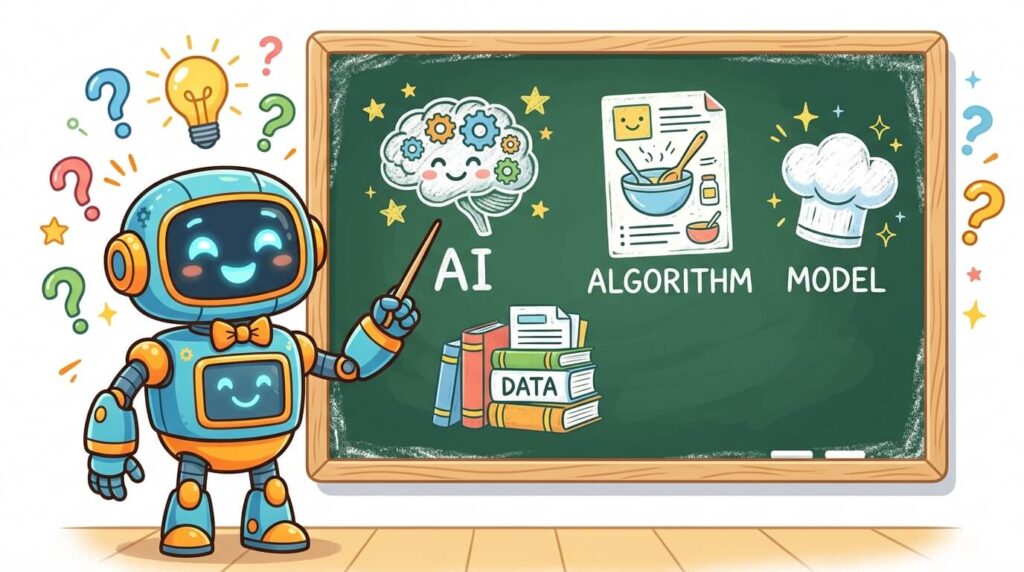
Every AI system—no matter how fancy—relies on three essential ingredients. Think of it like baking a cake:
Ingredient #1: Data (The Food)
Data is to AI what food is to you—without it, AI can’t grow or learn. Data is simply information. It could be:
- Thousands of pictures of cats and dogs
- Millions of Netflix viewing histories
- Hours of recorded human speech
- Years of stock market prices
The more data an AI system has, the better it can learn. It’s like studying for an exam—the more practice questions you solve, the better prepared you are.
Simple analogy: Imagine teaching a child what a dog looks like. You don’t give them a dictionary definition. You show them pictures of dogs, over and over, until they just know.
Ingredient #2: Algorithms (The Recipe)
If data is the ingredients, algorithms are the recipe. An algorithm is a set of mathematical instructions that tells the computer exactly how to learn from the data.
Here’s the key difference between traditional programming and AI:
- Traditional programming: You give the computer a list of rules—”IF this happens, THEN do that. “The computer follows your instructions like a robot.
- AI (Machine Learning): You give the computer data and an algorithm, and the computer figures out the rules all by itself. It discovers patterns on its own.
Simple analogy: Think of an algorithm like a lesson plan. It’s the step-by-step method a teacher uses to help a student learn from examples.
Ingredient #3: Models (The Cook)
The model is the trained system that actually does the work. After the algorithm has processed all the data, it creates a model—which is basically the AI’s “brain.”
Here’s the journey:
- Data goes in (millions of cat pictures)
- The algorithm processes the data (finds patterns: cats have pointy ears, whiskers, and four legs).
- Model is created (the trained brain that can now recognize a new cat it’s never seen before)
Simple analogy: The model is the cook who’s been trained. After studying enough recipes (data) and following the steps (algorithms), the cook can now create new dishes (make predictions) without looking at the recipe every time.
How Does AI Actually Learn? (The Training Process)
Now let’s walk through exactly what happens when an AI system learns something new.
Step 1: Show It Examples
AI learning starts with a massive collection of examples. This is called training data. If you’re building an AI to recognise cats, you feed it 10,000 pictures—some of cats, some of dogs, some of birds.
Simple analogy: Imagine you’re teaching a child to recognise a dog. You don’t give them a dictionary definition. You show them pictures of dogs, over and over, until they just know what a dog looks like.
Step 2: Find the Patterns
The AI’s algorithm starts analysing all those examples. It looks for patterns, relationships, and repeated structures. It might notice:
- Cats usually have pointy ears
- Dogs usually have floppy ears
- Cats have shorter snouts
- Dogs have longer snouts
The AI doesn’t know what “ears” or “snouts” are—it just notices that certain pixel patterns tend to appear together. Over time, it builds a mental map of what “cat-ness” looks like.
Simple analogy: This is like the child who looks at 100 pictures and starts noticing—”Oh, dogs usually have floppy ears and four legs and a wet nose. “The child figures out the pattern all by itself, without anyone telling it.
Step 3: Make Predictions (And Learn from Mistakes)
Once the AI has learned the patterns, you can test it. You show it a new image it has never seen before and ask, “Is this a cat or a dog?”
- If the AI guesses correctly → Great! It learned well.
- If the AI guesses wrong → It adjusts its internal “brain” slightly to do better next time.
This process—guess, check, adjust, repeat—is called ‘training’. The AI does this millions of times until it gets really, really good at the task.
Simple analogy: When a child mistakes a cat for a dog, they learn to look closer next time. AI does the same thing—but at superhuman speed, with millions of examples.
A Simple Analogy: Teaching a Child to Recognize a Cat
Let’s put it all together with one complete analogy.
The Old Way (Rule-Based Programming)
Imagine you’re teaching a child to recognize a cat using a checklist:
“If it has pointy ears AND whiskers AND a tail AND it meows, it’s a cat.”
This works—until it doesn’t. What if the cat is missing a tail? What if it’s a cat that doesn’t meow? What if it’s a dog with pointy ears? The rules break.
This is how traditional programming works. You write a set of rules, and the computer follows them exactly. But life is messy and full of exceptions, so rule-based systems often fail.
The AI Way (Learning from Examples)
Now imagine you teach the child differently. Instead of giving rules, you show the child hundreds of pictures of cats and dogs. After a while, the child just knows what a cat looks like. They can’t explain the rules—they just know.
That’s machine learning. The AI figures out the rules on its own by studying examples.
Analogy Breakdown:
- Data = the teacher showing you pictures
- Algorithm = the lesson plan
- Trained Model = the student who learns to classify what they see
Key difference: Traditional programming is like giving someone a rulebook. AI is like giving someone a library and letting them teach themselves.
What Makes AI “Intelligent”?
Pattern Recognition
AI’s superpower isn’t “thinking” like a human—it’s spotting patterns humans might miss. AI can analyze millions of data points in seconds and find connections we’d never notice.
Simple analogy: AI is like a detective who’s looked at a million crime scenes. They know what to look for because they’ve seen so many examples. They don’t “think” like Sherlock Holmes—they just have so much experience that patterns jump out at them.
Continuous Improvement
Here’s another thing that makes AI special: it keeps getting better. The more examples you give it, the better it becomes. This is called learning.
Simple analogy: The more you practice anything—playing piano, cooking, sports—the better you get. AI is exactly the same way. Each new piece of data is like another practice session.
Types of AI (Keep It Simple)
There’s a lot of hype about AI, but there are actually only two types you need to know about.
Narrow AI (The Only Kind That Exists Right Now)
Narrow AI is AI that’s really good at ONE specific thing. It can do that one thing better than humans, but it can’t do anything else.
Examples:
- Netflix recommendations
- Voice assistants (Siri, Alexa, Google Assistant)
- Self-driving cars
- ChatGPT (it writes text, but it can’t drive a car)
Simple analogy: Narrow AI is like a specialist doctor. They’re incredibly skilled in one area (like heart surgery) but useless outside of it. You wouldn’t ask a heart surgeon to repair your car—and you wouldn’t ask ChatGPT to drive you to work.
General AI (The Sci-Fi Kind—Doesn’t Exist Yet)
General AI would be an AI that can do anything a human can do. It could write poetry, drive a car, cook dinner, solve math problems, and have a conversation—all in one system.
Simple analogy: This is the robot butler from movies—like C-3PO or the robots in Westworld. It doesn’t exist yet. Despite all the hype, we’re nowhere close to building it. Narrow AI is all we have.
Why You Should Care (Even If You’re Not a Techie)
AI Is Everywhere—And Growing Fast
AI isn’t some far-off future technology. It’s already reshaping how we live and work:
- In 2025, one in five firms reported using AI—that’s more than double the rate from just two years ago.
- Roughly one in six people worldwide now use generative AI tools like ChatGPT or Claude.
- The global AI market is projected to grow to $2.40 trillion by 2032—that’s a 30.6% growth rate every single year.
AI isn’t going away. It’s becoming as common as the internet.
Understanding AI Helps You Navigate the Future
You don’t need to become a programmer or AI expert. But understanding the basics helps you:
- Make better decisions about technology in your career
- Understand the news and trends you see every day
- Avoid falling for hype or fear-mongering
- Spot opportunities to use AI to make your life easier
Simple analogy: You don’t need to know how an engine works to drive a car. But knowing the basics—like when to change the oil or what that warning light means—helps you drive better. Same goes for AI.
Summary (The TL;DR Version)
Here’s what you need to remember:
AI is a computer system that learns from data, finds patterns, and makes predictions—all without being explicitly programmed for every single task.
It works like teaching a child:
- Data = The examples you show
- Algorithms = The learning method or “lesson plan”
- Models = The trained “brain” that can now recognize new things
AI doesn’t “think” like humans. It just spots patterns—really, really fast. It’s a tool, not a mind. And it’s only good at one thing at a time.
That’s AI in a nutshell—no math, no coding, just pattern recognition at scale.
Frequently Asked Questions
Is AI going to take my job?
Not entirely—but it will change how many jobs work. AI is better at some tasks (like analyzing data or spotting patterns) and worse at others (like emotional intelligence or creative problem-solving). The most likely future is that AI automates certain parts of jobs, not whole jobs. Learning to work with AI is smarter than worrying about it.
Is AI actually “thinking”?
No. AI doesn’t think or feel—it just matches patterns. When ChatGPT writes a poem, it’s not being “creative” in the human sense. It’s analyzing millions of poems and producing text that looks similar. It’s pattern matching, not consciousness.
Do I need to learn to code to understand AI?
Absolutely not. This entire article proves you can understand AI without writing a single line of code. Knowing the concepts is far more valuable than memorizing technical details.
Enjoyed this explanation? Share it with someone who’s always wondered how AI works—and check out our other beginner-friendly tech guides!