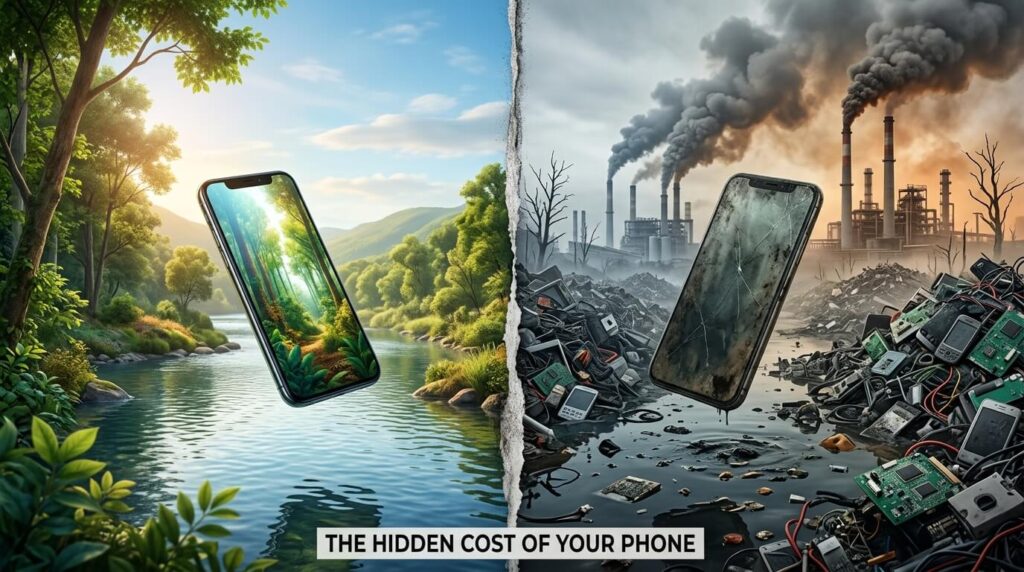
You check your phone 150 times a day. You upgrade every two years. You never think about what happens to your old device. But here’s the uncomfortable truth: your smartphone has a secret life—one that starts in a mine, passes through a factory, and ends in a landfill. And along the way, it leaves behind a trail of destruction that’s bigger than you ever imagined. Let’s trace the journey of a smartphone from birth to death and discover the hidden cost of staying connected.
The Journey Begins: Mining for Your Phone
Over 30 Elements in One Device
Your phone isn’t just glass and plastic. It’s a treasure trove of the Earth’s most precious resources. A single smartphone contains over 30 chemical elements—many of them rare and incredibly difficult to extract.
These include copper, gold, silver, platinum, palladium, lithium, cobalt, and rare earth metals. In 2025, there were an estimated 18 billion phones in use worldwide, each one containing a small fortune in critical metals.
The Dark Side of Extraction
But here’s what the glossy ads don’t show you: mining these materials comes at a devastating cost.
Mining causes deforestation, soil erosion, water contamination, and habitat destruction. Local communities often bear the brunt—experiencing health problems, displacement, and loss of livelihoods.
Many rare materials are extracted from conflict zones, raising serious questions about human rights and supply chain transparency. Cobalt mining in the Democratic Republic of Congo, for example, involves labor exploitation and opaque supply chains.
The Human Cost
The damage isn’t just environmental—it’s deeply human. Mining operations sometimes contaminate soil and water to such an extent that people can no longer live near the mines. There are rights abuses and environmental devastation in resource-rich but economically vulnerable regions.
Manufacturing: Where Most of the Damage Happens
The Shocking Truth About Your Phone’s Carbon Footprint
Here’s a statistic that should stop you in your tracks: 85% to 95% of a smartphone’s carbon footprint comes from the production phase alone. Every component produces its own carbon emissions before the device is even fully built.
Materials and manufacturing account for around 70% to 90% of the life cycle emissions of a typical smartphone. Up to 80% of emissions in most ICT devices come from manufacturing operations, particularly component fabrication in coal-dependent areas.
In other words, by the time you unbox your new phone, almost all of its environmental damage has already been done.
Real Numbers, Real Impact
Let’s put some real numbers on this. Here’s how the latest flagship smartphones compare in terms of carbon footprint:
| Smartphone Model | Total CO₂e (kg) | Manufacturing Share | Use Phase | Transport & Recycling |
|---|---|---|---|---|
| iPhone 13 | 64 kg | 81% (52 kg) | 16% | 3% |
| Google Pixel 10 | 73.8 kg | ~80% | ~15% | ~5% |
| iPhone 17 Pro | 51.2 kg | ~80% | ~15% | ~5% |
| iPhone 17 | 50.66 kg | ~80% | ~15% | ~5% |
| Xiaomi 14 | 47.22 kg | ~78% | ~17% | ~5% |
| Galaxy S25 | 42.73 kg | ~75% | ~18% | ~7% |
Source: Manufacturer environmental reports, 2025–2026 data.
To put that in perspective, producing a single smartphone creates roughly the same emissions as driving a car for 200-300 kilometers.
Why Manufacturing Is So Energy-Intensive
Producing the integrated circuit (IC)—the “brain” of your phone—dominates life cycle impacts with 63% of the climate change impact. The supply chain is opaque and extractive, embodying a form of modern postcolonialism where wealthy nations extract resources from poorer ones.
The Short Lifespan Problem
We Upgrade Too Often
The rapid replacement of smartphone models leads to the production of electrical waste that contains dangerous substances like lead and mercury. We’re conditioned to upgrade every two years—but that’s a disaster for the planet.
Longer device lifespans can deliver substantial emission reductions and savings. Every extra year you keep your phone, you’re preventing the emissions of manufacturing a new one. It’s the single most impactful action you can take.
1.2 Billion New Phones, 10 Billion Dormant
The numbers are staggering: 1.2 billion new smartphones were sold in 2024. And there are an estimated 10 billion dormant devices sitting in drawers and closets around the world.
We’re not just buying phones—we’re hoarding them. And each one represents a massive environmental cost.
The Afterlife: Where Old Phones Go to Die
The E-Waste Crisis by the Numbers
Here’s where the story gets truly alarming. In 2025, the world generated 65.3 million tonnes of e-waste—and that number is climbing to 82 million tonnes by 2030. We’re adding 2.6 million tonnes of e-waste every single year.
To visualize that: 65 million tonnes is roughly the weight of 6,500 Eiffel Towers—every single year.
The Recycling Disaster
Only 22% of electronic waste is recycled globally. That means nearly 80% ends up in landfills or is informally processed. That’s potentially $50 billion in recoverable materials lost to landfills or informal processing every year.
The global average of 22% hides enormous disparities:
| Region | Formal Recycling Rate | Notes |
|---|---|---|
| Europe | 42.8% | ~7.5 kg per person properly recycled |
| Asia | ~12% | Vast informal sector, low formal rates |
| Latin America | ~3% | 97% not disposed of sustainably |
| Africa | ~1% | Nearly all e-waste is informally processed |
The Toxic Reality
E-waste isn’t just trash—it’s toxic. It contains dangerous substances: lead, mercury, cadmium, and other heavy metals. These materials can cause serious health risks to humans and the environment when improperly disposed of.
In Latin America, 97% of e-waste is not disposed of sustainably. The problem is truly global.
What Can You Do? (Solutions That Actually Work)
The situation is dire—but not hopeless. Here are five things you can do right now to make a difference.
Keep Your Phone Longer
The single most impactful thing you can do: use your phone for 3-4 years instead of 2. Longer device lifespans deliver substantial emission reductions.
Think of it this way: every extra year you keep your phone, you’re preventing the emissions of manufacturing a new one. It’s the easiest, most effective action you can take.
Buy Refurbished
A refurbished smartphone produces 89% less e-waste than a new device. Refurbished phones are cheaper, just as functional, and dramatically better for the planet.
Every refurbished phone sold is one less phone manufactured. It’s a win-win for your wallet and the planet.
Choose Repairable Phones
A highly modular and repairable smartphone can achieve a 40% reduction in climate emissions, energy use, material consumption, water usage, and land occupation.
The Fairphone is a great example of a modular, repairable phone. And since June 2025, the EU requires standardized energy labels displaying battery life, durability, and repairability scores on smartphones and tablets.
Recycle Properly
Up to 80% of the materials in smartphones are recyclable. Don’t let your old phone sit in a drawer—recycle it through proper channels.
Find certified e-waste recyclers in your area. Many phone manufacturers offer trade-in and recycling programs. It takes five minutes and makes a real difference.
Support Right to Repair
The right-to-repair movement advocates for the freedom to repair and customize devices. Repairable products maintain their market value for longer, increasing the attractiveness of second-hand markets.
Support legislation that requires manufacturers to provide repair manuals and spare parts. The more we demand repairable products, the more manufacturers will make them.
The Refurbished Phone Challenge
Here are three challenges to get you started:
- When it’s time to upgrade, buy refurbished instead of new
- Keep your current phone for one extra year
- Recycle your old phone properly instead of letting it collect dust
Summary (The TL;DR Version)
Your smartphone has a massive environmental footprint—most of it hidden before you even turn it on. From mining rare minerals in conflict zones to manufacturing that produces 85-95% of its carbon emissions, to ending up in a landfill where only 22% of e-waste is recycled.
But here’s the good news: you have power.
- Keep your phone longer
- Buy refurbished
- Choose repairable devices
- Recycle properly
The most sustainable phone is the one you already have—and the second most sustainable is the one that’s been given a second life.
Frequently Asked Questions
Which part of a smartphone’s life causes the most environmental damage?
Manufacturing. It accounts for 85-95% of the carbon footprint.
How much e-waste do we produce each year?
In 2025, we generated 65.3 million tonnes. That’s projected to reach 82 million tonnes by 2030.
Is recycling smartphones worth it?
Absolutely. Up to 80% of materials are recyclable. The global average recycling rate is only 22%—we could be recovering billions in valuable materials.
Is buying a refurbished phone really better for the environment?
Yes. A refurbished smartphone produces 89% less e-waste than a new device.
What is the Right to Repair movement?
It’s a movement advocating for consumers’ freedom to repair their own devices, reducing e-waste and extending product lifespans.
What’s the single best thing I can do?
Keep your phone for 3-4 years instead of 2. It’s the most impactful individual action you can take.
Ready to make a difference? Start with one change today—commit to keeping your phone for an extra year. Share this article with someone who’s about to upgrade. Together, we can turn the tide on e-waste.