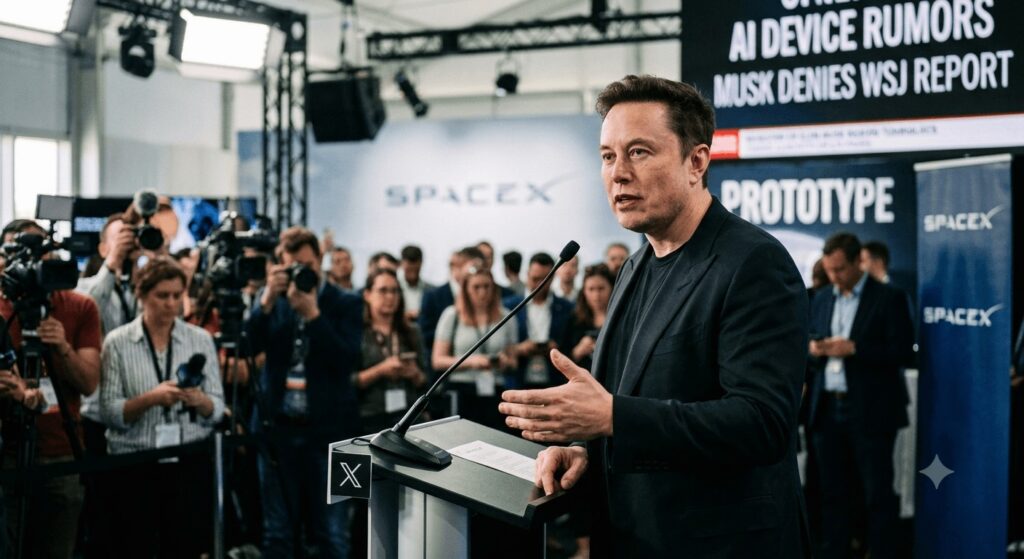
- Elon Musk Says “Utterly False” — But What Did WSJ Really Report About SpaceX’s AI Device?
- SpaceX AI Phone Rumours: Breaking Down the WSJ Report and Musk’s Denial
On July 1, 2026, tech news exploded with a bombshell: The Wall Street Journal reported that SpaceX had shown investors a sleek, handset-like AI device prototype ahead of its record-breaking IPO. Within hours, Elon Musk shot it down with a blunt two-word response on X: “Utterly false”.
So who do you believe? A prestigious financial newspaper with anonymous sources — or the world’s most famous tech CEO, speaking directly to millions of followers?
This article breaks down exactly what the WSJ actually reported, what Musk said (and didn’t say), the broader context that makes this rumour believable (or not), and what it all means for SpaceX, Starlink, and the future of AI hardware. By the end, you’ll have a clear, balanced picture of one of 2026’s most intriguing tech stories — and you’ll be equipped to decide for yourself where the truth lies.
What Did The Wall Street Journal Actually Report?
According to the WSJ, citing people familiar with the matter, SpaceX showed select investors and stakeholders a prototype of a “handset-like” AI device ahead of its June 2026 IPO.
The reported specifications included:
- Design: Sleeker and slimmer than an iPhone
- Operating System: A proprietary SpaceX operating system (not Android or iOS)
- AI Integration: Technology from xAI — Musk’s AI company, which SpaceX acquired in February 2026
- Processor: Qualcomm Snapdragon chips
- Project Status: SpaceX reportedly told investors the project is at a very early stage — the design could still change, and there is no guarantee the device will ever reach production
The strategic motive: A proprietary device running xAI technology would keep SpaceX outside the Android and iOS ecosystems entirely — avoiding platform fees and restrictions. It would also fit into SpaceX’s broader wireless ambitions, giving the company hardware, software, and connectivity under one roof.
Elon Musk’s Denial — What He Said and What He Didn’t
Musk’s response was characteristically brief. He posted on X:
That was it. No elaboration. No clarification. Just two words.
Key details about the denial:
- Timing: The post came within hours of the WSJ report going live
- Deletion: The post was later deleted, adding another layer of uncertainty
- Market impact: SpaceX stock (SPCXB) fell roughly 7% following the denial. Qualcomm shares had briefly risen about 3% on the news before Musk’s denial
Previous denials: This isn’t the first time Musk has shot down phone rumours:
- In February 2026, after Reuters reported SpaceX was working on a Starlink-connected phone, Musk flatly stated “we are not developing a phone”
- In January 2026, Musk said a Starlink phone was “not out of the question at some point” — adding that such a device would be “very different from current phones”
- In 2024, Musk said “the idea of making a phone makes me want to die” — but added, “if we have to make a phone, we will”
What he didn’t say: Musk didn’t clarify whether SpaceX has any AI hardware project at all. He didn’t address the possibility of a prototype existing internally. And he didn’t comment on the WSJ’s sources or the accuracy of their specific claims.
Why This Rumour Actually Makes Sense — The SpaceX Context
The xAI Acquisition
In February 2026, SpaceX acquired xAI in a deal valued at approximately **$1.25 trillion**. The transaction valued SpaceX at roughly $1 trillion and xAI at around $250 billion. xAI became a wholly-owned subsidiary of SpaceX.
The merger gave SpaceX direct access to xAI’s AI models, including the Grok large language model, and its AI infrastructure. Musk framed the deal as part of an ambitious scheme to build space-based data centres to power the future of artificial intelligence.
Since the acquisition, SpaceX has moved to fold xAI fully into its own operations.
Why this matters: If SpaceX already owns a cutting-edge AI company, building a dedicated AI device isn’t a stretch — it’s a logical next step.
Starlink Mobile — SpaceX’s Wireless Ambitions
SpaceX is actively expanding into mobile services:
- SpaceX already partners with T-Mobile to provide Direct-to-Cell satellite phone service using Starlink satellites
- In June 2026, SpaceX told investors it plans to sell Starlink-branded mobile service directly to US consumers
- The company acquired wireless spectrum from EchoStar for $17 billion
- SpaceX is in talks with Charter Communications about using their ground infrastructure
- This would put SpaceX in direct competition with Verizon, AT&T, and T-Mobile
Why this matters: SpaceX is already building the network infrastructure for a phone service. A proprietary AI device that runs on that network would give SpaceX complete control — hardware, software, and connectivity under one roof. As one analyst put it, spectrum on that scale “is not the kind of asset a company buys to remain a wholesale supplier”.
The “Everything App” Vision
Musk has long envisioned building an “everything app” similar to China’s WeChat — combining messaging, payments, shopping, social media, and more. A dedicated device could bring together technologies from Tesla, SpaceX, xAI, and X under one roof.
Musk has also expressed frustration with Apple and Google’s control over app stores — a proprietary device would bypass those gatekeepers entirely.
The AI Hardware Graveyard — Why This Would Be a Risky Move
Humane AI Pin
- Launched with massive hype, priced at $699 plus a $24/month subscription
- Sold fewer than 10,000 units — far below the 100,000 target
- February 2025: HP acquired Humane’s core assets for $116 million
- The AI Pin was permanently bricked — features like calling stopped working
- Reviewers cited wrong AI answers, long response times, and overheating batteries
Rabbit R1
- Attracted 100,000 pre-orders in just four days
- Retained only about 5,000 active users after five months
- Users found it slow, buggy, and unable to perform complex tasks
- November 2025: Rabbit collapsed due to a broken capital chain
The Core Problem
Both devices failed because they asked consumers to carry a second gadget that did less than the phone already in their pocket. As one industry observer put it: “A company wanting to sell an AI device does not equate to consumers wanting to buy such a thing”.
Why SpaceX might be different:
- SpaceX has manufacturing expertise through Tesla
- SpaceX has access to the chips needed for on-device compute
- SpaceX has an existing satellite network and spectrum to support connectivity
But having the capability doesn’t guarantee consumer demand. As Vital Knowledge analysts wrote: “SpaceX has a long way to go before successfully manufacturing a consumer device at scale and competing against the leading platforms”. They added: “It’s hard to imagine SpaceX becoming a force in consumer electronics”.
So, What’s the Truth? What We Actually Know
What we know for certain:
- WSJ published a detailed report citing multiple sources
- Musk publicly denied it with “utterly false”
- SpaceX has the technology, infrastructure, and financial resources to build such a device
- SpaceX is actively expanding into mobile services via Starlink
What we don’t know:
- Whether a prototype actually exists
- Whether the WSJ’s sources were misinformed or misquoted
- Whether Musk’s denial is about the existence of a project or simply the accuracy of the WSJ’s specific claims
Possible explanations:
1. WSJ got it right — SpaceX showed a prototype, Musk denied it for strategic reasons (e.g., to manage expectations, avoid regulatory scrutiny, or because the project isn’t ready for public discussion).
2. WSJ got it wrong — Their sources conflated internal R&D exploration with a formal investor presentation.
3. Somewhere in between — SpaceX may have shown something AI-related to investors, but the WSJ’s description of a “slimmer-than-iPhone handset” was inaccurate or exaggerated.
4. Timing confusion — Musk’s denial in February that SpaceX was “developing a phone” may not rule out an AI device that isn’t a traditional phone. His January comment that a Starlink phone was “not out of the question” leaves significant room for interpretation.
What This Means for the Future
SpaceX’s AI ambitions are real
Whether or not this specific device exists, SpaceX is pouring billions into AI infrastructure, xAI’s Grok model, and space-based computing.
Starlink Mobile is coming
SpaceX is moving toward becoming a direct competitor to Verizon, AT&T, and T-Mobile. The US mobile market is measured in hundreds of millions of subscribers and tens of billions of dollars in annual revenue — a far larger pool than the satellite-broadband business Starlink has built so far.
OpenAI is building an AI device too
OpenAI is working with Apple’s former design chief Jony Ive on an AI device, targeting a late-2026 reveal. OpenAI recently hired Apple’s Vision Pro hardware engineering VP Paul Meade. If OpenAI is doing it, Musk would almost certainly want to compete.
The device could still happen
Even if the WSJ report was wrong about timing or specifics, SpaceX building an AI device in the future remains entirely plausible given its trajectory. Musk’s own words leave the door open: a Starlink phone is “not out of the question at some point”.
5 FAQs
FAQ 1: Did SpaceX officially confirm or deny the AI device report?
Answer: SpaceX has not officially confirmed the report. However, Elon Musk publicly denied it on X (formerly Twitter), calling the Wall Street Journal‘s story “utterly false.” He did not provide any further details or clarification. Interestingly, Musk later deleted that denial post, which has only added to the confusion and speculation.
FAQ 2: Why would SpaceX want to make an AI device or phone?
Answer: There are several strategic reasons. First, SpaceX acquired xAI (which owns the Grok AI model) in February 2026, giving it direct access to advanced AI technology. Second, SpaceX is building Starlink Mobile — a direct-to-consumer satellite phone service that would compete with Verizon, AT&T, and T-Mobile. Third, a proprietary device would allow SpaceX to bypass Apple and Google’s app store fees and create a fully integrated hardware-software ecosystem, potentially supporting Musk’s vision of an “everything app” similar to WeChat.
FAQ 3: Has Elon Musk talked about making a phone before?
Answer: Yes, but his statements have been contradictory. In 2024, Musk said “the idea of making a phone makes me want to die” but added “if we have to make a phone, we will.” In January 2026, he said a Starlink phone was “not out of the question at some point” and would be “very different from current phones.” However, just a month later (February 2026), he flatly stated “we are not developing a phone” after a Reuters report. This pattern of denial and openness makes the current rumour difficult to dismiss entirely.
FAQ 4: How is this different from failed AI gadgets like the AI Pin or Rabbit R1?
Answer: The main difference is SpaceX’s existing infrastructure. Unlike Humane and Rabbit, which were start-ups with no ecosystem, SpaceX already has:
- Satellite network (Starlink) for global connectivity
- Wireless spectrum (acquired from EchoStar for $17 billion)
- Manufacturing expertise (through Tesla)
- Advanced AI models (through xAI)
However, the core consumer challenge remains the same: convincing people to carry an additional device that does less than the smartphone already in their pocket. So while SpaceX has better resources, consumer demand is still a major risk.
FAQ 5: So, is the SpaceX AI device actually going to happen?
Answer: The honest answer is nobody knows for sure. There are three main possibilities:
- The WSJ report was accurate — a prototype exists, but Musk denied it for strategic reasons (e.g., managing expectations or avoiding regulatory scrutiny).
- The WSJ report was wrong — their sources may have exaggerated or conflated internal R&D exploration with a formal investor presentation.
- Somewhere in between — SpaceX may have shown something AI-related, but the description of a “slimmer-than-iPhone handset” was inaccurate.
What is certain is that SpaceX is actively building the network and AI infrastructure to make such a device possible in the future — even if this specific rumour turns out to be false.
Conclusion
The SpaceX AI device rumour is a classic he-said-she-said tech story. On one side, you have a reputable newspaper with multiple sources claiming a prototype exists. On the other, you have Elon Musk — a CEO with a history of denying products before they launch — calling it “utterly false”.
What’s undeniable is that SpaceX is building the infrastructure (Starlink, xAI, wireless spectrum) and has the capability (Tesla manufacturing, chip access) to make such a device a reality.
What remains unclear is whether they actually showed a prototype to investors — or whether it will ever reach consumers.
Either the WSJ’s sources are wrong, or SpaceX is walking back a project it pitched to investors only weeks ago. Neither explanation is particularly reassuring for anyone trying to judge whether this device will ever exist.
But one thing is certain: the intersection of SpaceX, AI, and consumer hardware is a story worth watching — because even if this rumour is false, the next one might not be.
What do you think — is SpaceX secretly building an AI device, or is this just another tech rumour that got out of hand? Share your thoughts in the comments below.